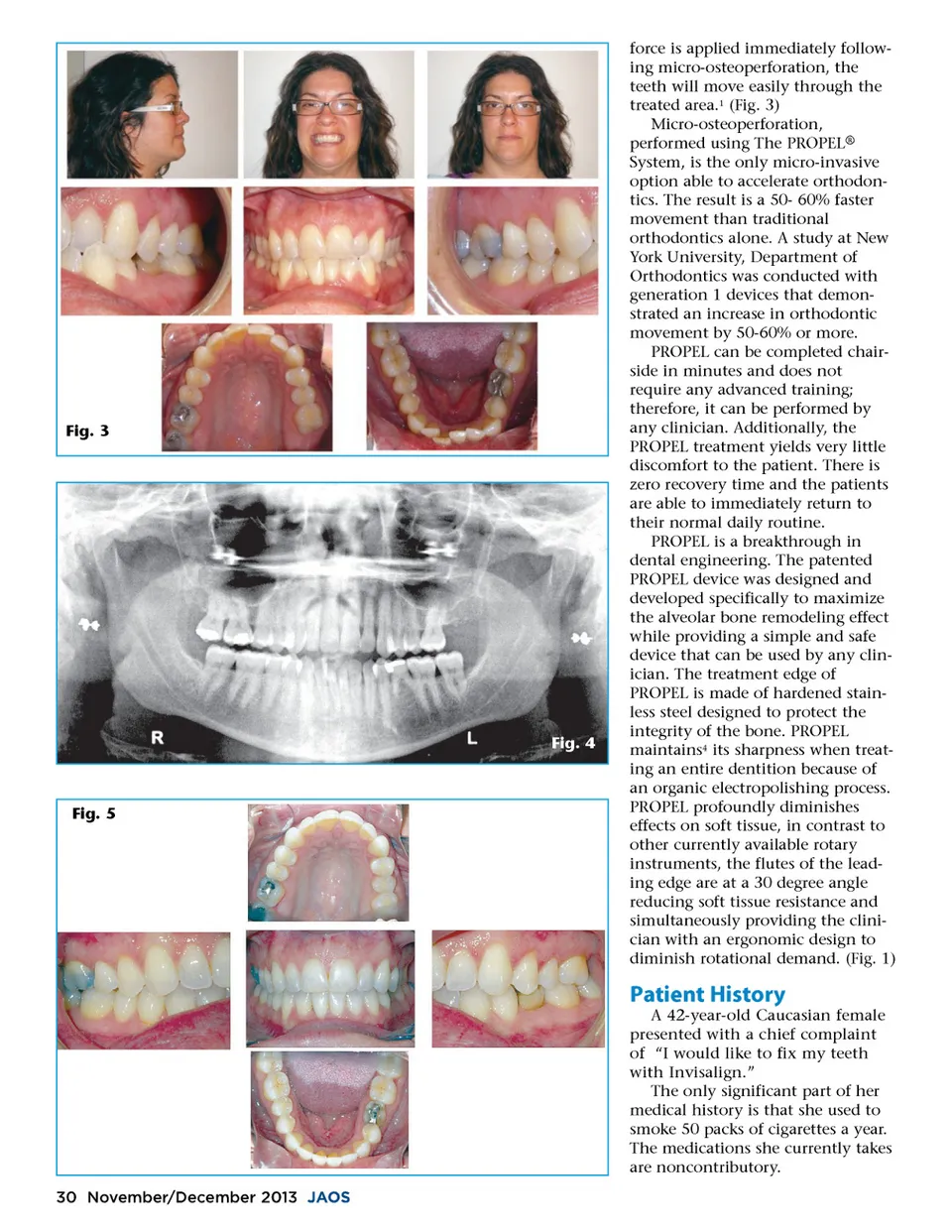
Fig. 6 This patient presented with: b Class I Malocclusion, narrow arches, b Moderate Crowding b Crossbite at Tooth 22 b Retained Primary Tooth K We discussed using Invisalign to treat her case and estimated that the treatment time would be 15 months. When offered the oppor-tunity to treat her case in a shorter amount of time, the patient gladly accepted.(Figs. 3 & 4) small like PROPEL, cytokine expres-sion is increased for approximately 6 – 8 weeks (#3). After 6-8 weeks cytokine expression drops back to baseline and bone turnover returns to normal orthodontic levels. Additional treatments are some-times, although not always, needed to continue the increase in rate and continued predictability of move-ment. In this case, a second treat-ment assured a shortened aligner with perfect tracking and no need for refinement aligners. Because cytokines can be inhib-ited by immune-modulators and anti-inflammatory medications, no steroid or NSAID use is allowed during the patient’s treatment. Micro-osteoperforations are performed chairside during normal orthodontic appointments and the patient returns to their normal daily activities immediately following PROPEL treatment. There is little soft tissue effect and often little or no discomfort following the treat-ment. In this case, multiple sites were performed at the same time. The patient was advised to take acetaminophen for any discomfort. The patient took a single dose of Tylenol the evening of the first and second treatment. Pretreatment photos The patient began treatment with 24 aligners. As recommended by all clear aligner treatments, she was instructed to wear her aligners for 14 days. After her initial PROPEL micro-osteoperforation, the patient was instructed to change her aligners every 11 days instead of the prescribed 14 day change. Micro-osteoperforation was performed after aligner number 5 and a second treatment was given after aligner number 10. After any intervention, whether it is large, such as corticotomy or www.orthodontics.com November/December 2013 31
Journal of the American Orthodontic Society November-December 2013: Page 31