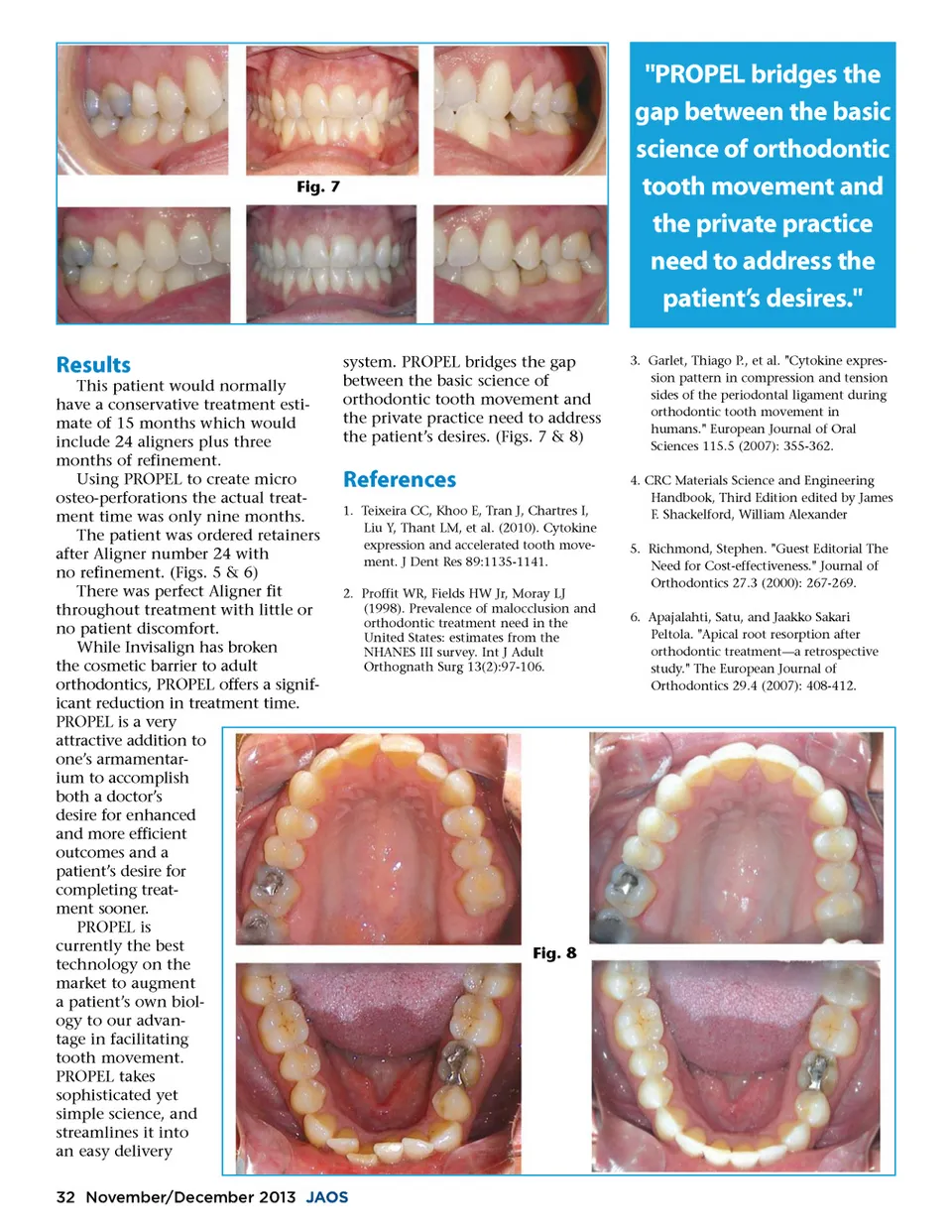
Fig. 7 "PROPEL bridges the gap between the basic science of orthodontic tooth movement and the private practice need to address the patient’s desires." system. PROPEL bridges the gap between the basic science of orthodontic tooth movement and the private practice need to address the patient’s desires. (Figs. 7 & 8) 3. Garlet, Thiago P., et al. "Cytokine expres-sion pattern in compression and tension sides of the periodontal ligament during orthodontic tooth movement in humans." European Journal of Oral Sciences 115.5 (2007): 355-362. 4. CRC Materials Science and Engineering Handbook, Third Edition edited by James F. Shackelford, William Alexander 5. Richmond, Stephen. "Guest Editorial The Need for Cost-effectiveness." Journal of Orthodontics 27.3 (2000): 267-269. 6. Apajalahti, Satu, and Jaakko Sakari Peltola. "Apical root resorption after orthodontic treatment—a retrospective study." The European Journal of Orthodontics 29.4 (2007): 408-412. Results This patient would normally have a conservative treatment esti-mate of 15 months which would include 24 aligners plus three months of refinement. Using PROPEL to create micro osteo-perforations the actual treat-ment time was only nine months. The patient was ordered retainers after Aligner number 24 with no refinement. (Figs. 5 & 6) There was perfect Aligner fit throughout treatment with little or no patient discomfort. While Invisalign has broken the cosmetic barrier to adult orthodontics, PROPEL offers a signif-icant reduction in treatment time. PROPEL is a very attractive addition to one’s armamentar-ium to accomplish both a doctor’s desire for enhanced and more efficient outcomes and a patient’s desire for completing treat-ment sooner. PROPEL is currently the best technology on the market to augment a patient’s own biol-ogy to our advan-tage in facilitating tooth movement. PROPEL takes sophisticated yet simple science, and streamlines it into an easy delivery References 1. Teixeira CC, Khoo E, Tran J, Chartres I, Liu Y, Thant LM, et al. (2010). Cytokine expression and accelerated tooth move-ment. J Dent Res 89:1135-1141. 2. Proffit WR, Fields HW Jr, Moray LJ (1998). Prevalence of malocclusion and orthodontic treatment need in the United States: estimates from the NHANES III survey. Int J Adult Orthognath Surg 13(2):97-106. Fig. 8 32 November/December 2013 JAOS
Journal of the American Orthodontic Society November-December 2013: Page 32