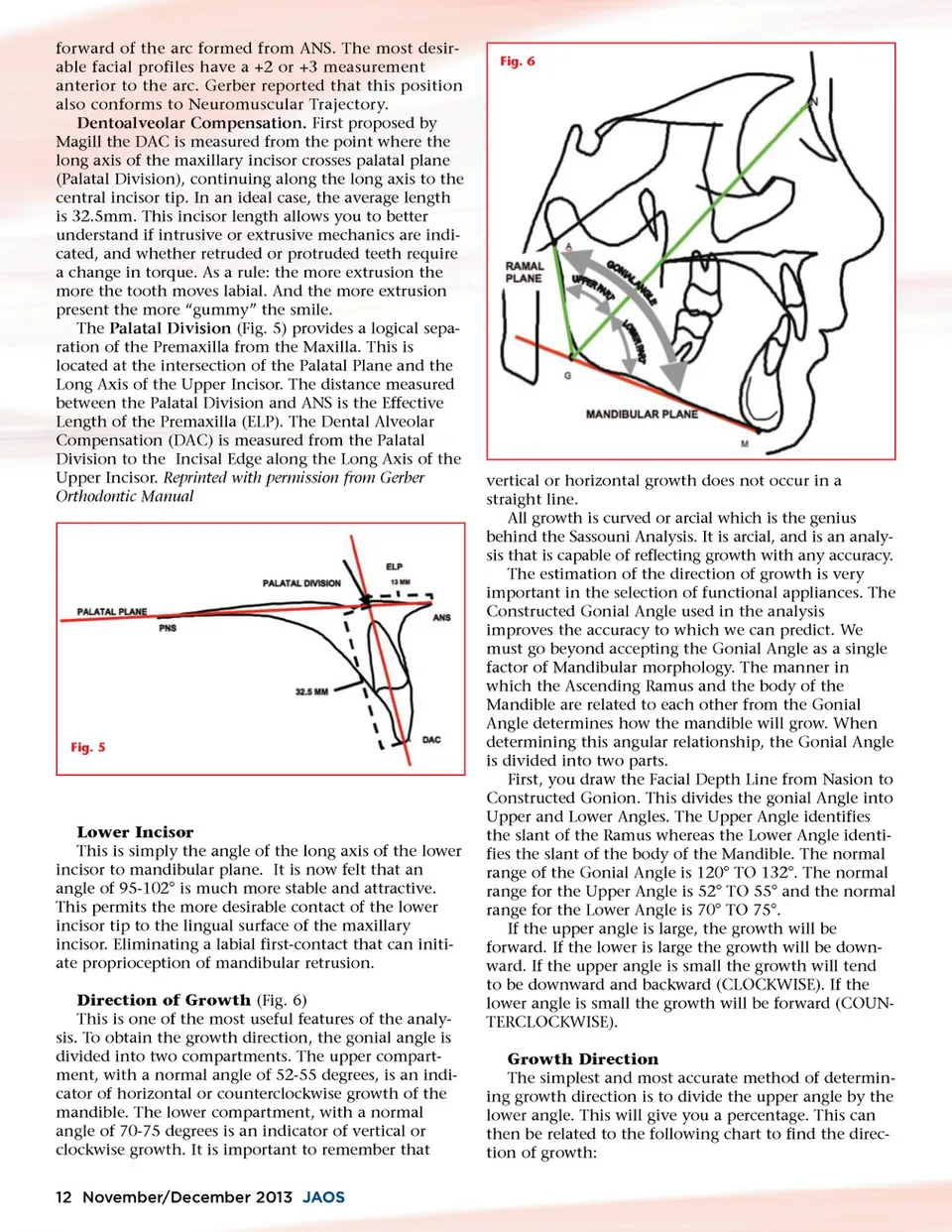
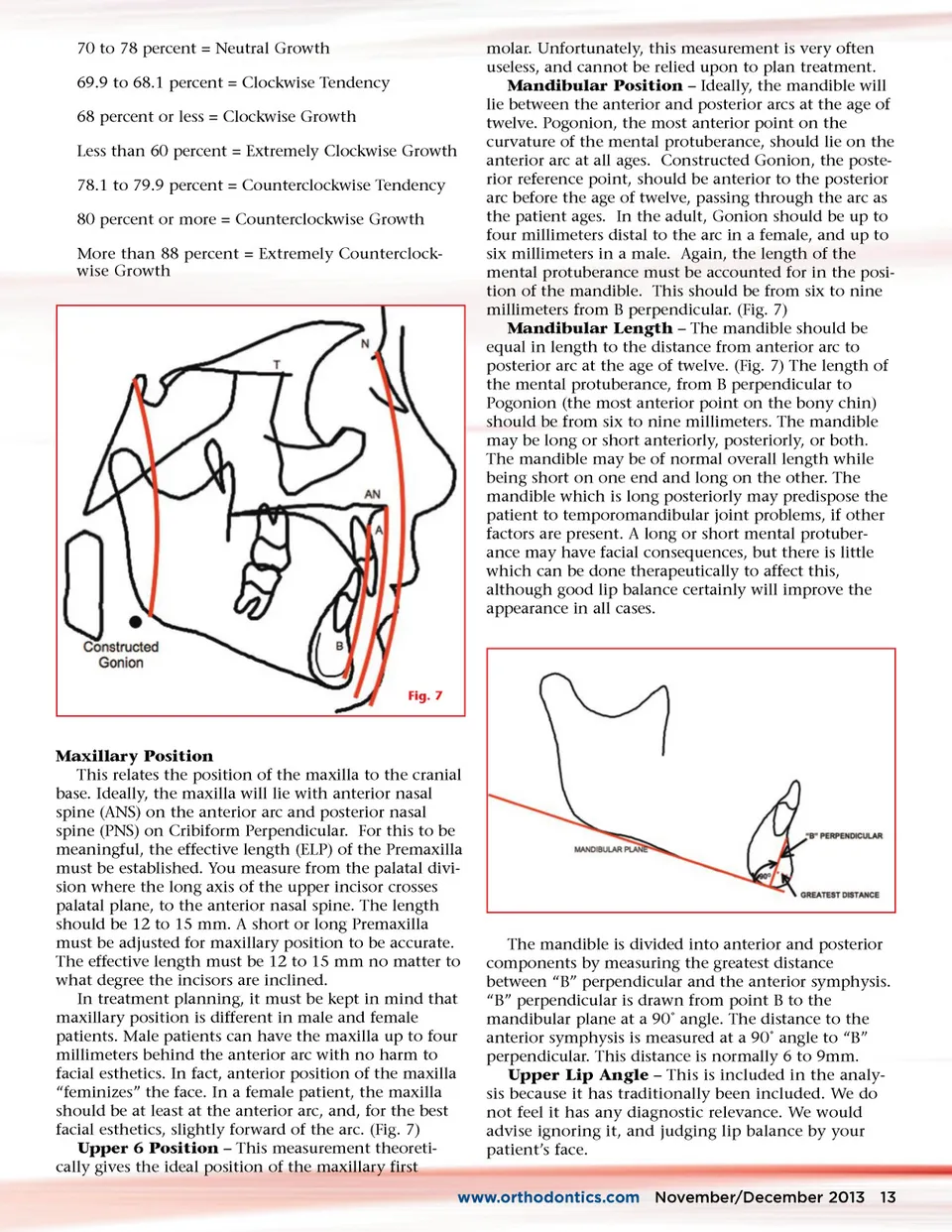
70 to 78 percent = Neutral Growth 69.9 to 68.1 percent = Clockwise Tendency 68 percent or less = Clockwise Growth Less than 60 percent = Extremely Clockwise Growth 78.1 to 79.9 percent = Counterclockwise Tendency 80 percent or more = Counterclockwise Growth More than 88 percent = Extremely Counterclock-wise Growth molar. Unfortunately, this measurement is very often useless, and cannot be relied upon to plan treatment. Mandibular Position – Ideally, the mandible will lie between the anterior and posterior arcs at the age of twelve. Pogonion, the most anterior point on the curvature of the mental protuberance, should lie on the anterior arc at all ages. Constructed Gonion, the poste-rior reference point, should be anterior to the posterior arc before the age of twelve, passing through the arc as the patient ages. In the adult, Gonion should be up to four millimeters distal to the arc in a female, and up to six millimeters in a male. Again, the length of the mental protuberance must be accounted for in the posi-tion of the mandible. This should be from six to nine millimeters from B perpendicular. (Fig. 7) Mandibular Length – The mandible should be equal in length to the distance from anterior arc to posterior arc at the age of twelve. (Fig. 7) The length of the mental protuberance, from B perpendicular to Pogonion (the most anterior point on the bony chin) should be from six to nine millimeters. The mandible may be long or short anteriorly, posteriorly, or both. The mandible may be of normal overall length while being short on one end and long on the other. The mandible which is long posteriorly may predispose the patient to temporomandibular joint problems, if other factors are present. A long or short mental protuber-ance may have facial consequences, but there is little which can be done therapeutically to affect this, although good lip balance certainly will improve the appearance in all cases. Fig. 7 Maxillary Position This relates the position of the maxilla to the cranial base. Ideally, the maxilla will lie with anterior nasal spine (ANS) on the anterior arc and posterior nasal spine (PNS) on Cribiform Perpendicular. For this to be meaningful, the effective length (ELP) of the Premaxilla must be established. You measure from the palatal divi-sion where the long axis of the upper incisor crosses palatal plane, to the anterior nasal spine. The length should be 12 to 15 mm. A short or long Premaxilla must be adjusted for maxillary position to be accurate. The effective length must be 12 to 15 mm no matter to what degree the incisors are inclined. In treatment planning, it must be kept in mind that maxillary position is different in male and female patients. Male patients can have the maxilla up to four millimeters behind the anterior arc with no harm to facial esthetics. In fact, anterior position of the maxilla “feminizes” the face. In a female patient, the maxilla should be at least at the anterior arc, and, for the best facial esthetics, slightly forward of the arc. (Fig. 7) Upper 6 Position – This measurement theoreti-cally gives the ideal position of the maxillary first The mandible is divided into anterior and posterior components by measuring the greatest distance between “B” perpendicular and the anterior symphysis. “B” perpendicular is drawn from point B to the mandibular plane at a 90˚ angle. The distance to the anterior symphysis is measured at a 90˚ angle to “B” perpendicular. This distance is normally 6 to 9mm. Upper Lip Angle – This is included in the analy-sis because it has traditionally been included. We do not feel it has any diagnostic relevance. We would advise ignoring it, and judging lip balance by your patient’s face. www.orthodontics.com November/December 2013 13
Journal of the American Orthodontic Society November-December 2013: Page 13