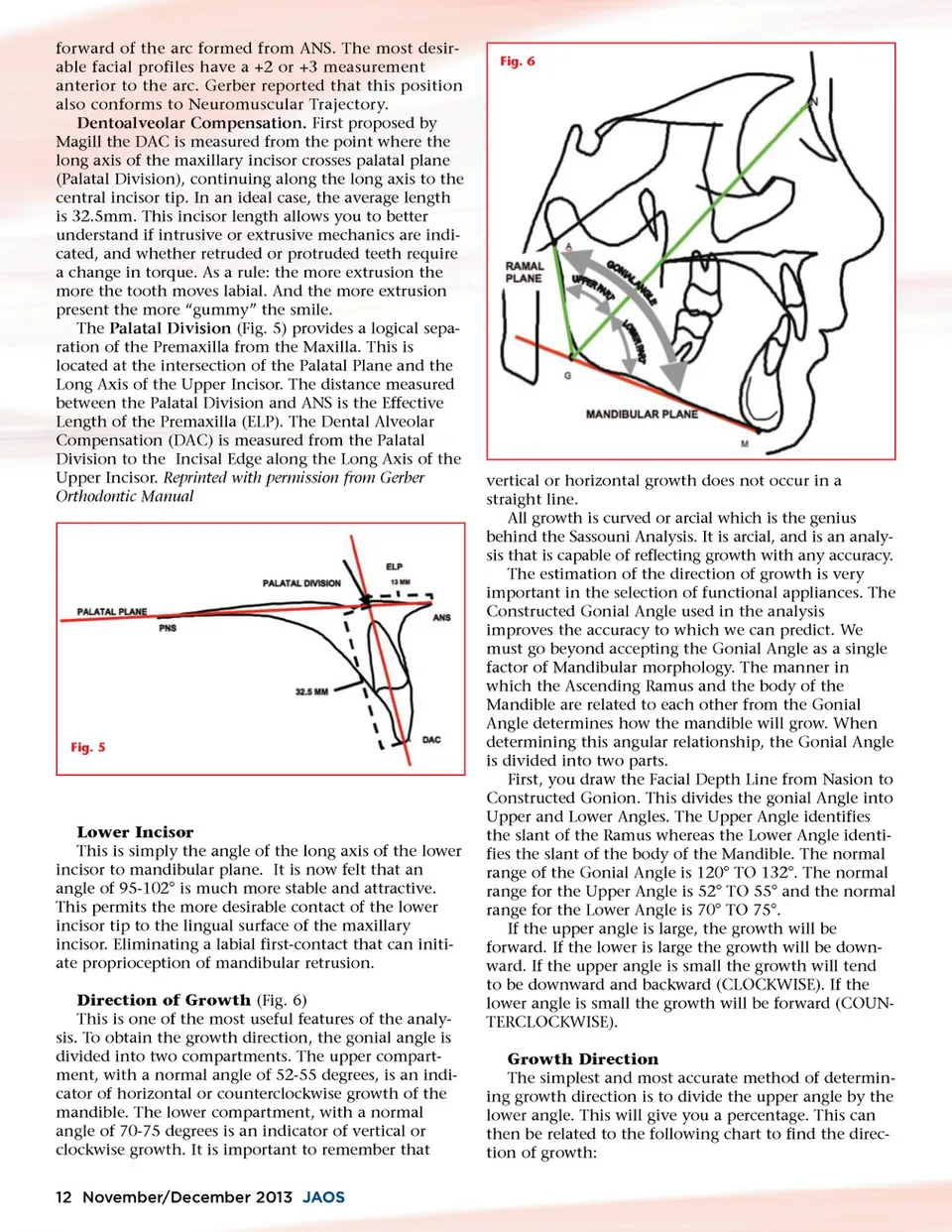
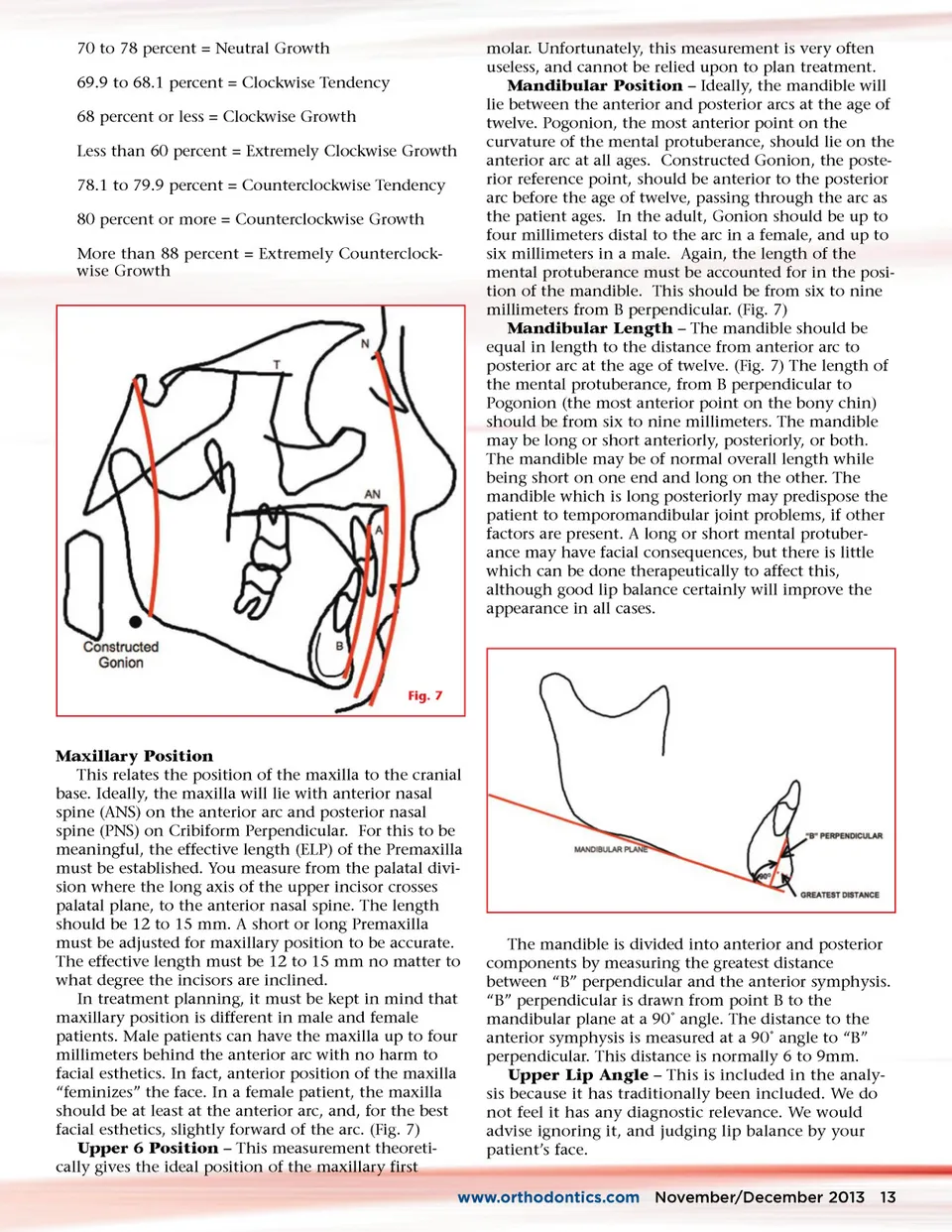
forward of the arc formed from ANS. The most desir-able facial profiles have a +2 or +3 measurement anterior to the arc. Gerber reported that this position also conforms to Neuromuscular Trajectory. Dentoalveolar Compensation. First proposed by Magill the DAC is measured from the point where the long axis of the maxillary incisor crosses palatal plane (Palatal Division), continuing along the long axis to the central incisor tip. In an ideal case, the average length is 32.5mm. This incisor length allows you to better understand if intrusive or extrusive mechanics are indi-cated, and whether retruded or protruded teeth require a change in torque. As a rule: the more extrusion the more the tooth moves labial. And the more extrusion present the more “gummy” the smile. The Palatal Division (Fig. 5) provides a logical sepa-ration of the Premaxilla from the Maxilla. This is located at the intersection of the Palatal Plane and the Long Axis of the Upper Incisor. The distance measured between the Palatal Division and ANS is the Effective Length of the Premaxilla (ELP). The Dental Alveolar Compensation (DAC) is measured from the Palatal Division to the Incisal Edge along the Long Axis of the Upper Incisor. Reprinted with permission from Gerber Orthodontic Manual Fig. 6 Fig. 5 Lower Incisor This is simply the angle of the long axis of the lower incisor to mandibular plane. It is now felt that an angle of 95-102° is much more stable and attractive. This permits the more desirable contact of the lower incisor tip to the lingual surface of the maxillary incisor. Eliminating a labial first-contact that can initi-ate proprioception of mandibular retrusion. Direction of Growth (Fig. 6) This is one of the most useful features of the analy-sis. To obtain the growth direction, the gonial angle is divided into two compartments. The upper compart-ment, with a normal angle of 52-55 degrees, is an indi-cator of horizontal or counterclockwise growth of the mandible. The lower compartment, with a normal angle of 70-75 degrees is an indicator of vertical or clockwise growth. It is important to remember that 12 November/December 2013 JAOS vertical or horizontal growth does not occur in a straight line. All growth is curved or arcial which is the genius behind the Sassouni Analysis. It is arcial, and is an analy-sis that is capable of reflecting growth with any accuracy. The estimation of the direction of growth is very important in the selection of functional appliances. The Constructed Gonial Angle used in the analysis improves the accuracy to which we can predict. We must go beyond accepting the Gonial Angle as a single factor of Mandibular morphology. The manner in which the Ascending Ramus and the body of the Mandible are related to each other from the Gonial Angle determines how the mandible will grow. When determining this angular relationship, the Gonial Angle is divided into two parts. First, you draw the Facial Depth Line from Nasion to Constructed Gonion. This divides the gonial Angle into Upper and Lower Angles. The Upper Angle identifies the slant of the Ramus whereas the Lower Angle identi-fies the slant of the body of the Mandible. The normal range of the Gonial Angle is 120° TO 132°. The normal range for the Upper Angle is 52° TO 55° and the normal range for the Lower Angle is 70° TO 75°. If the upper angle is large, the growth will be forward. If the lower is large the growth will be down-ward. If the upper angle is small the growth will tend to be downward and backward (CLOCKWISE). If the lower angle is small the growth will be forward (COUN-TERCLOCKWISE). Growth Direction The simplest and most accurate method of determin-ing growth direction is to divide the upper angle by the lower angle. This will give you a percentage. This can then be related to the following chart to find the direc-tion of growth:
Journal of the American Orthodontic Society November-December 2013: Page 12