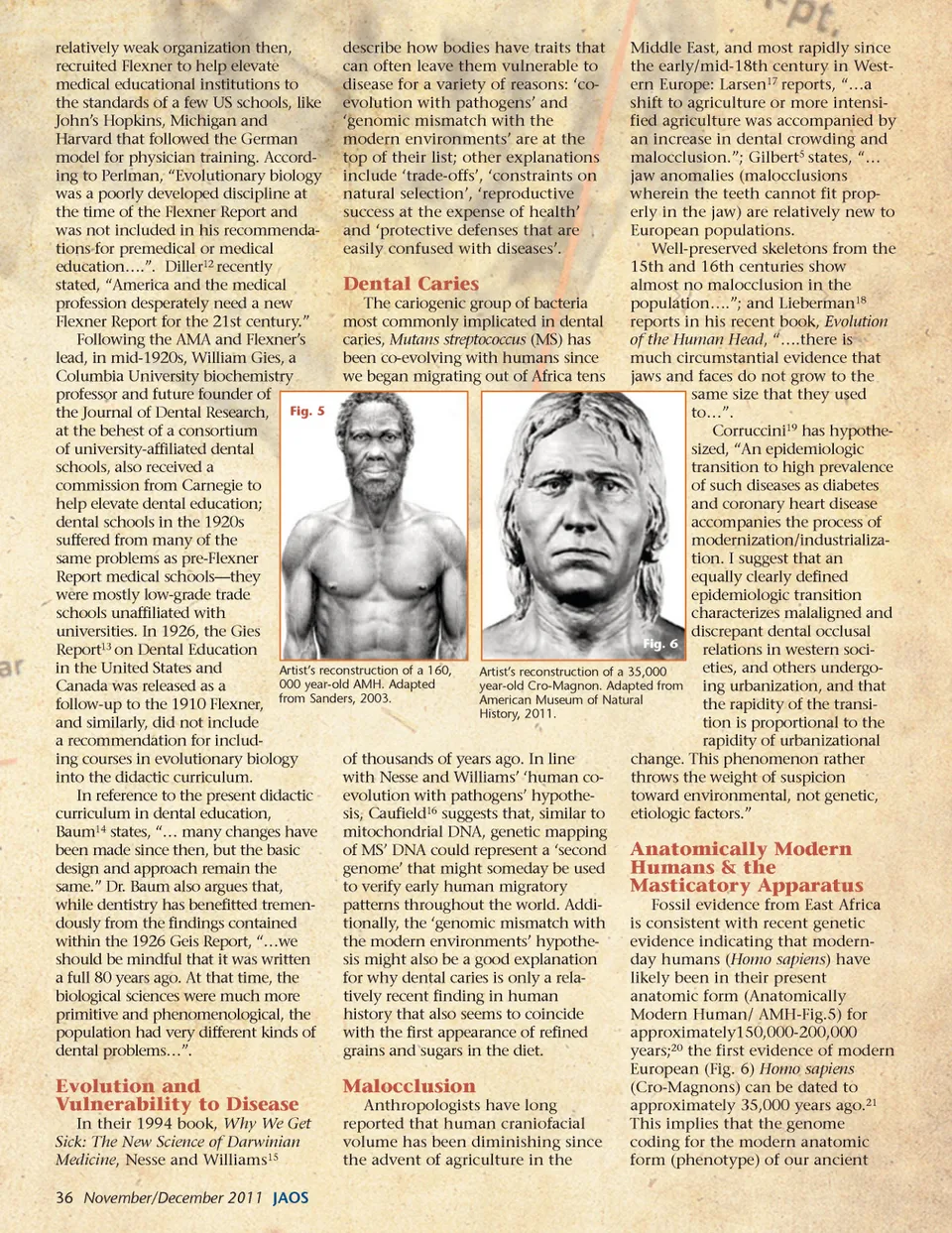
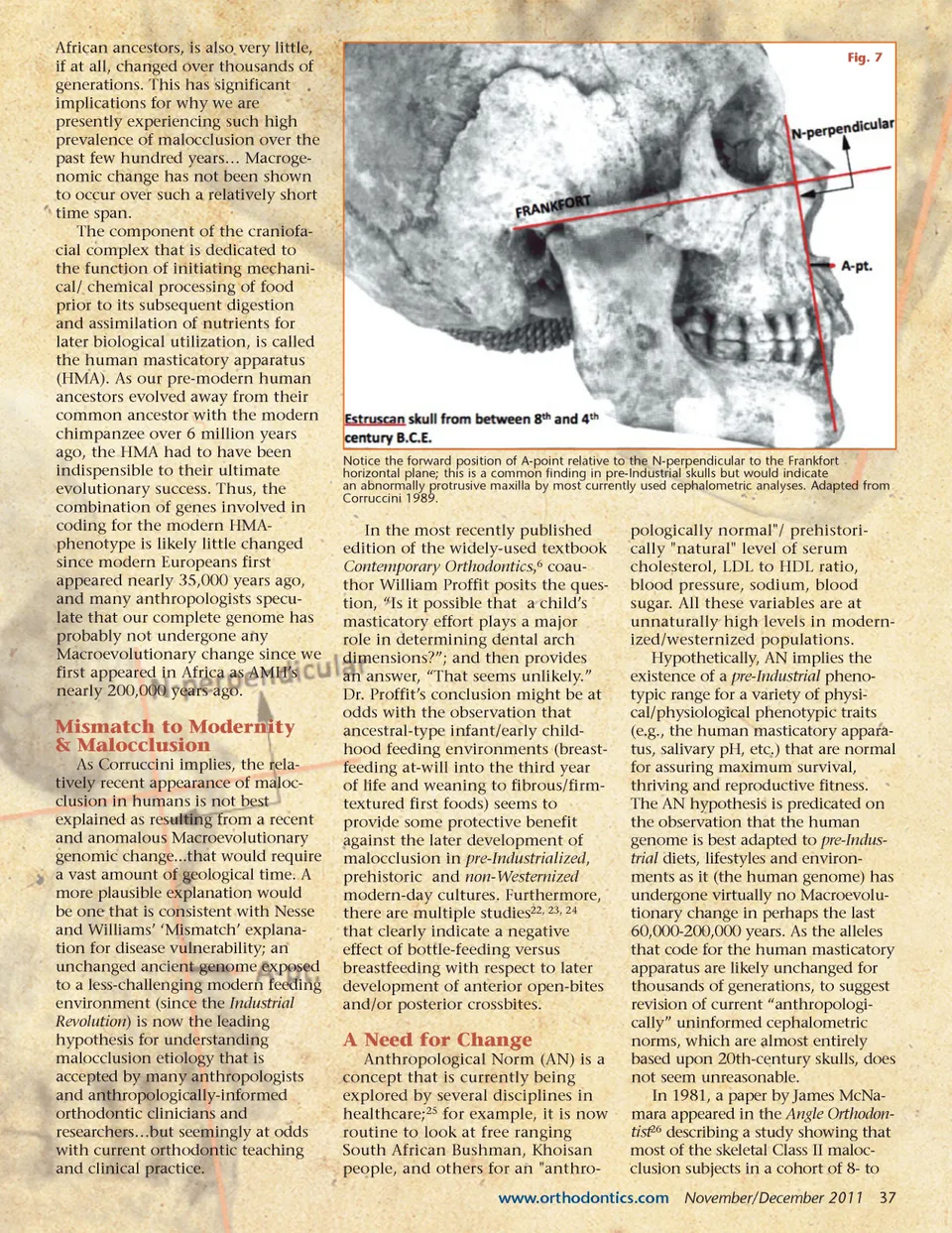
Middle East, and most rapidly since relatively weak organization then, describe how bodies have traits that the early/mid-18th century in West-recruited Flexner to help elevate can often leave them vulnerable to ern Europe: Larsen 17 reports, “…a medical educational institutions to disease for a variety of reasons: ‘co-the standards of a few US schools, like evolution with pathogens’ and shift to agriculture or more intensi-John’s Hopkins, Michigan and ‘genomic mismatch with the fied agriculture was accompanied by Harvard that followed the German modern environments’ are at the an increase in dental crowding and model for physician training. Accord-top of their list; other explanations malocclusion.”; Gilbert 5 states, “… ing to Perlman, “Evolutionary biology include ‘trade-offs’, ‘constraints on jaw anomalies (malocclusions was a poorly developed discipline at natural selection’, ‘reproductive wherein the teeth cannot fit prop-the time of the Flexner Report and success at the expense of health’ erly in the jaw) are relatively new to was not included in his recommenda-and ‘protective defenses that are European populations. tions for premedical or medical easily confused with diseases’. Well-preserved skeletons from the education….”. Diller 12 recently 15th and 16th centuries show almost no malocclusion in the stated, “America and the medical Dental Caries population….”; and Lieberman 18 profession desperately need a new The cariogenic group of bacteria Flexner Report for the 21st century.” most commonly implicated in dental reports in his recent book, Evolution Following the AMA and Flexner’s caries, Mutans streptococcus (MS) has of the Human Head , “….there is lead, in mid-1920s, William Gies, a been co-evolving with humans since much circumstantial evidence that Columbia University biochemistry we began migrating out of Africa tens jaws and faces do not grow to the professor and future founder of same size that they used the Journal of Dental Research, Fig. 5 to…”. at the behest of a consortium Corruccini 19 has hypothe-of university-affiliated dental sized, “An epidemiologic schools, also received a transition to high prevalence commission from Carnegie to of such diseases as diabetes help elevate dental education; and coronary heart disease dental schools in the 1920s accompanies the process of suffered from many of the modernization/industrializa-same problems as pre-Flexner tion. I suggest that an Report medical schools—they equally clearly defined were mostly low-grade trade epidemiologic transition schools unaffiliated with characterizes malaligned and universities. In 1926, the Gies discrepant dental occlusal Fig. 6 Report 13 on Dental Education relations in western soci-eties, and others undergo-in the United States and Artist’s reconstruction of a 160, Artist’s reconstruction of a 35,000 000 year-old AMH. Adapted year-old Cro-Magnon. Adapted from ing urbanization, and that Canada was released as a American Museum of Natural the rapidity of the transi-follow-up to the 1910 Flexner, from Sanders, 2003. History, 2011. tion is proportional to the and similarly, did not include rapidity of urbanizational a recommendation for includ-change. This phenomenon rather of thousands of years ago. In line ing courses in evolutionary biology throws the weight of suspicion with Nesse and Williams’ ‘human co-into the didactic curriculum. toward environmental, not genetic, evolution with pathogens’ hypothe-In reference to the present didactic etiologic factors.” sis, Caufield 16 suggests that, similar to curriculum in dental education, Baum 14 states, “… many changes have mitochondrial DNA, genetic mapping of MS’ DNA could represent a ‘second Anatomically Modern been made since then, but the basic genome’ that might someday be used design and approach remain the Humans & the to verify early human migratory same.” Dr. Baum also argues that, Masticatory Apparatus patterns throughout the world. Addi-while dentistry has benefitted tremen-Fossil evidence from East Africa tionally, the ‘genomic mismatch with dously from the findings contained is consistent with recent genetic the modern environments’ hypothe-within the 1926 Geis Report, “…we evidence indicating that modern-sis might also be a good explanation should be mindful that it was written day humans ( Homo sapiens ) have for why dental caries is only a rela-a full 80 years ago. At that time, the likely been in their present tively recent finding in human biological sciences were much more anatomic form (Anatomically history that also seems to coincide primitive and phenomenological, the Modern Human/ AMH-Fig.5) for with the first appearance of refined population had very different kinds of approximately150,000-200,000 grains and sugars in the diet. dental problems…”. years; 20 the first evidence of modern European (Fig. 6) Homo sapiens (Cro-Magnons) can be dated to Evolution and Malocclusion approximately 35,000 years ago. 21 Vulnerability to Disease Anthropologists have long In their 1994 book, Why We Get reported that human craniofacial This implies that the genome Sick: The New Science of Darwinian volume has been diminishing since coding for the modern anatomic Medicine , Nesse and Williams 15 the advent of agriculture in the form (phenotype) of our ancient 36 November/December 2011 JAOS
Journal of the American Orthodontic Society November-December 2011: Page 36