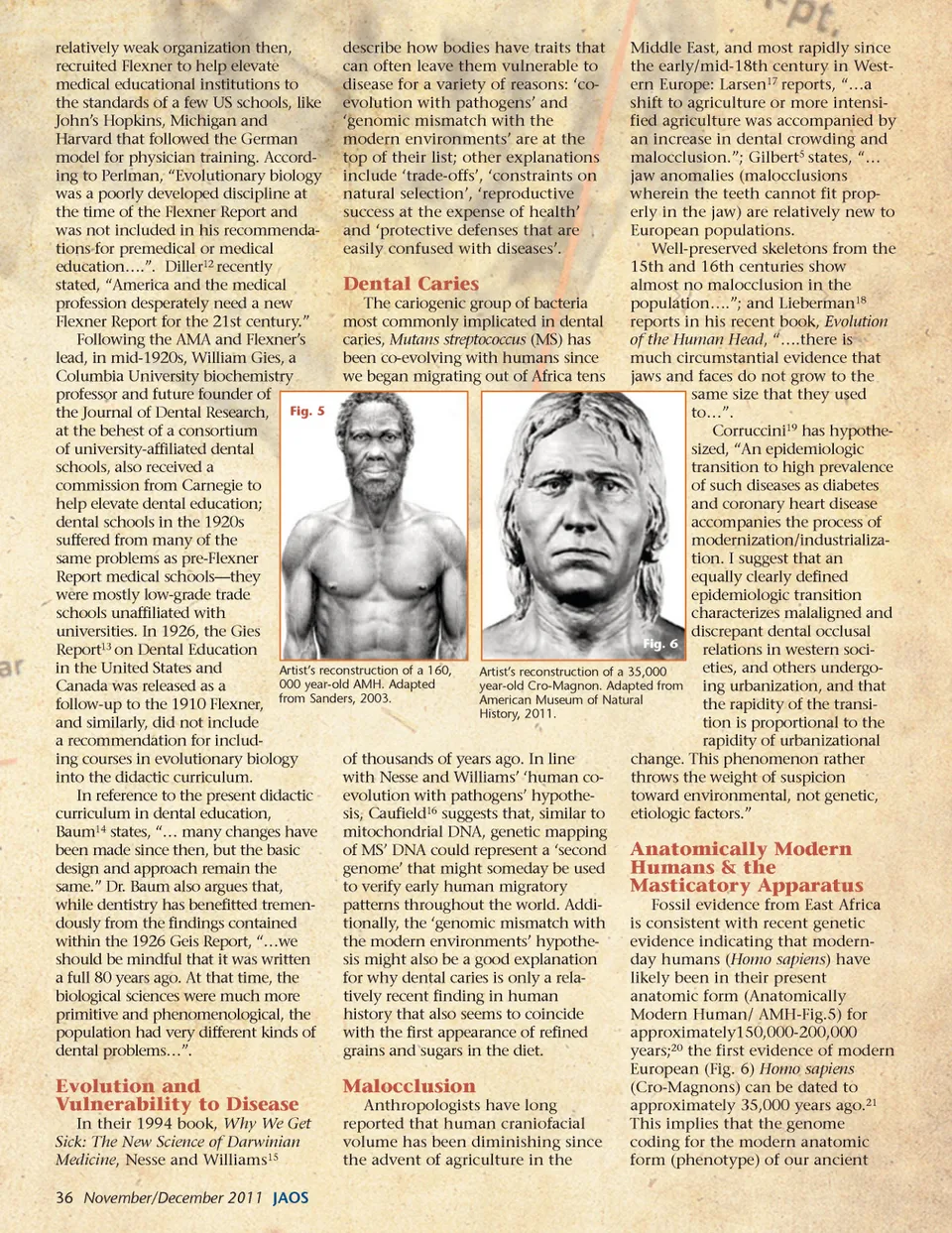
African ancestors, is also very little, if at all, changed over thousands of generations. This has significant implications for why we are presently experiencing such high prevalence of malocclusion over the past few hundred years… Macroge-nomic change has not been shown to occur over such a relatively short time span. The component of the craniofa-cial complex that is dedicated to the function of initiating mechani-cal/ chemical processing of food prior to its subsequent digestion and assimilation of nutrients for later biological utilization, is called the human masticatory apparatus (HMA). As our pre-modern human ancestors evolved away from their common ancestor with the modern chimpanzee over 6 million years ago, the HMA had to have been indispensible to their ultimate evolutionary success. Thus, the combination of genes involved in coding for the modern HMA-phenotype is likely little changed since modern Europeans first appeared nearly 35,000 years ago, and many anthropologists specu-late that our complete genome has probably not undergone any Macroevolutionary change since we first appeared in Africa as AMH’s nearly 200,000 years ago. Fig. 7 Notice the forward position of A-point relative to the N-perpendicular to the Frankfort horizontal plane; this is a common finding in pre-Industrial skulls but would indicate an abnormally protrusive maxilla by most currently used cephalometric analyses. Adapted from Corruccini 1989. Mismatch to Modernity & Malocclusion As Corruccini implies, the rela-tively recent appearance of maloc-clusion in humans is not best explained as resulting from a recent and anomalous Macroevolutionary genomic change...that would require a vast amount of geological time. A more plausible explanation would be one that is consistent with Nesse and Williams’ ‘Mismatch’ explana-tion for disease vulnerability; an unchanged ancient genome exposed to a less-challenging modern feeding environment (since the Industrial Revolution ) is now the leading hypothesis for understanding malocclusion etiology that is accepted by many anthropologists and anthropologically-informed orthodontic clinicians and researchers…but seemingly at odds with current orthodontic teaching and clinical practice. In the most recently published edition of the widely-used textbook Contemporary Orthodontics , 6 coau-thor William Proffit posits the ques-tion, “Is it possible that a child’s masticatory effort plays a major role in determining dental arch dimensions?”; and then provides an answer, “That seems unlikely.” Dr. Proffit’s conclusion might be at odds with the observation that ancestral-type infant/early child-hood feeding environments (breast-feeding at-will into the third year of life and weaning to fibrous/firm-textured first foods) seems to provide some protective benefit against the later development of malocclusion in pre-Industrialized , prehistoric and non-Westernized modern-day cultures. Furthermore, there are multiple studies 22, 23, 24 that clearly indicate a negative effect of bottle-feeding versus breastfeeding with respect to later development of anterior open-bites and/or posterior crossbites. A Need for Change Anthropological Norm (AN) is a concept that is currently being explored by several disciplines in healthcare; 25 for example, it is now routine to look at free ranging South African Bushman, Khoisan people, and others for an "anthro-pologically normal"/ prehistori-cally "natural" level of serum cholesterol, LDL to HDL ratio, blood pressure, sodium, blood sugar. All these variables are at unnaturally high levels in modern-ized/westernized populations. Hypothetically, AN implies the existence of a pre-Industrial pheno-typic range for a variety of physi-cal/physiological phenotypic traits (e.g., the human masticatory appara-tus, salivary pH, etc.) that are normal for assuring maximum survival, thriving and reproductive fitness. The AN hypothesis is predicated on the observation that the human genome is best adapted to pre-Indus-trial diets, lifestyles and environ-ments as it (the human genome) has undergone virtually no Macroevolu-tionary change in perhaps the last 60,000-200,000 years. As the alleles that code for the human masticatory apparatus are likely unchanged for thousands of generations, to suggest revision of current “anthropologi-cally” uninformed cephalometric norms, which are almost entirely based upon 20th-century skulls, does not seem unreasonable. In 1981, a paper by James McNa-mara appeared in the Angle Orthodon-tist 26 describing a study showing that most of the skeletal Class II maloc-clusion subjects in a cohort of 8-to www.orthodontics.com November/December 2011 37
Journal of the American Orthodontic Society November-December 2011: Page 37