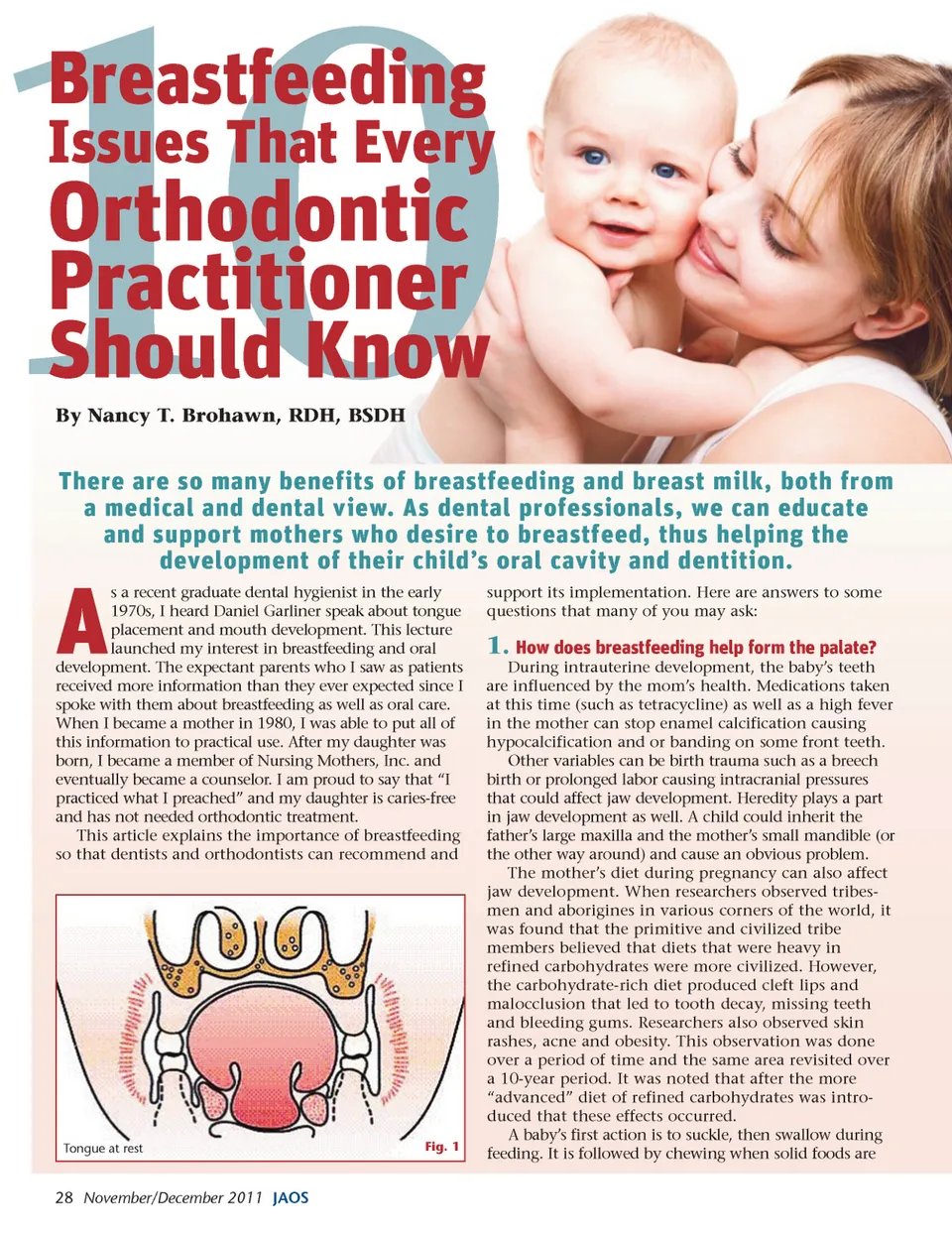
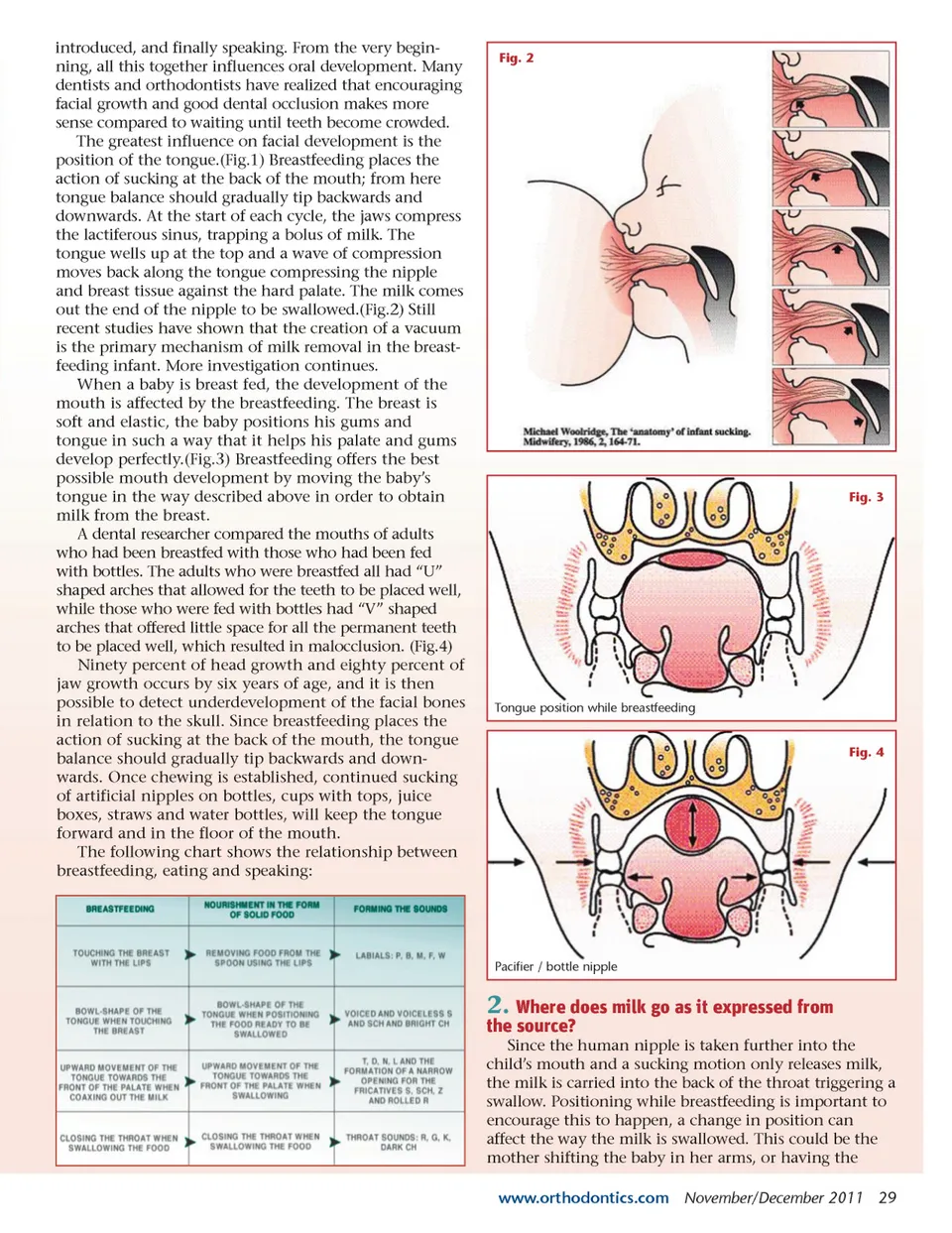
10 Breastfeeding Issues That Every Orthodontic Practitioner Should Know By Nancy T. Brohawn, RDH, BSDH There are so many benefits of breastfeeding and breast milk, both from a medical and dental view. As dental professionals, we can educate and support mothers who desire to breastfeed, thus helping the development of their child’s oral cavity and dentition. support its implementation. Here are answers to some questions that many of you may ask: A s a recent graduate dental hygienist in the early 1970s, I heard Daniel Garliner speak about tongue placement and mouth development. This lecture launched my interest in breastfeeding and oral development. The expectant parents who I saw as patients received more information than they ever expected since I spoke with them about breastfeeding as well as oral care. When I became a mother in 1980, I was able to put all of this information to practical use. After my daughter was born, I became a member of Nursing Mothers, Inc. and eventually became a counselor. I am proud to say that “I practiced what I preached” and my daughter is caries-free and has not needed orthodontic treatment. This article explains the importance of breastfeeding so that dentists and orthodontists can recommend and 1. How does breastfeeding help form the palate? During intrauterine development, the baby’s teeth are influenced by the mom’s health. Medications taken at this time (such as tetracycline) as well as a high fever in the mother can stop enamel calcification causing hypocalcification and or banding on some front teeth. Other variables can be birth trauma such as a breech birth or prolonged labor causing intracranial pressures that could affect jaw development. Heredity plays a part in jaw development as well. A child could inherit the father’s large maxilla and the mother’s small mandible (or the other way around) and cause an obvious problem. The mother’s diet during pregnancy can also affect jaw development. When researchers observed tribes-men and aborigines in various corners of the world, it was found that the primitive and civilized tribe members believed that diets that were heavy in refined carbohydrates were more civilized. However, the carbohydrate-rich diet produced cleft lips and malocclusion that led to tooth decay, missing teeth and bleeding gums. Researchers also observed skin rashes, acne and obesity. This observation was done over a period of time and the same area revisited over a 10-year period. It was noted that after the more “advanced” diet of refined carbohydrates was intro-duced that these effects occurred. A baby’s first action is to suckle, then swallow during feeding. It is followed by chewing when solid foods are Tongue at rest Fig. 1 28 November/December 2011 JAOS
Journal of the American Orthodontic Society November-December 2011: Page 28