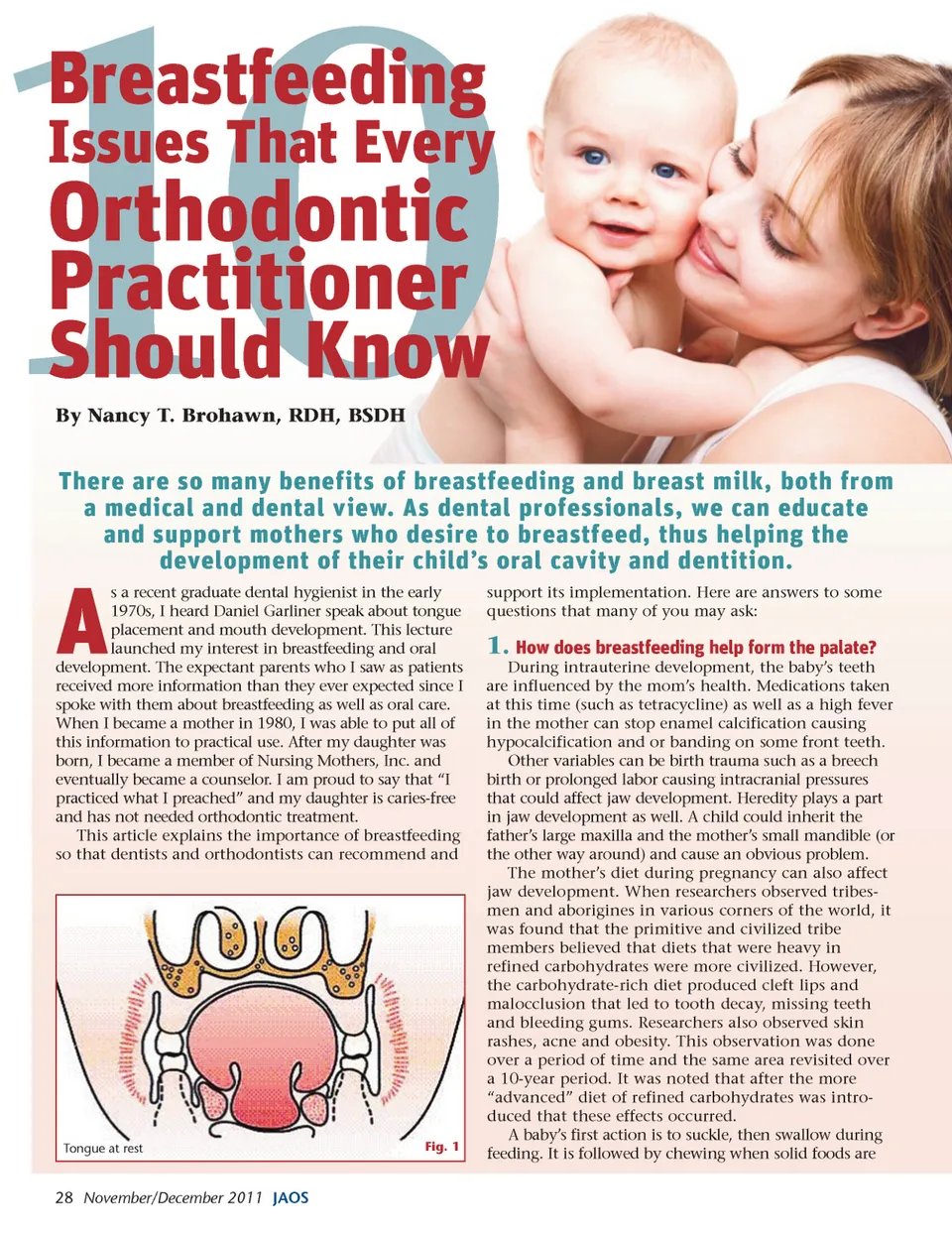
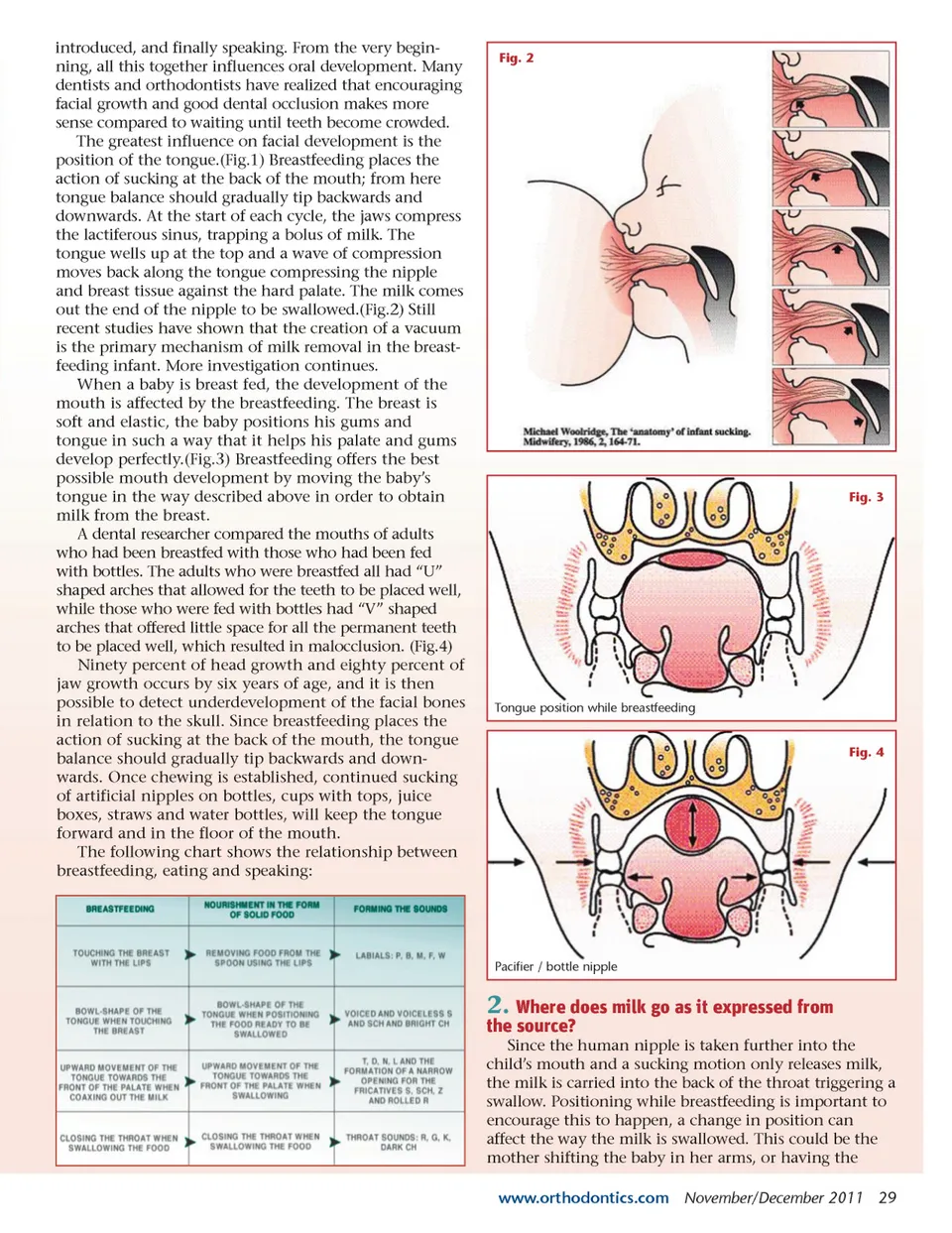
introduced, and finally speaking. From the very begin-ning, all this together influences oral development. Many dentists and orthodontists have realized that encouraging facial growth and good dental occlusion makes more sense compared to waiting until teeth become crowded. The greatest influence on facial development is the position of the tongue.(Fig.1) Breastfeeding places the action of sucking at the back of the mouth; from here tongue balance should gradually tip backwards and downwards. At the start of each cycle, the jaws compress the lactiferous sinus, trapping a bolus of milk. The tongue wells up at the top and a wave of compression moves back along the tongue compressing the nipple and breast tissue against the hard palate. The milk comes out the end of the nipple to be swallowed.(Fig.2) Still recent studies have shown that the creation of a vacuum is the primary mechanism of milk removal in the breast-feeding infant. More investigation continues. When a baby is breast fed, the development of the mouth is affected by the breastfeeding. The breast is soft and elastic, the baby positions his gums and tongue in such a way that it helps his palate and gums develop perfectly.(Fig.3) Breastfeeding offers the best possible mouth development by moving the baby’s tongue in the way described above in order to obtain milk from the breast. A dental researcher compared the mouths of adults who had been breastfed with those who had been fed with bottles. The adults who were breastfed all had “U” shaped arches that allowed for the teeth to be placed well, while those who were fed with bottles had “V” shaped arches that offered little space for all the permanent teeth to be placed well, which resulted in malocclusion. (Fig.4) Ninety percent of head growth and eighty percent of jaw growth occurs by six years of age, and it is then possible to detect underdevelopment of the facial bones in relation to the skull. Since breastfeeding places the action of sucking at the back of the mouth, the tongue balance should gradually tip backwards and down-wards. Once chewing is established, continued sucking of artificial nipples on bottles, cups with tops, juice boxes, straws and water bottles, will keep the tongue forward and in the floor of the mouth. The following chart shows the relationship between breastfeeding, eating and speaking: Fig. 2 Fig. 3 Tongue position while breastfeeding Fig. 4 Pacifier / bottle nipple 2. Where does milk go as it expressed from the source? Since the human nipple is taken further into the child’s mouth and a sucking motion only releases milk, the milk is carried into the back of the throat triggering a swallow. Positioning while breastfeeding is important to encourage this to happen, a change in position can affect the way the milk is swallowed. This could be the mother shifting the baby in her arms, or having the www.orthodontics.com November/December 2011 29
Journal of the American Orthodontic Society November-December 2011: Page 29