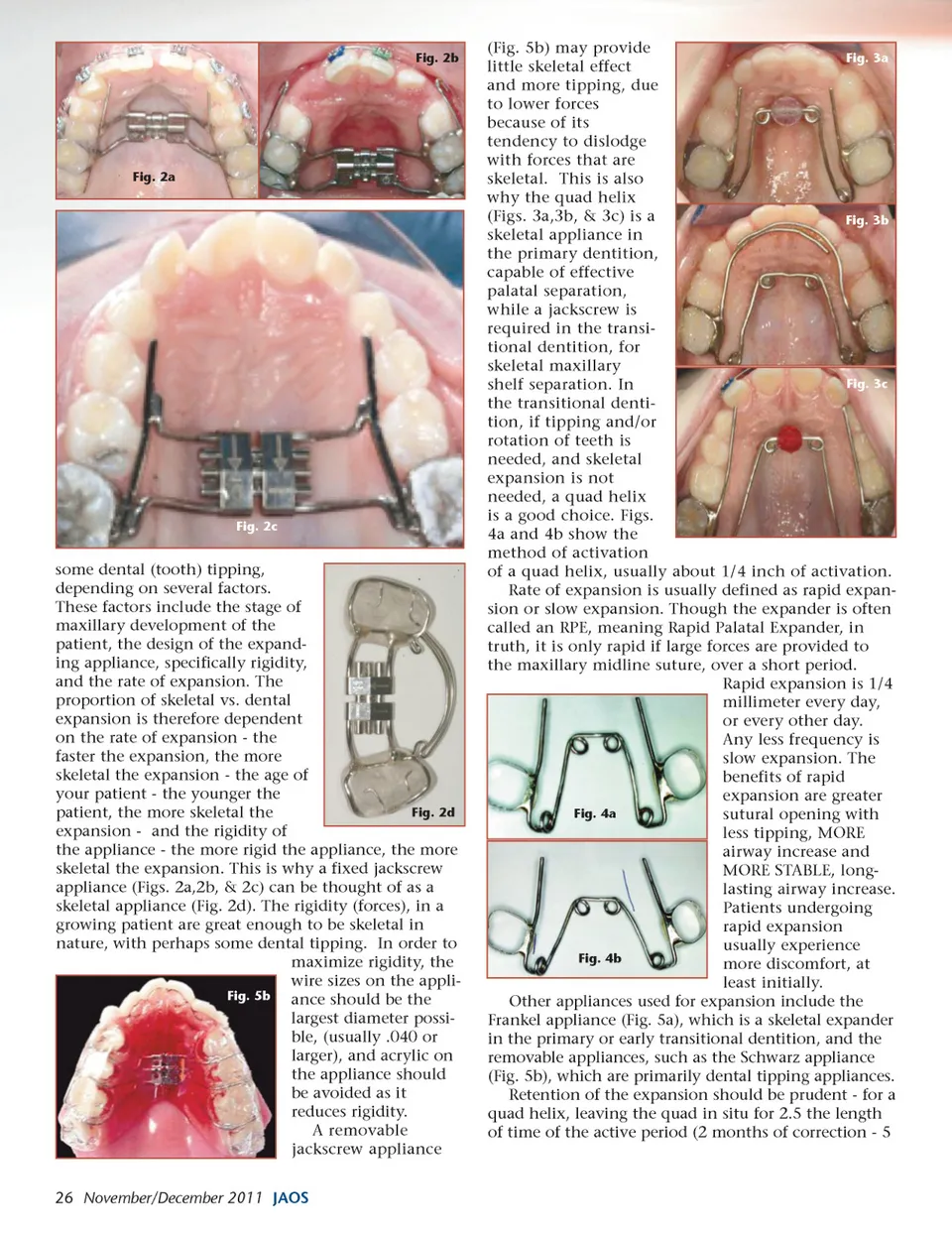
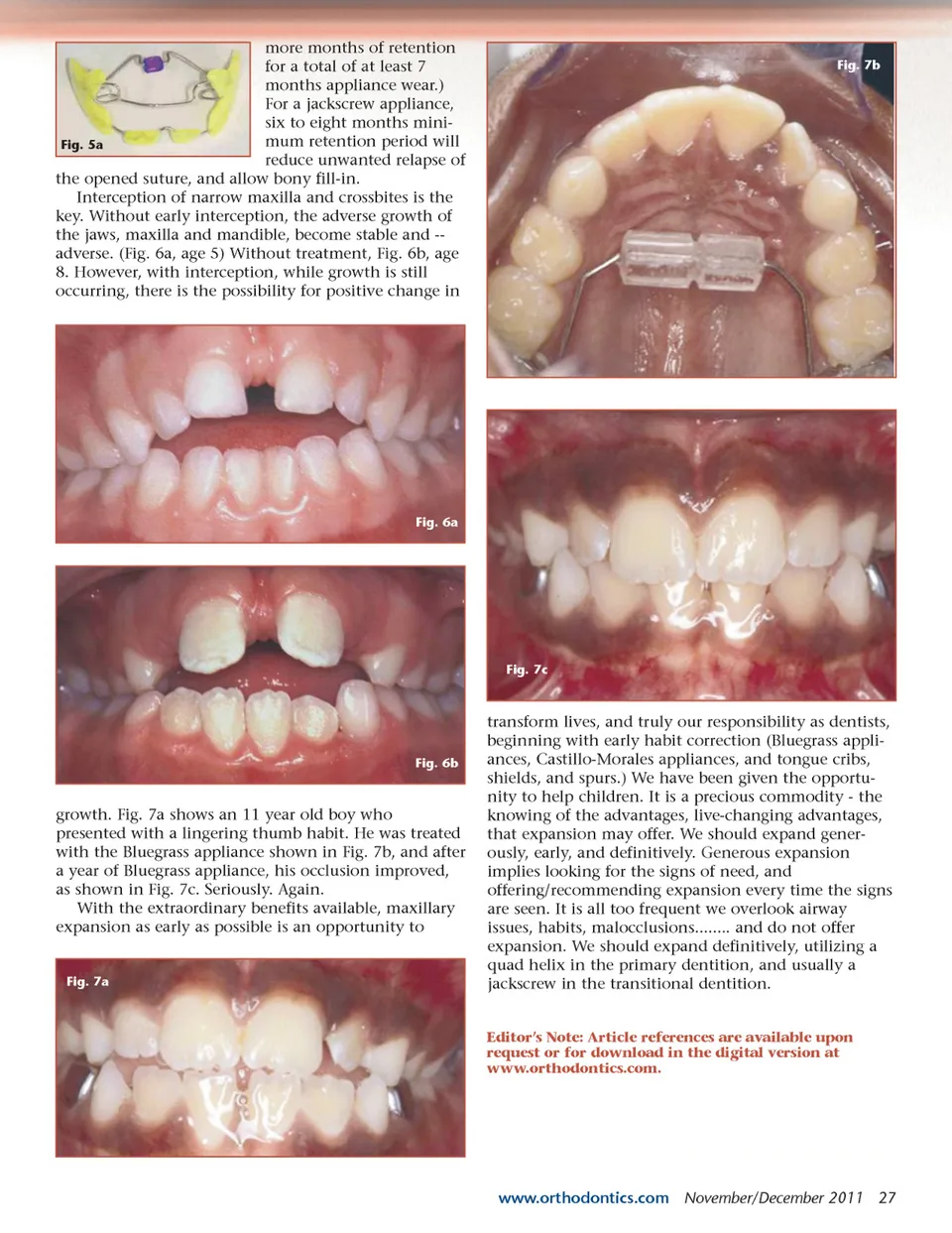
Fig. 2b Fig. 2a Fig. 2c some dental (tooth) tipping, depending on several factors. These factors include the stage of maxillary development of the patient, the design of the expand-ing appliance, specifically rigidity, and the rate of expansion. The proportion of skeletal vs. dental expansion is therefore dependent on the rate of expansion -the faster the expansion, the more skeletal the expansion -the age of your patient -the younger the Fig. 2d patient, the more skeletal the expansion -and the rigidity of the appliance -the more rigid the appliance, the more skeletal the expansion. This is why a fixed jackscrew appliance (Figs. 2a,2b, & 2c) can be thought of as a skeletal appliance (Fig. 2d). The rigidity (forces), in a growing patient are great enough to be skeletal in nature, with perhaps some dental tipping. In order to maximize rigidity, the wire sizes on the appli-Fig. 5b ance should be the largest diameter possi-ble, (usually .040 or larger), and acrylic on the appliance should be avoided as it reduces rigidity. A removable jackscrew appliance 26 November/December 2011 JAOS (Fig. 5b) may provide Fig. 3a little skeletal effect and more tipping, due to lower forces because of its tendency to dislodge with forces that are skeletal. This is also why the quad helix (Figs. 3a,3b, & 3c) is a Fig. 3b skeletal appliance in the primary dentition, capable of effective palatal separation, while a jackscrew is required in the transi-tional dentition, for skeletal maxillary Fig. 3c shelf separation. In the transitional denti-tion, if tipping and/or rotation of teeth is needed, and skeletal expansion is not needed, a quad helix is a good choice. Figs. 4a and 4b show the method of activation of a quad helix, usually about 1/4 inch of activation. Rate of expansion is usually defined as rapid expan-sion or slow expansion. Though the expander is often called an RPE, meaning Rapid Palatal Expander, in truth, it is only rapid if large forces are provided to the maxillary midline suture, over a short period. Rapid expansion is 1/4 millimeter every day, or every other day. Any less frequency is slow expansion. The benefits of rapid expansion are greater Fig. 4a sutural opening with less tipping, MORE airway increase and MORE STABLE, long-lasting airway increase. Patients undergoing rapid expansion usually experience Fig. 4b more discomfort, at least initially. Other appliances used for expansion include the Frankel appliance (Fig. 5a), which is a skeletal expander in the primary or early transitional dentition, and the removable appliances, such as the Schwarz appliance (Fig. 5b), which are primarily dental tipping appliances. Retention of the expansion should be prudent -for a quad helix, leaving the quad in situ for 2.5 the length of time of the active period (2 months of correction -5
Journal of the American Orthodontic Society November-December 2011: Page 26