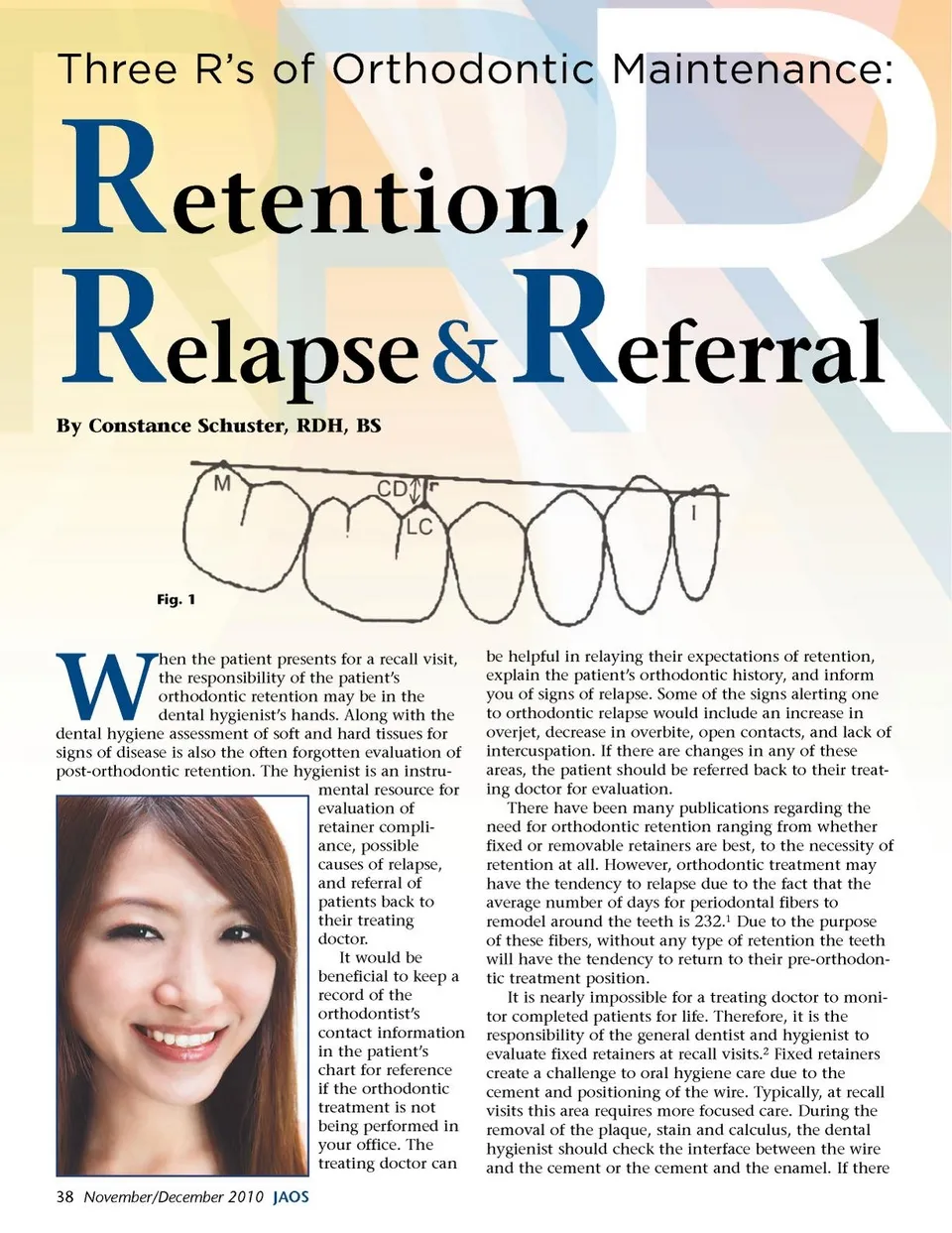
Three R’s of Orthodontic Maintenance: R etention, R elapse & R eferral By Constance Schuster, RDH, BS Fig. 1 W hen the patient presents for a recall visit, the responsibility of the patient’s orthodontic retention may be in the dental hygienist’s hands. Along with the dental hygiene assessment of soft and hard tissues for signs of disease is also the often forgotten evaluation of post-orthodontic retention. The hygienist is an instru-mental resource for evaluation of retainer compli-ance, possible causes of relapse, and referral of patients back to their treating doctor. It would be beneficial to keep a record of the orthodontist’s contact information in the patient’s chart for reference if the orthodontic treatment is not being performed in your office. The treating doctor can 38 November/December 2010 JAOS be helpful in relaying their expectations of retention, explain the patient’s orthodontic history, and inform you of signs of relapse. Some of the signs alerting one to orthodontic relapse would include an increase in overjet, decrease in overbite, open contacts, and lack of intercuspation. If there are changes in any of these areas, the patient should be referred back to their treat-ing doctor for evaluation. There have been many publications regarding the need for orthodontic retention ranging from whether fixed or removable retainers are best, to the necessity of retention at all. However, orthodontic treatment may have the tendency to relapse due to the fact that the average number of days for periodontal fibers to remodel around the teeth is 232. 1 Due to the purpose of these fibers, without any type of retention the teeth will have the tendency to return to their pre-orthodon-tic treatment position. It is nearly impossible for a treating doctor to moni-tor completed patients for life. Therefore, it is the responsibility of the general dentist and hygienist to evaluate fixed retainers at recall visits. 2 Fixed retainers create a challenge to oral hygiene care due to the cement and positioning of the wire. Typically, at recall visits this area requires more focused care. During the removal of the plaque, stain and calculus, the dental hygienist should check the interface between the wire and the cement or the cement and the enamel. If there
Journal of the American Orthodontic Society November-December 2010: Page 38