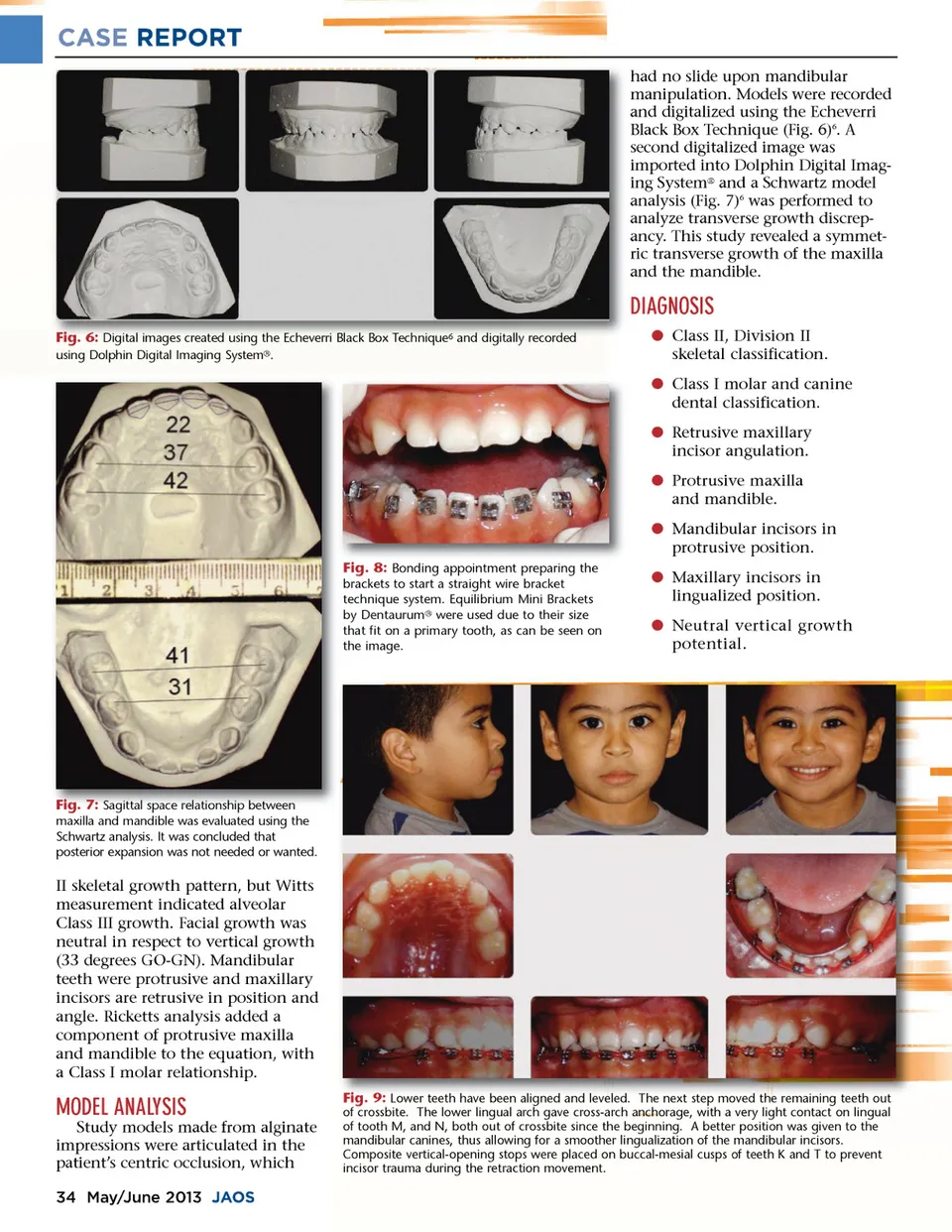
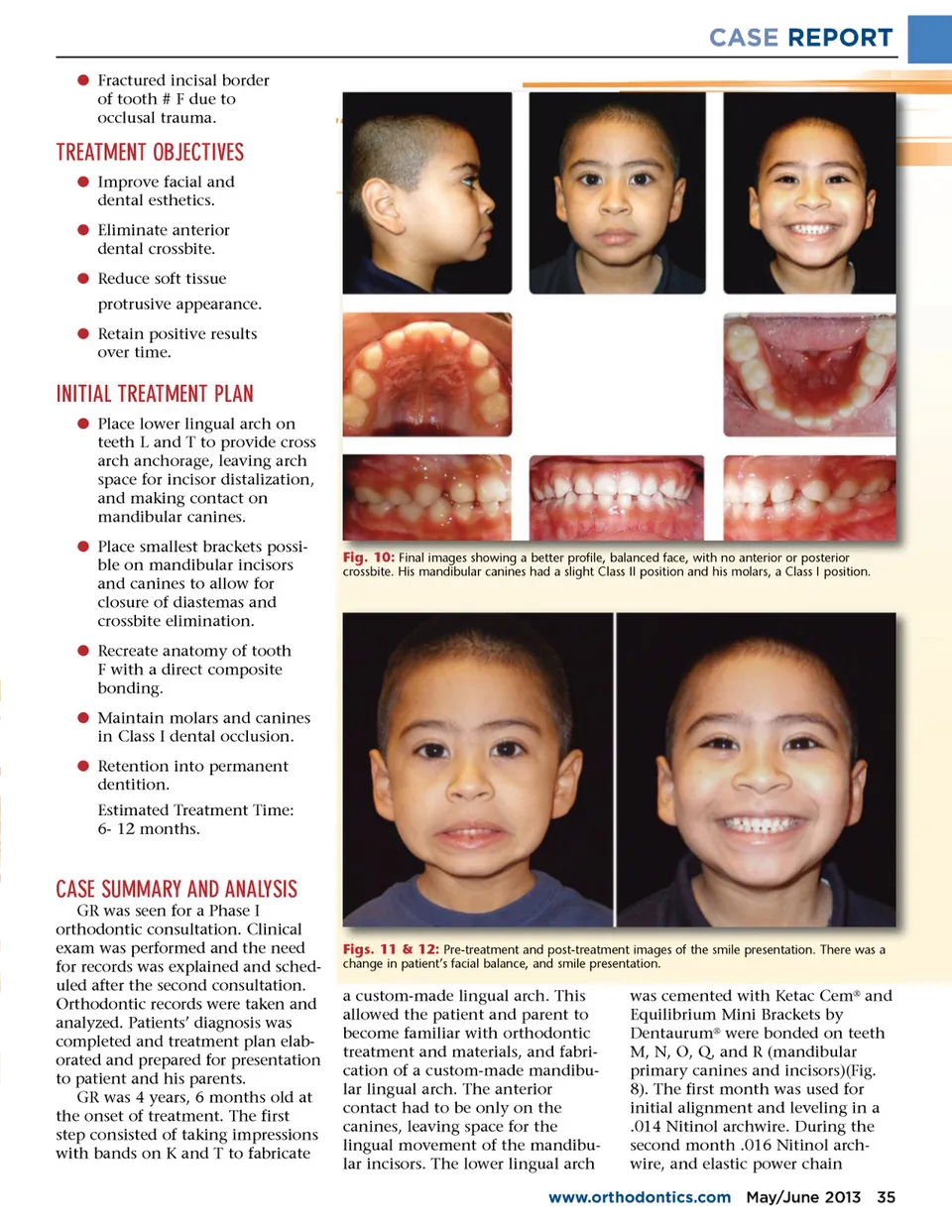
CASE REPORT b Fractured incisal border of tooth # F due to occlusal trauma. TREATMENT OBJECTIVES b Improve facial and dental esthetics. b Eliminate anterior dental crossbite. b Reduce soft tissue protrusive appearance. b Retain positive results over time. INITIAL TREATMENT PLAN b Place lower lingual arch on teeth L and T to provide cross arch anchorage, leaving arch space for incisor distalization, and making contact on mandibular canines. b Place smallest brackets possi-ble on mandibular incisors and canines to allow for closure of diastemas and crossbite elimination. b Recreate anatomy of tooth F with a direct composite bonding. b Maintain molars and canines in Class I dental occlusion. b Retention into permanent dentition. Estimated Treatment Time: 6-12 months. Fig. 10: Final images showing a better profile, balanced face, with no anterior or posterior crossbite. His mandibular canines had a slight Class II position and his molars, a Class I position. CASE SUMMARY AND ANALYSIS GR was seen for a Phase I orthodontic consultation. Clinical exam was performed and the need for records was explained and sched-uled after the second consultation. Orthodontic records were taken and analyzed. Patients’ diagnosis was completed and treatment plan elab-orated and prepared for presentation to patient and his parents. GR was 4 years, 6 months old at the onset of treatment. The first step consisted of taking impressions with bands on K and T to fabricate Figs. 11 & 12: Pre-treatment and post-treatment images of the smile presentation. There was a change in patient’s facial balance, and smile presentation. a custom-made lingual arch. This allowed the patient and parent to become familiar with orthodontic treatment and materials, and fabri-cation of a custom-made mandibu-lar lingual arch. The anterior contact had to be only on the canines, leaving space for the lingual movement of the mandibu-lar incisors. The lower lingual arch was cemented with Ketac Cem ® and Equilibrium Mini Brackets by Dentaurum ® were bonded on teeth M, N, O, Q, and R (mandibular primary canines and incisors)(Fig. 8). The first month was used for initial alignment and leveling in a .014 Nitinol archwire. During the second month .016 Nitinol arch-wire, and elastic power chain www.orthodontics.com May/June 2013 35
Journal of the American Orthodontic Society May-June 2013: Page 35