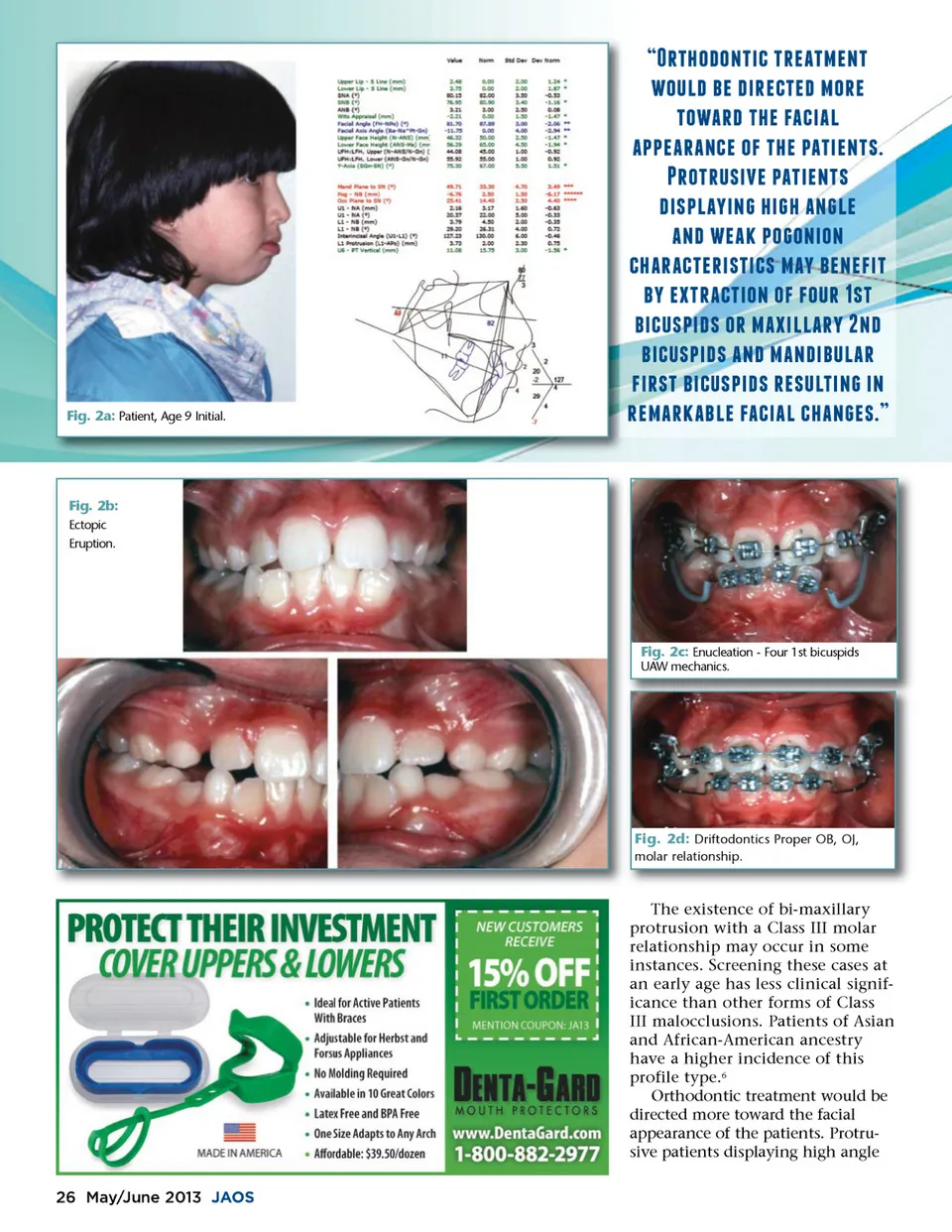
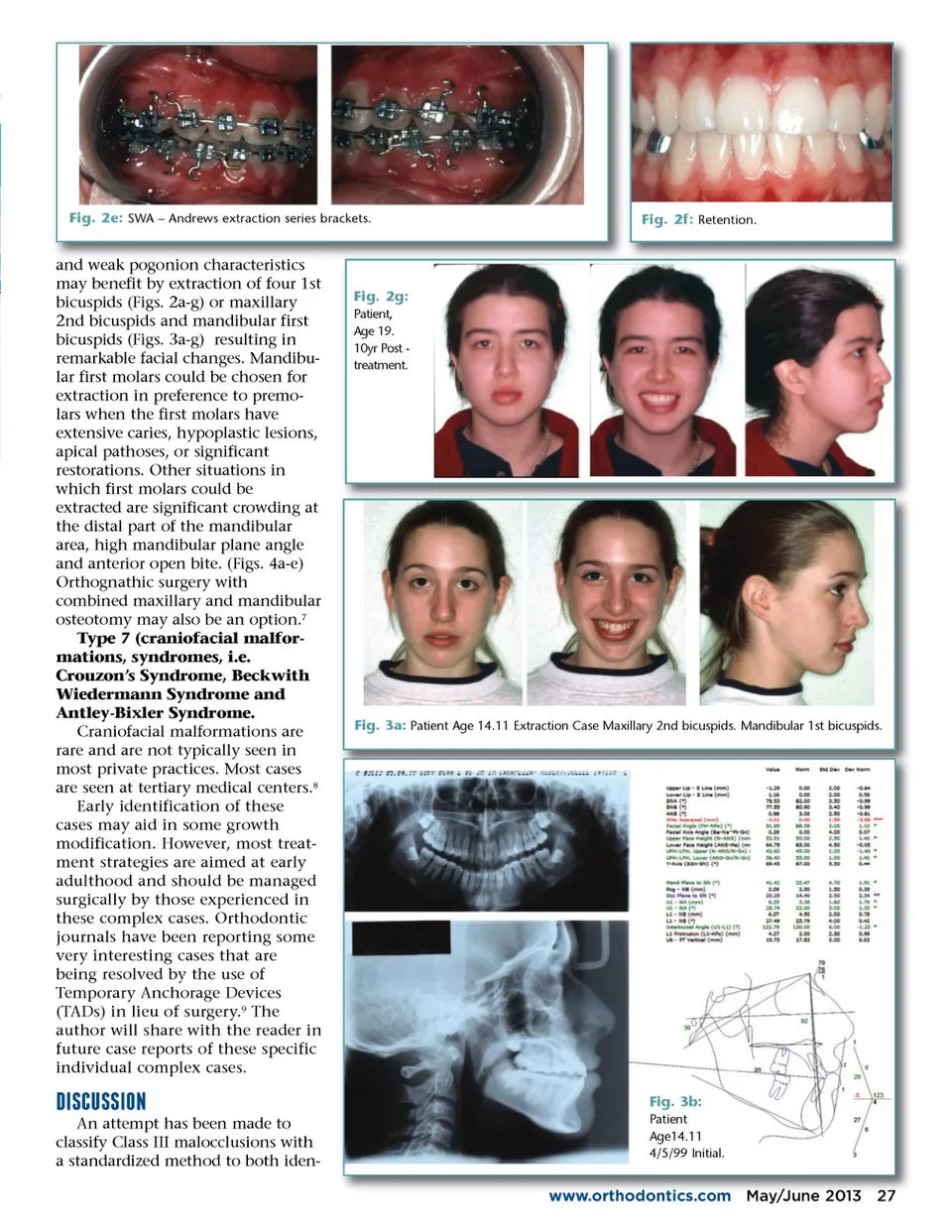
Fig. 2e: SWA – Andrews extraction series brackets. Fig. 2f: Retention. and weak pogonion characteristics may benefit by extraction of four 1st bicuspids (Figs. 2a-g) or maxillary 2nd bicuspids and mandibular first bicuspids (Figs. 3a-g) resulting in remarkable facial changes. Mandibu-lar first molars could be chosen for extraction in preference to premo-lars when the first molars have extensive caries, hypoplastic lesions, apical pathoses, or significant restorations. Other situations in which first molars could be extracted are significant crowding at the distal part of the mandibular area, high mandibular plane angle and anterior open bite. (Figs. 4a-e) Orthognathic surgery with combined maxillary and mandibular osteotomy may also be an option. 7 Type 7 (craniofacial malfor-mations, syndromes, i.e. Crouzon’s Syndrome, Beckwith Wiedermann Syndrome and Antley-Bixler Syndrome. Craniofacial malformations are rare and are not typically seen in most private practices. Most cases are seen at tertiary medical centers. 8 Early identification of these cases may aid in some growth modification. However, most treat-ment strategies are aimed at early adulthood and should be managed surgically by those experienced in these complex cases. Orthodontic journals have been reporting some very interesting cases that are being resolved by the use of Temporary Anchorage Devices (TADs) in lieu of surgery. 9 The author will share with the reader in future case reports of these specific individual complex cases. Fig. 2g: Patient, Age 19. 10yr Post -treatment. Fig. 3a: Patient Age 14.11 Extraction Case Maxillary 2nd bicuspids. Mandibular 1st bicuspids. #d;c;d;d;#2 An attempt has been made to classify Class III malocclusions with a standardized method to both iden-Fig. 3b: Patient Age14.11 4/5/99 Initial. www.orthodontics.com May/June 2013 27
Journal of the American Orthodontic Society May-June 2013: Page 27