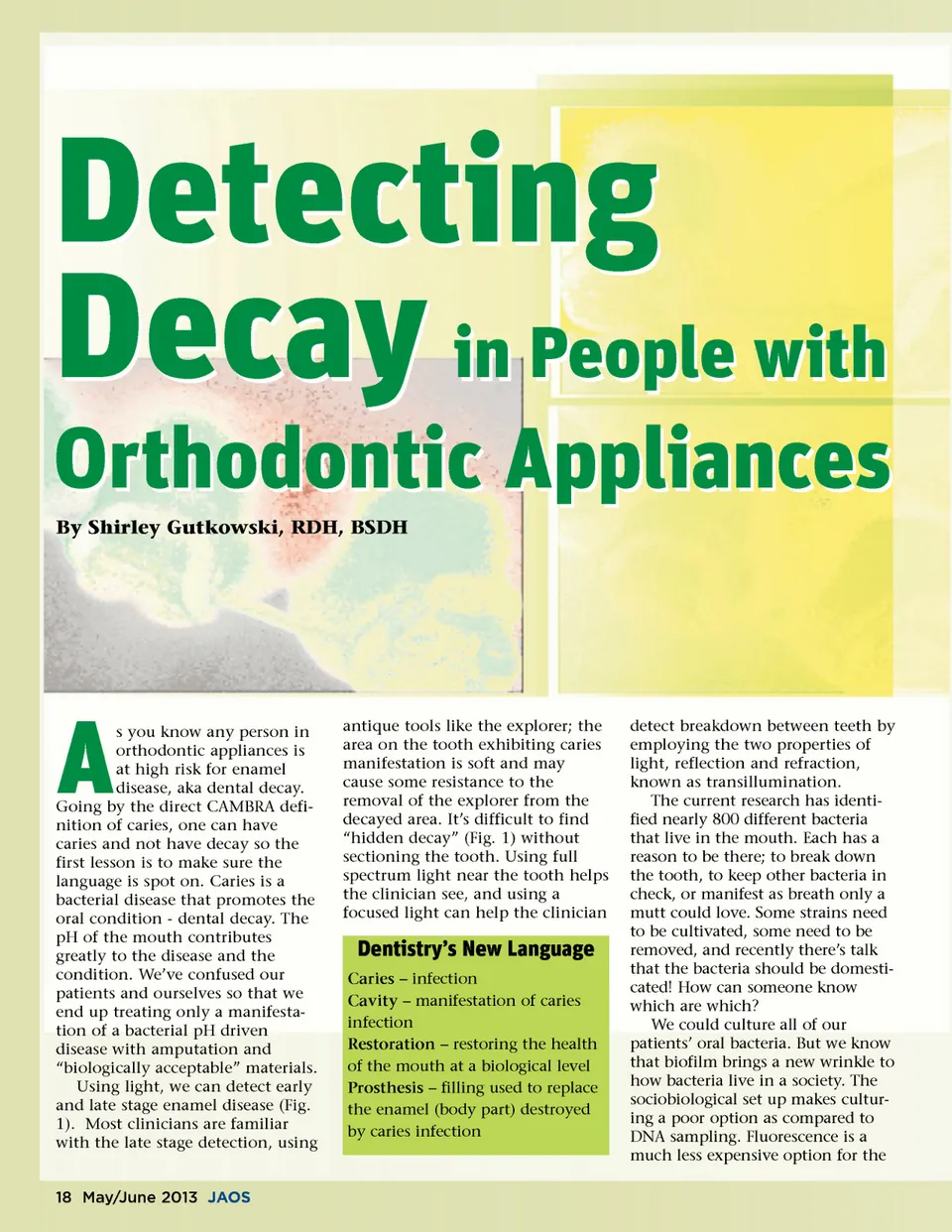
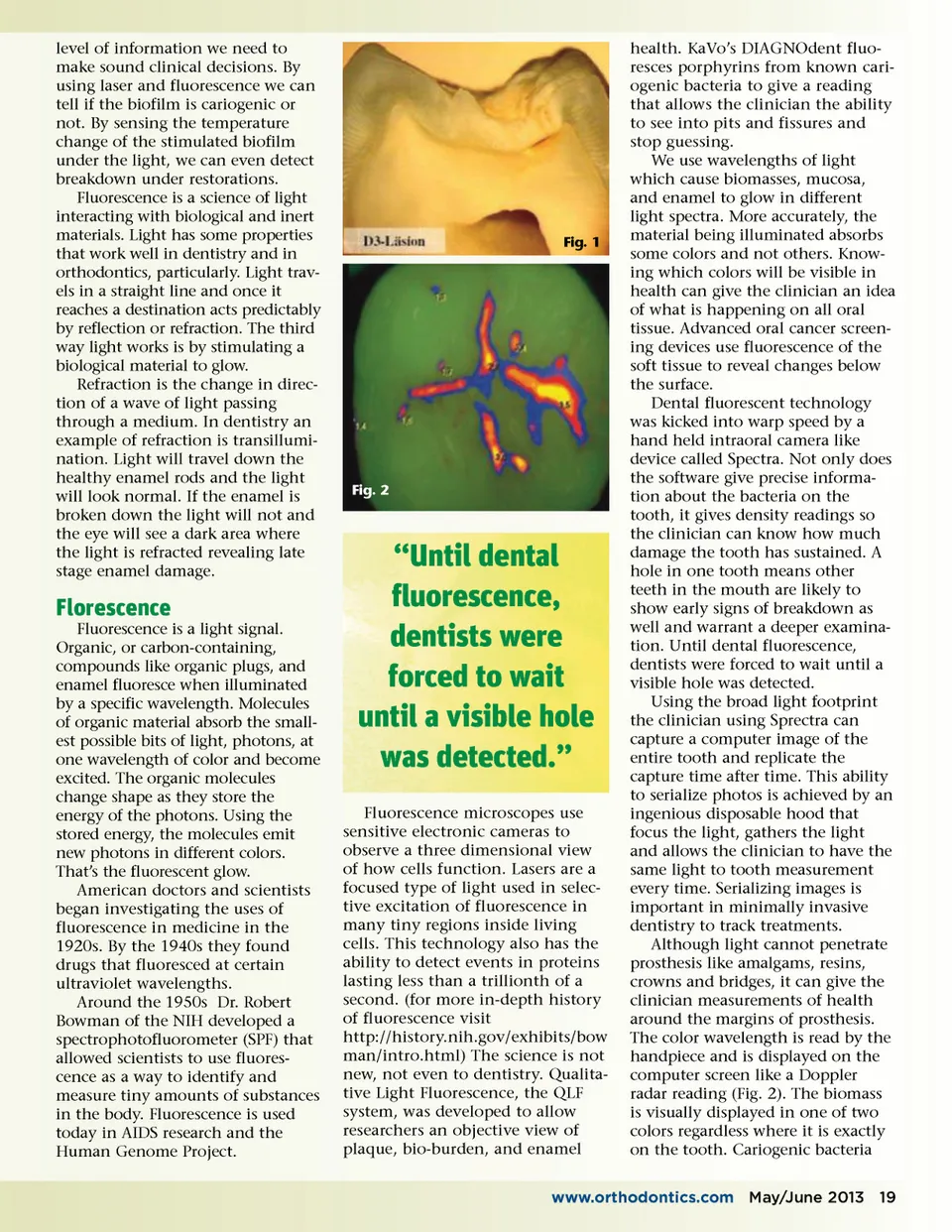
Detecting Decay in People with Orthodontic Appliances By Shirley Gutkowski, RDH, BSDH s you know any person in orthodontic appliances is at high risk for enamel disease, aka dental decay. Going by the direct CAMBRA defi-nition of caries, one can have caries and not have decay so the first lesson is to make sure the language is spot on. Caries is a bacterial disease that promotes the oral condition -dental decay. The pH of the mouth contributes greatly to the disease and the condition. We’ve confused our patients and ourselves so that we end up treating only a manifesta-tion of a bacterial pH driven disease with amputation and “biologically acceptable” materials. Using light, we can detect early and late stage enamel disease (Fig. 1). Most clinicians are familiar with the late stage detection, using A antique tools like the explorer; the area on the tooth exhibiting caries manifestation is soft and may cause some resistance to the removal of the explorer from the decayed area. It’s difficult to find “hidden decay” (Fig. 1) without sectioning the tooth. Using full spectrum light near the tooth helps the clinician see, and using a focused light can help the clinician Dentistry’s New Language Caries – infection Cavity – manifestation of caries infection Restoration – restoring the health of the mouth at a biological level Prosthesis – filling used to replace the enamel (body part) destroyed by caries infection detect breakdown between teeth by employing the two properties of light, reflection and refraction, known as transillumination. The current research has identi-fied nearly 800 different bacteria that live in the mouth. Each has a reason to be there; to break down the tooth, to keep other bacteria in check, or manifest as breath only a mutt could love. Some strains need to be cultivated, some need to be removed, and recently there’s talk that the bacteria should be domesti-cated! How can someone know which are which? We could culture all of our patients’ oral bacteria. But we know that biofilm brings a new wrinkle to how bacteria live in a society. The sociobiological set up makes cultur-ing a poor option as compared to DNA sampling. Fluorescence is a much less expensive option for the 18 May/June 2013 JAOS
Journal of the American Orthodontic Society May-June 2013: Page 18