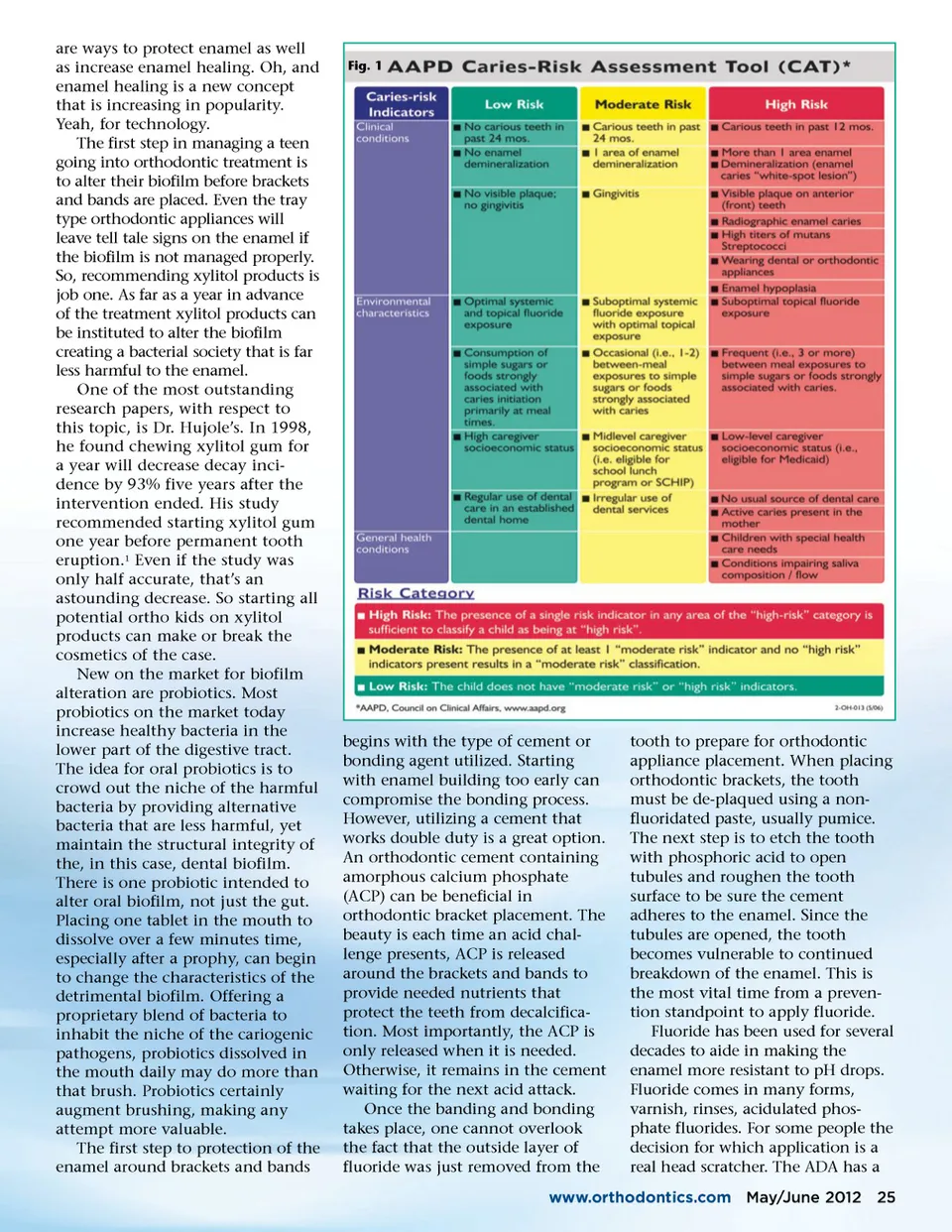
are ways to protect enamel as well as increase enamel healing. Oh, and enamel healing is a new concept that is increasing in popularity. Yeah, for technology. The first step in managing a teen going into orthodontic treatment is to alter their biofilm before brackets and bands are placed. Even the tray type orthodontic appliances will leave tell tale signs on the enamel if the biofilm is not managed properly. So, recommending xylitol products is job one. As far as a year in advance of the treatment xylitol products can be instituted to alter the biofilm creating a bacterial society that is far less harmful to the enamel. One of the most outstanding research papers, with respect to this topic, is Dr. Hujole’s. In 1998, he found chewing xylitol gum for a year will decrease decay inci-dence by 93% five years after the intervention ended. His study recommended starting xylitol gum one year before permanent tooth eruption. 1 Even if the study was only half accurate, that’s an astounding decrease. So starting all potential ortho kids on xylitol products can make or break the cosmetics of the case. New on the market for biofilm alteration are probiotics. Most probiotics on the market today increase healthy bacteria in the lower part of the digestive tract. The idea for oral probiotics is to crowd out the niche of the harmful bacteria by providing alternative bacteria that are less harmful, yet maintain the structural integrity of the, in this case, dental biofilm. There is one probiotic intended to alter oral biofilm, not just the gut. Placing one tablet in the mouth to dissolve over a few minutes time, especially after a prophy, can begin to change the characteristics of the detrimental biofilm. Offering a proprietary blend of bacteria to inhabit the niche of the cariogenic pathogens, probiotics dissolved in the mouth daily may do more than that brush. Probiotics certainly augment brushing, making any attempt more valuable. The first step to protection of the enamel around brackets and bands Fig. 1 begins with the type of cement or bonding agent utilized. Starting with enamel building too early can compromise the bonding process. However, utilizing a cement that works double duty is a great option. An orthodontic cement containing amorphous calcium phosphate (ACP) can be beneficial in orthodontic bracket placement. The beauty is each time an acid chal-lenge presents, ACP is released around the brackets and bands to provide needed nutrients that protect the teeth from decalcifica-tion. Most importantly, the ACP is only released when it is needed. Otherwise, it remains in the cement waiting for the next acid attack. Once the banding and bonding takes place, one cannot overlook the fact that the outside layer of fluoride was just removed from the tooth to prepare for orthodontic appliance placement. When placing orthodontic brackets, the tooth must be de-plaqued using a non-fluoridated paste, usually pumice. The next step is to etch the tooth with phosphoric acid to open tubules and roughen the tooth surface to be sure the cement adheres to the enamel. Since the tubules are opened, the tooth becomes vulnerable to continued breakdown of the enamel. This is the most vital time from a preven-tion standpoint to apply fluoride. Fluoride has been used for several decades to aide in making the enamel more resistant to pH drops. Fluoride comes in many forms, varnish, rinses, acidulated phos-phate fluorides. For some people the decision for which application is a real head scratcher. The ADA has a www.orthodontics.com May/June 2012 25
Journal of the American Orthodontic Society May-June 2012: Page 25