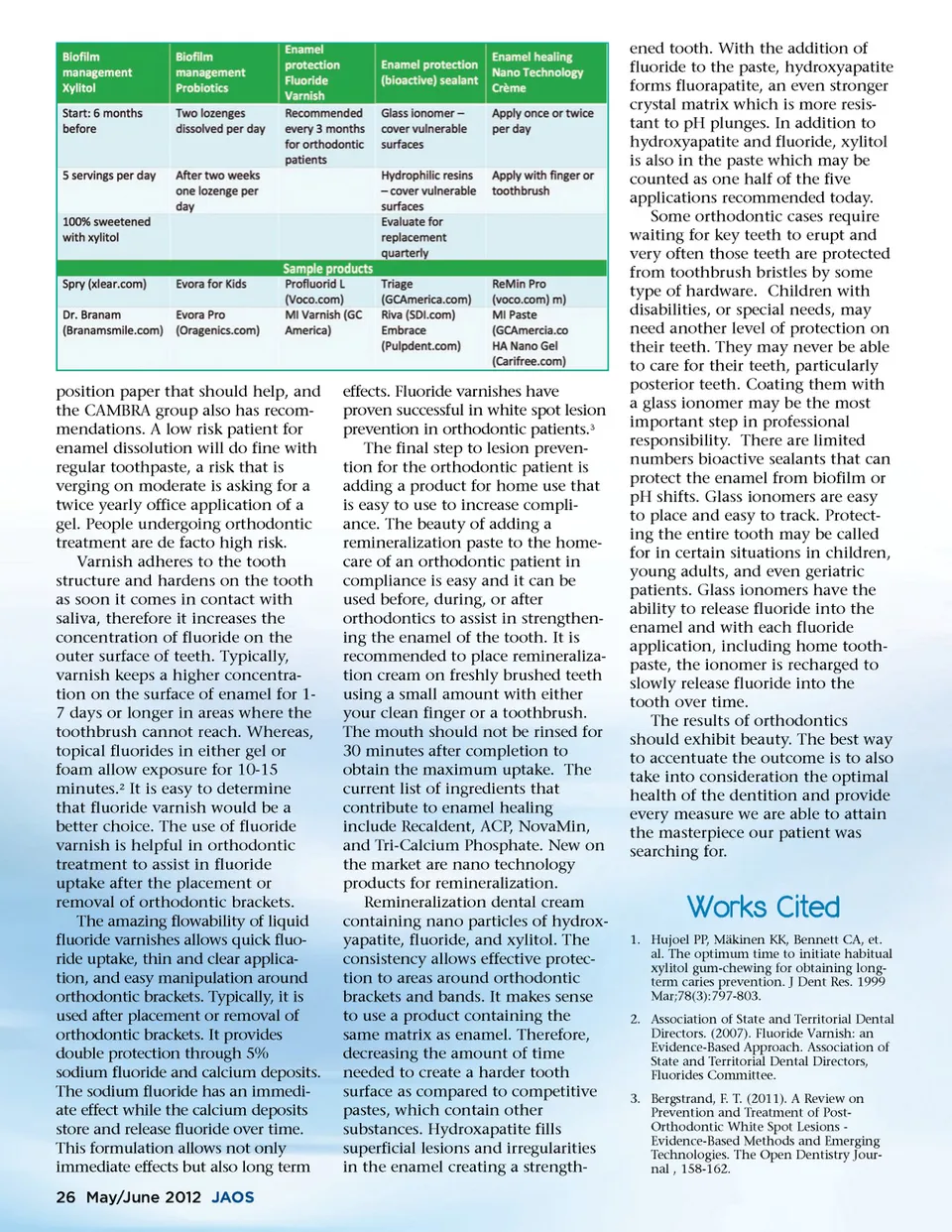
position paper that should help, and the CAMBRA group also has recom-mendations. A low risk patient for enamel dissolution will do fine with regular toothpaste, a risk that is verging on moderate is asking for a twice yearly office application of a gel. People undergoing orthodontic treatment are de facto high risk. Varnish adheres to the tooth structure and hardens on the tooth as soon it comes in contact with saliva, therefore it increases the concentration of fluoride on the outer surface of teeth. Typically, varnish keeps a higher concentra-tion on the surface of enamel for 1-7 days or longer in areas where the toothbrush cannot reach. Whereas, topical fluorides in either gel or foam allow exposure for 10-15 minutes. 2 It is easy to determine that fluoride varnish would be a better choice. The use of fluoride varnish is helpful in orthodontic treatment to assist in fluoride uptake after the placement or removal of orthodontic brackets. The amazing flowability of liquid fluoride varnishes allows quick fluo-ride uptake, thin and clear applica-tion, and easy manipulation around orthodontic brackets. Typically, it is used after placement or removal of orthodontic brackets. It provides double protection through 5% sodium fluoride and calcium deposits. The sodium fluoride has an immedi-ate effect while the calcium deposits store and release fluoride over time. This formulation allows not only immediate effects but also long term 26 May/June 2012 JAOS effects. Fluoride varnishes have proven successful in white spot lesion prevention in orthodontic patients. 3 The final step to lesion preven-tion for the orthodontic patient is adding a product for home use that is easy to use to increase compli-ance. The beauty of adding a remineralization paste to the home-care of an orthodontic patient in compliance is easy and it can be used before, during, or after orthodontics to assist in strengthen-ing the enamel of the tooth. It is recommended to place remineraliza-tion cream on freshly brushed teeth using a small amount with either your clean finger or a toothbrush. The mouth should not be rinsed for 30 minutes after completion to obtain the maximum uptake. The current list of ingredients that contribute to enamel healing include Recaldent, ACP, NovaMin, and Tri-Calcium Phosphate. New on the market are nano technology products for remineralization. Remineralization dental cream containing nano particles of hydrox-yapatite, fluoride, and xylitol. The consistency allows effective protec-tion to areas around orthodontic brackets and bands. It makes sense to use a product containing the same matrix as enamel. Therefore, decreasing the amount of time needed to create a harder tooth surface as compared to competitive pastes, which contain other substances. Hydroxapatite fills superficial lesions and irregularities in the enamel creating a strength-ened tooth. With the addition of fluoride to the paste, hydroxyapatite forms fluorapatite, an even stronger crystal matrix which is more resis-tant to pH plunges. In addition to hydroxyapatite and fluoride, xylitol is also in the paste which may be counted as one half of the five applications recommended today. Some orthodontic cases require waiting for key teeth to erupt and very often those teeth are protected from toothbrush bristles by some type of hardware. Children with disabilities, or special needs, may need another level of protection on their teeth. They may never be able to care for their teeth, particularly posterior teeth. Coating them with a glass ionomer may be the most important step in professional responsibility. There are limited numbers bioactive sealants that can protect the enamel from biofilm or pH shifts. Glass ionomers are easy to place and easy to track. Protect-ing the entire tooth may be called for in certain situations in children, young adults, and even geriatric patients. Glass ionomers have the ability to release fluoride into the enamel and with each fluoride application, including home tooth-paste, the ionomer is recharged to slowly release fluoride into the tooth over time. The results of orthodontics should exhibit beauty. The best way to accentuate the outcome is to also take into consideration the optimal health of the dentition and provide every measure we are able to attain the masterpiece our patient was searching for. W orks Cited 1. Hujoel PP, Mäkinen KK, Bennett CA, et. al. The optimum time to initiate habitual xylitol gum-chewing for obtaining long-term caries prevention. J Dent Res. 1999 Mar;78(3):797-803. 2. Association of State and Territorial Dental Directors. (2007). Fluoride Varnish: an Evidence-Based Approach. Association of State and Territorial Dental Directors, Fluorides Committee. 3. Bergstrand, F. T. (2011). A Review on Prevention and Treatment of Post-Orthodontic White Spot Lesions -Evidence-Based Methods and Emerging Technologies. The Open Dentistry Jour-nal , 158-162.
Journal of the American Orthodontic Society May-June 2012: Page 26