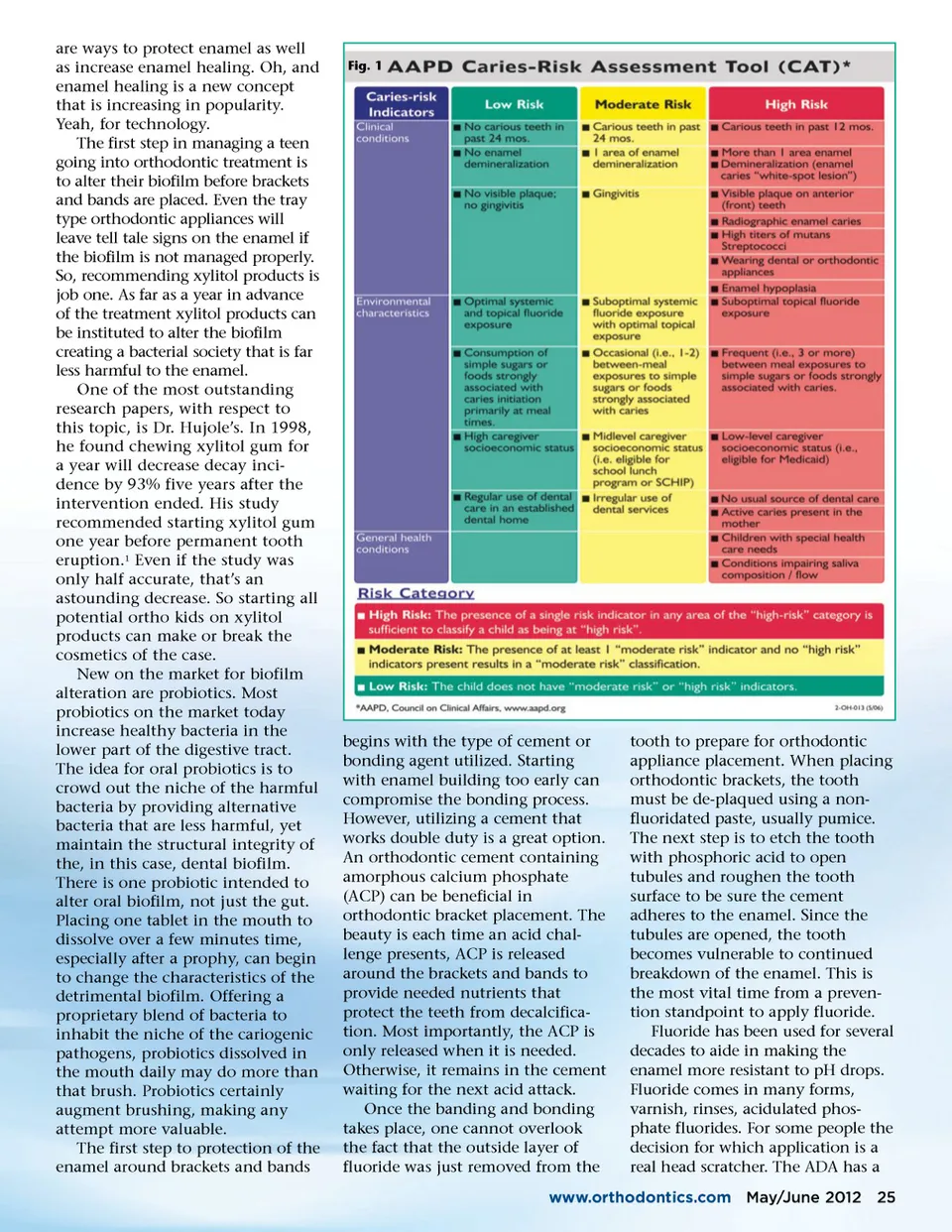
By Shirley Gutkowski, RDH, BSDH, FACE and Constance Schuster, RDH, BS here is always a challenge to keep the enamel surrounding orthodontic brackets and appliances healthy. The ability to achieve good homecare is really tested when a pre-teen with limits of self awareness and dexterity has brack-T ets and bands cemented to their teeth. Plaque and food traps on every tooth don’t seem to phase the patient at all. Without meticulous attention to the removal of these deposits, enamel decalcification is inevitable. The question created is how can healthcare providers assist these patients with prevention of multi-ple enamel lesions? According the American Academy of Pediatric Dentistry’s Caries Risk Assessment Tool (CAT) (Fig. 1), all patients wearing orthodontic appliances are automatically considered at high risk. Of course, teaching home care to pre-teens and teens is extremely important. However, compliance to brushing time, frequency, and tech-nique remains a persistent problem. What if, as a dental professional, adding one or two easy steps that take less than a few minutes to perform makes the difference for the non-compliant patient? By sharing some of the responsibility of healthy outcomes through the use of prod-ucts specific to improving the results, everyone can be a winner. Professional responsibility starts with understanding a few basics from the first semester of school. Brush and floss is great but enamel lesions occur from pH dips, and bacterial challenges involving pH. Fluoride has limitations in that it makes the enamel resistant to breakdown to a pH of 5.5, lower than that -all bets are off. And, we also have to remember that there are ways to manage a biofilm with-out resorting only to mechanical disruption. We also know that there 24 May/June 2012 JAOS
Journal of the American Orthodontic Society May-June 2012: Page 24