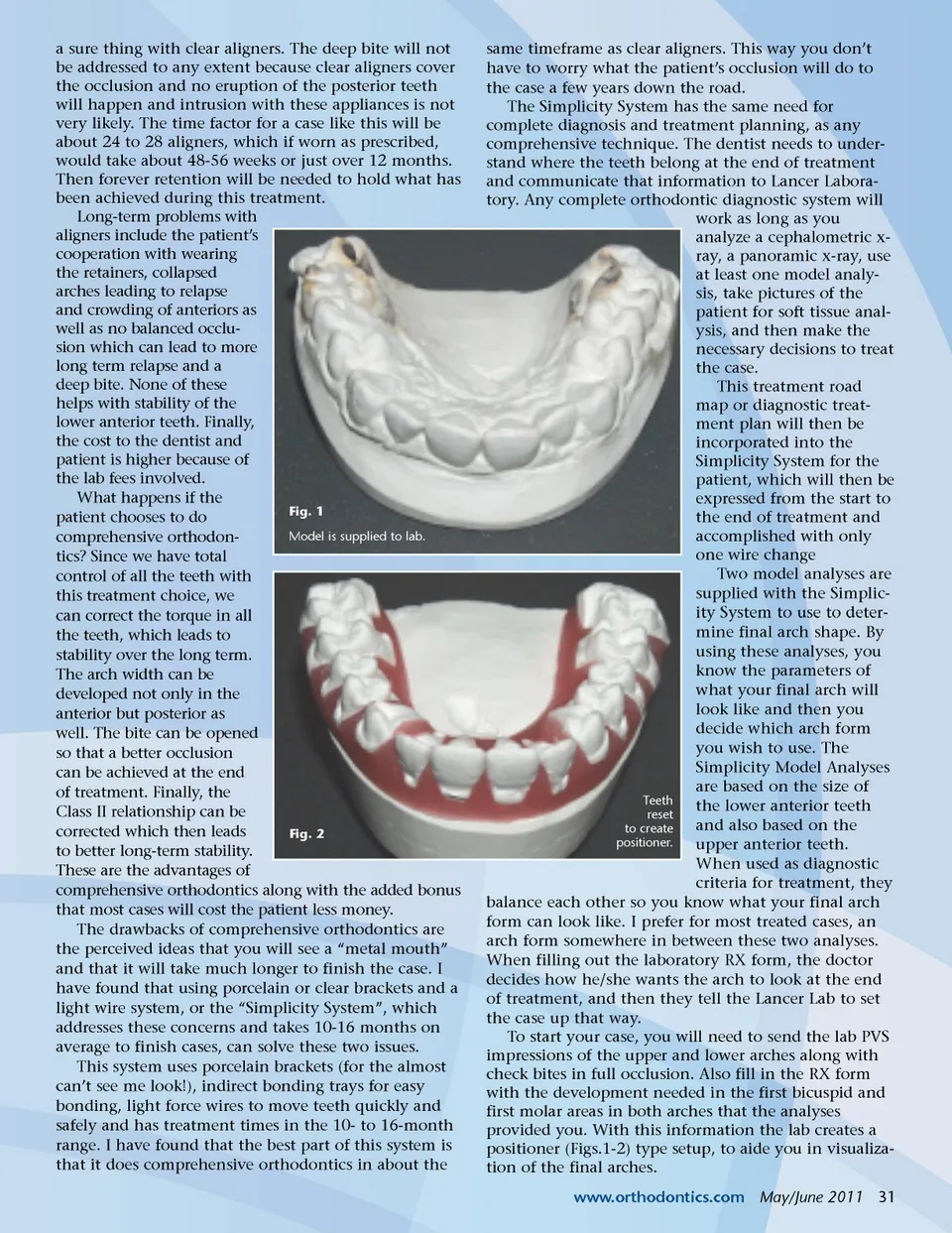
a sure thing with clear aligners. The deep bite will not be addressed to any extent because clear aligners cover the occlusion and no eruption of the posterior teeth will happen and intrusion with these appliances is not very likely. The time factor for a case like this will be about 24 to 28 aligners, which if worn as prescribed, would take about 48-56 weeks or just over 12 months. Then forever retention will be needed to hold what has been achieved during this treatment. Long-term problems with aligners include the patient’s cooperation with wearing the retainers, collapsed arches leading to relapse and crowding of anteriors as well as no balanced occlu-sion which can lead to more long term relapse and a deep bite. None of these helps with stability of the lower anterior teeth. Finally, the cost to the dentist and patient is higher because of the lab fees involved. What happens if the Fig. 1 patient chooses to do Model is supplied to lab. comprehensive orthodon-tics? Since we have total control of all the teeth with this treatment choice, we can correct the torque in all the teeth, which leads to stability over the long term. The arch width can be developed not only in the anterior but posterior as well. The bite can be opened so that a better occlusion can be achieved at the end of treatment. Finally, the Class II relationship can be corrected which then leads Fig. 2 to better long-term stability. These are the advantages of comprehensive orthodontics along with the added bonus that most cases will cost the patient less money. The drawbacks of comprehensive orthodontics are the perceived ideas that you will see a “metal mouth” and that it will take much longer to finish the case. I have found that using porcelain or clear brackets and a light wire system, or the “Simplicity System”, which addresses these concerns and takes 10-16 months on average to finish cases, can solve these two issues. This system uses porcelain brackets (for the almost can’t see me look!), indirect bonding trays for easy bonding, light force wires to move teeth quickly and safely and has treatment times in the 10-to 16-month range. I have found that the best part of this system is that it does comprehensive orthodontics in about the same timeframe as clear aligners. This way you don’t have to worry what the patient’s occlusion will do to the case a few years down the road. The Simplicity System has the same need for complete diagnosis and treatment planning, as any comprehensive technique. The dentist needs to under-stand where the teeth belong at the end of treatment and communicate that information to Lancer Labora-tory. Any complete orthodontic diagnostic system will work as long as you analyze a cephalometric x-ray, a panoramic x-ray, use at least one model analy-sis, take pictures of the patient for soft tissue anal-ysis, and then make the necessary decisions to treat the case. This treatment road map or diagnostic treat-ment plan will then be incorporated into the Simplicity System for the patient, which will then be expressed from the start to the end of treatment and accomplished with only one wire change Two model analyses are supplied with the Simplic-ity System to use to deter-mine final arch shape. By using these analyses, you know the parameters of what your final arch will look like and then you decide which arch form you wish to use. The Simplicity Model Analyses are based on the size of Teeth the lower anterior teeth reset and also based on the to create positioner. upper anterior teeth. When used as diagnostic criteria for treatment, they balance each other so you know what your final arch form can look like. I prefer for most treated cases, an arch form somewhere in between these two analyses. When filling out the laboratory RX form, the doctor decides how he/she wants the arch to look at the end of treatment, and then they tell the Lancer Lab to set the case up that way. To start your case, you will need to send the lab PVS impressions of the upper and lower arches along with check bites in full occlusion. Also fill in the RX form with the development needed in the first bicuspid and first molar areas in both arches that the analyses provided you. With this information the lab creates a positioner (Figs.1-2) type setup, to aide you in visualiza-tion of the final arches. www.orthodontics.com May/June 2011 31
Journal of the American Orthodontic Society May-June 2011: Page 31