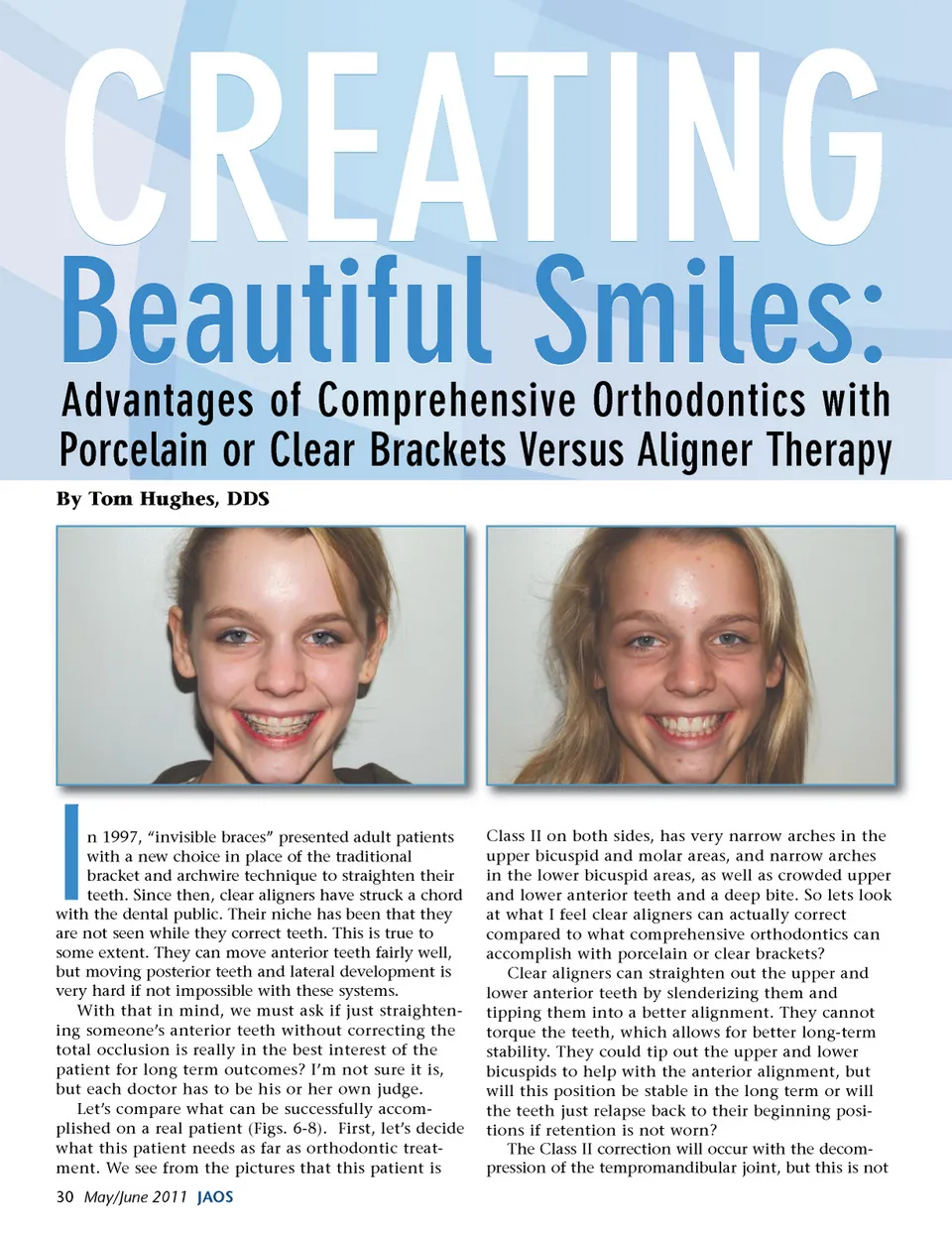
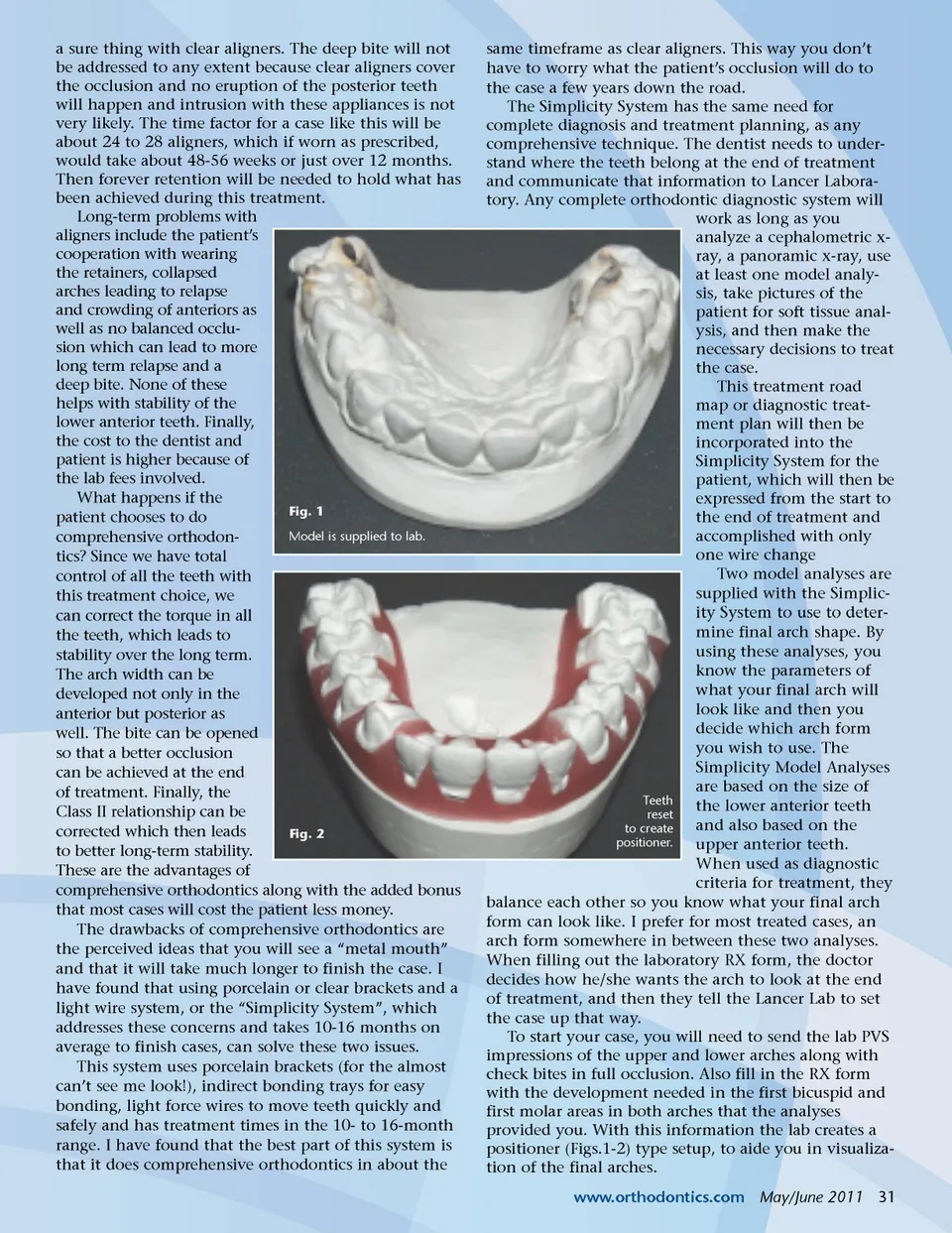
CREATING Beautiful Smiles: By Tom Hughes, DDS Advantages of Comprehensive Orthodontics with Porcelain or Clear Brackets Versus Aligner Therapy I n 1997, “invisible braces” presented adult patients with a new choice in place of the traditional bracket and archwire technique to straighten their teeth. Since then, clear aligners have struck a chord with the dental public. Their niche has been that they are not seen while they correct teeth. This is true to some extent. They can move anterior teeth fairly well, but moving posterior teeth and lateral development is very hard if not impossible with these systems. With that in mind, we must ask if just straighten-ing someone’s anterior teeth without correcting the total occlusion is really in the best interest of the patient for long term outcomes? I’m not sure it is, but each doctor has to be his or her own judge. Let’s compare what can be successfully accom-plished on a real patient (Figs. 6-8). First, let’s decide what this patient needs as far as orthodontic treat-ment. We see from the pictures that this patient is 30 May/June 2011 JAOS Class II on both sides, has very narrow arches in the upper bicuspid and molar areas, and narrow arches in the lower bicuspid areas, as well as crowded upper and lower anterior teeth and a deep bite. So lets look at what I feel clear aligners can actually correct compared to what comprehensive orthodontics can accomplish with porcelain or clear brackets? Clear aligners can straighten out the upper and lower anterior teeth by slenderizing them and tipping them into a better alignment. They cannot torque the teeth, which allows for better long-term stability. They could tip out the upper and lower bicuspids to help with the anterior alignment, but will this position be stable in the long term or will the teeth just relapse back to their beginning posi-tions if retention is not worn? The Class II correction will occur with the decom-pression of the tempromandibular joint, but this is not
Journal of the American Orthodontic Society May-June 2011: Page 30