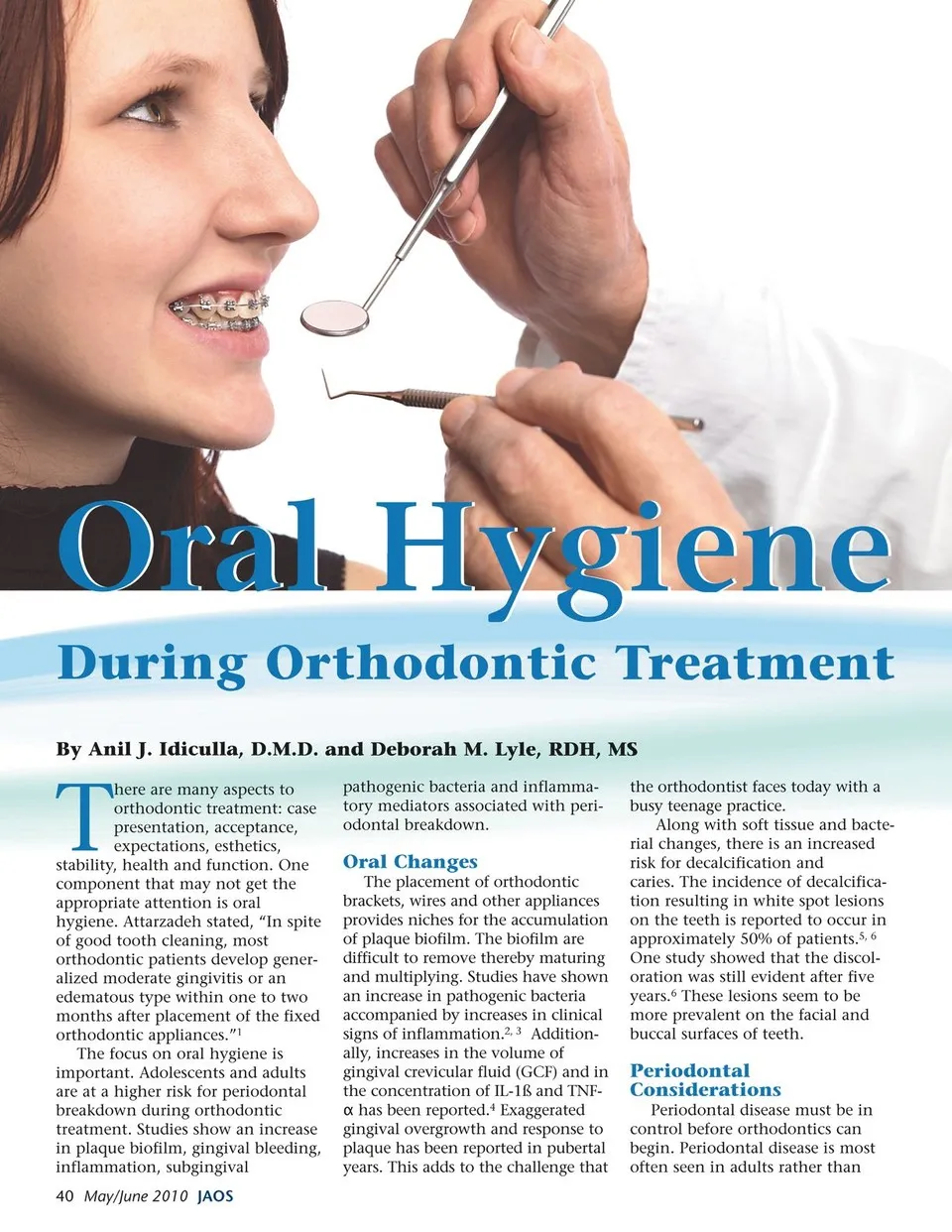
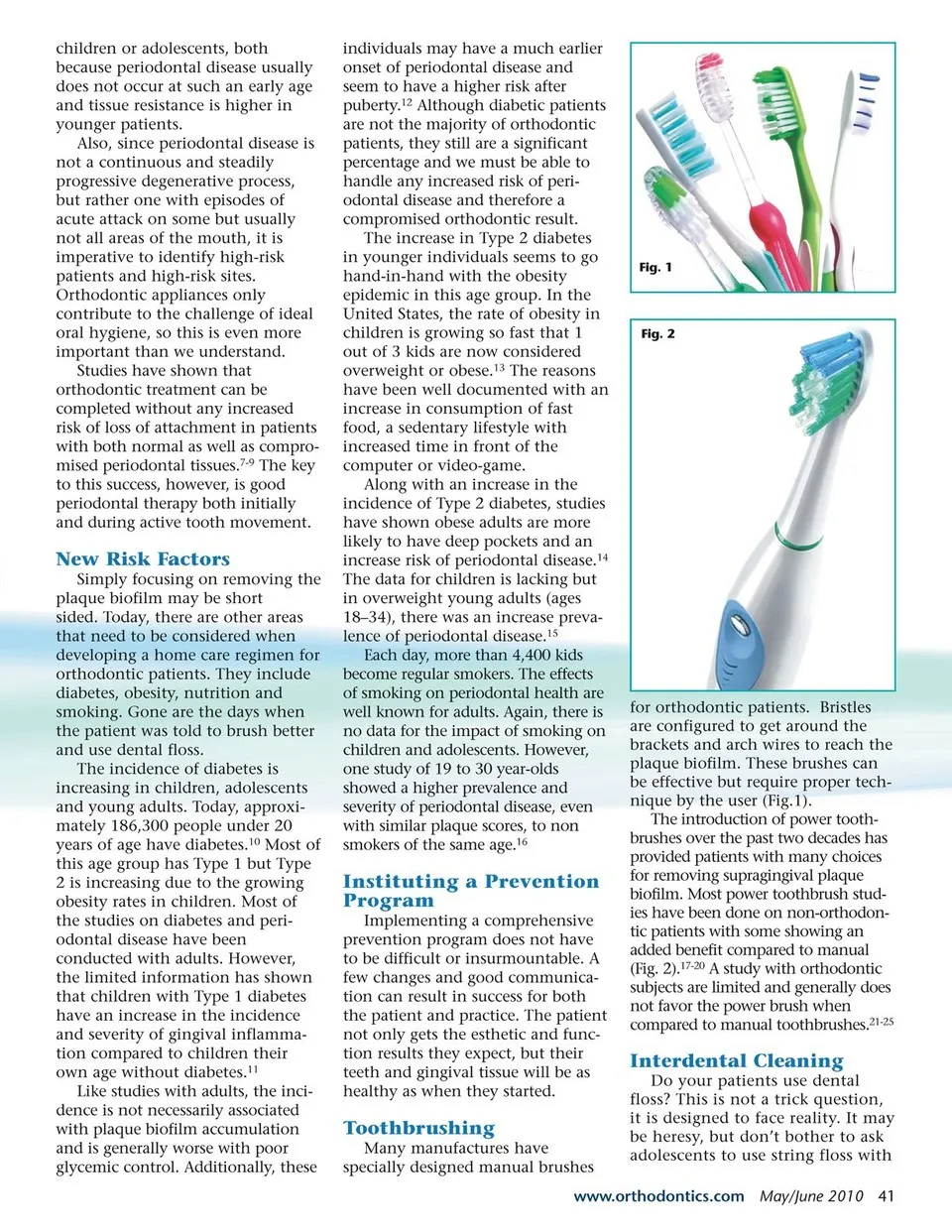
children or adolescents, both because periodontal disease usually does not occur at such an early age and tissue resistance is higher in younger patients. Also, since periodontal disease is not a continuous and steadily progressive degenerative process, but rather one with episodes of acute attack on some but usually not all areas of the mouth, it is imperative to identify high-risk patients and high-risk sites. Orthodontic appliances only contribute to the challenge of ideal oral hygiene, so this is even more important than we understand. Studies have shown that orthodontic treatment can be completed without any increased risk of loss of attachment in patients with both normal as well as compro- mised periodontal tissues.7-9 The key to this success, however, is good periodontal therapy both initially and during active tooth movement. New Risk Factors Simply focusing on removing the plaque biofilm may be short sided. Today, there are other areas that need to be considered when developing a home care regimen for orthodontic patients. They include diabetes, obesity, nutrition and smoking. Gone are the days when the patient was told to brush better and use dental floss. The incidence of diabetes is increasing in children, adolescents and young adults. Today, approxi- mately 186,300 people under 20 years of age have diabetes.10 Most of this age group has Type 1 but Type 2 is increasing due to the growing obesity rates in children. Most of the studies on diabetes and peri- odontal disease have been conducted with adults. However, the limited information has shown that children with Type 1 diabetes have an increase in the incidence and severity of gingival inflamma- tion compared to children their own age without diabetes.11 Like studies with adults, the inci- dence is not necessarily associated with plaque biofilm accumulation and is generally worse with poor glycemic control. Additionally, these individuals may have a much earlier onset of periodontal disease and seem to have a higher risk after puberty.12 Although diabetic patients are not the majority of orthodontic patients, they still are a significant percentage and we must be able to handle any increased risk of peri- odontal disease and therefore a compromised orthodontic result. The increase in Type 2 diabetes in younger individuals seems to go hand-in-hand with the obesity epidemic in this age group. In the United States, the rate of obesity in children is growing so fast that 1 out of 3 kids are now considered overweight or obese.13 The reasons have been well documented with an increase in consumption of fast food, a sedentary lifestyle with increased time in front of the computer or video-game. Along with an increase in the incidence of Type 2 diabetes, studies have shown obese adults are more likely to have deep pockets and an increase risk of periodontal disease.14 The data for children is lacking but in overweight young adults (ages 18–34), there was an increase preva- lence of periodontal disease.15 Each day, more than 4,400 kids become regular smokers. The effects of smoking on periodontal health are well known for adults. Again, there is no data for the impact of smoking on children and adolescents. However, one study of 19 to 30 year-olds showed a higher prevalence and severity of periodontal disease, even with similar plaque scores, to non smokers of the same age.16 Instituting a Prevention Program Implementing a comprehensive prevention program does not have to be difficult or insurmountable. A few changes and good communica- tion can result in success for both the patient and practice. The patient not only gets the esthetic and func- tion results they expect, but their teeth and gingival tissue will be as healthy as when they started. Toothbrushing Many manufactures have specially designed manual brushes Fig. 1 Fig. 2 for orthodontic patients. Bristles are configured to get around the brackets and arch wires to reach the plaque biofilm. These brushes can be effective but require proper tech- nique by the user (Fig.1). The introduction of power tooth- brushes over the past two decades has provided patients with many choices for removing supragingival plaque biofilm. Most power toothbrush stud- ies have been done on non-orthodon- tic patients with some showing an added benefit compared to manual (Fig. 2).17-20 A study with orthodontic subjects are limited and generally does not favor the power brush when compared to manual toothbrushes.21-25 Interdental Cleaning Do your patients use dental floss? This is not a trick question, it is designed to face reality. It may be heresy, but don’t bother to ask adolescents to use string floss with www.orthodontics.com May/June 2010 41
Journal of the American Orthodontic Society May-June 2010: Page 41