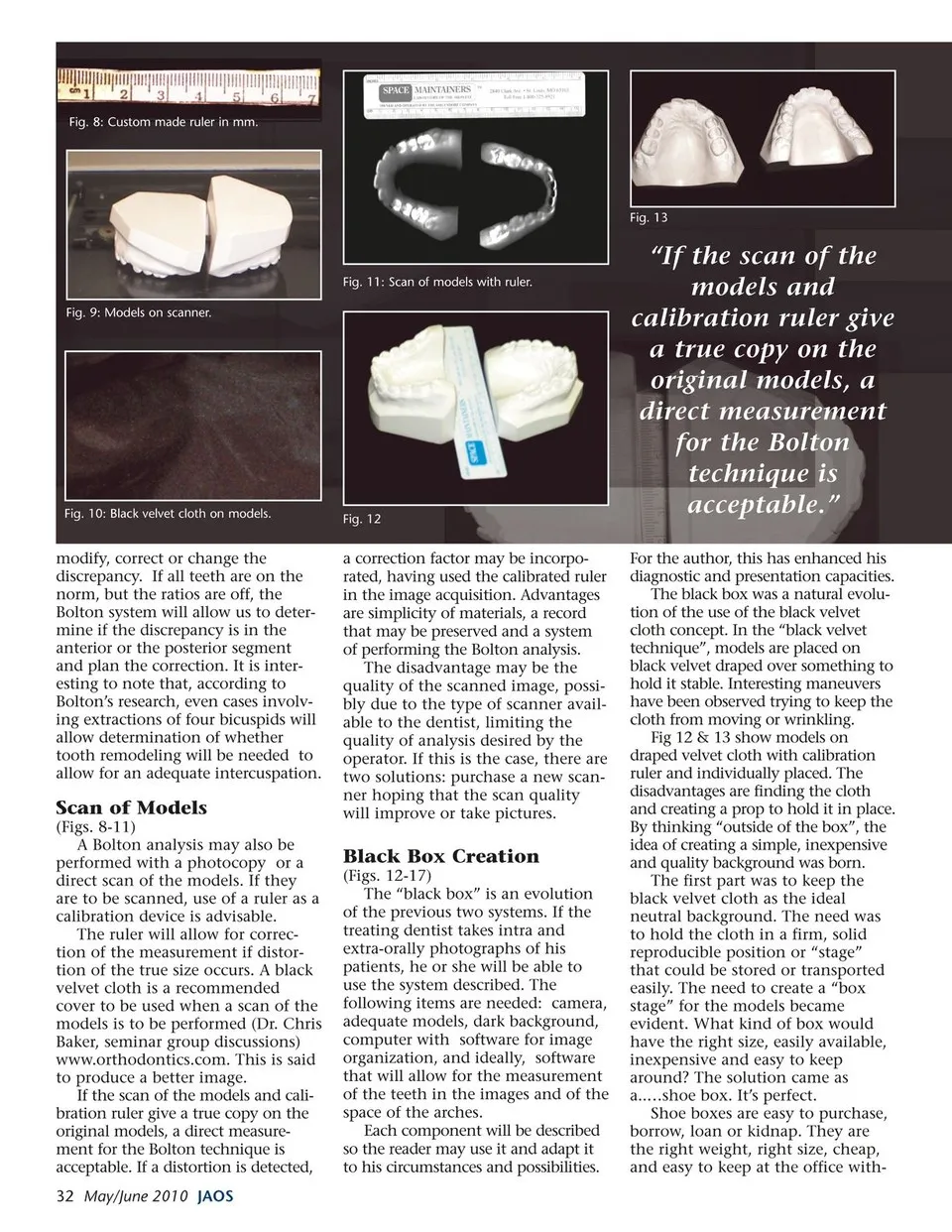
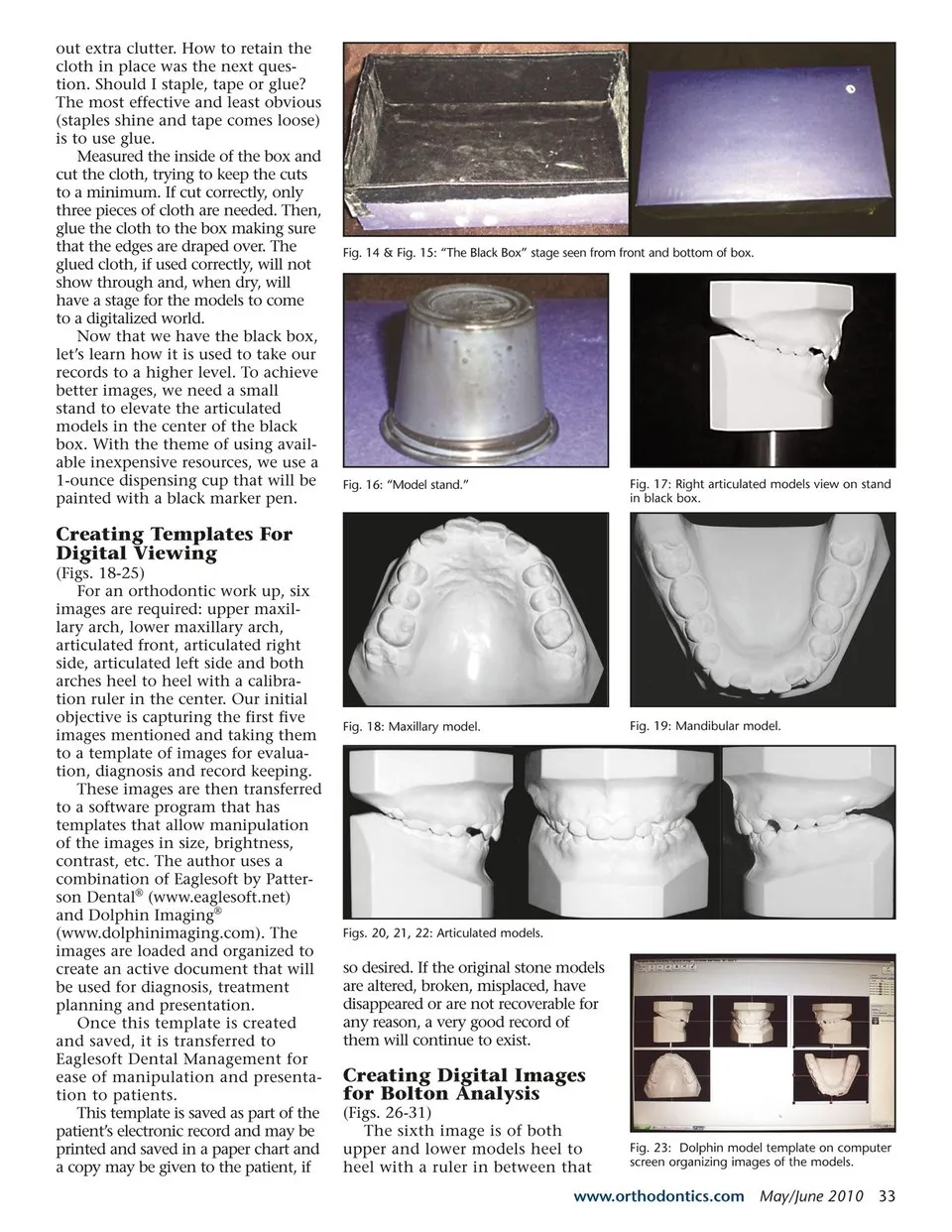
Fig. 8: Custom made ruler in mm. Fig. 13 Fig. 11: Scan of models with ruler. Fig. 9: Models on scanner. “If the scan of the models and calibration ruler give a true copy on the original models, a Fig. 10: Black velvet cloth on models. modify, correct or change the discrepancy. If all teeth are on the norm, but the ratios are off, the Bolton system will allow us to deter- mine if the discrepancy is in the anterior or the posterior segment and plan the correction. It is inter- esting to note that, according to Bolton’s research, even cases involv- ing extractions of four bicuspids will allow determination of whether tooth remodeling will be needed to allow for an adequate intercuspation. Scan of Models (Figs. 8-11) A Bolton analysis may also be performed with a photocopy or a direct scan of the models. If they are to be scanned, use of a ruler as a calibration device is advisable. The ruler will allow for correc- tion of the measurement if distor- tion of the true size occurs. A black velvet cloth is a recommended cover to be used when a scan of the models is to be performed (Dr. Chris Baker, seminar group discussions) www.orthodontics.com. This is said to produce a better image. If the scan of the models and cali- bration ruler give a true copy on the original models, a direct measure- ment for the Bolton technique is acceptable. If a distortion is detected, 32 May/June 2010 JAOS Fig. 12 a correction factor may be incorpo- rated, having used the calibrated ruler in the image acquisition. Advantages are simplicity of materials, a record that may be preserved and a system of performing the Bolton analysis. The disadvantage may be the quality of the scanned image, possi- bly due to the type of scanner avail- able to the dentist, limiting the quality of analysis desired by the operator. If this is the case, there are two solutions: purchase a new scan- ner hoping that the scan quality will improve or take pictures. Black Box Creation (Figs. 12-17) The “black box” is an evolution of the previous two systems. If the treating dentist takes intra and extra-orally photographs of his patients, he or she will be able to use the system described. The following items are needed: camera, adequate models, dark background, computer with software for image organization, and ideally, software that will allow for the measurement of the teeth in the images and of the space of the arches. Each component will be described so the reader may use it and adapt it to his circumstances and possibilities. direct measurement for the Bolton technique is acceptable.” For the author, this has enhanced his diagnostic and presentation capacities. The black box was a natural evolu- tion of the use of the black velvet cloth concept. In the “black velvet technique”, models are placed on black velvet draped over something to hold it stable. Interesting maneuvers have been observed trying to keep the cloth from moving or wrinkling. Fig 12 & 13 show models on draped velvet cloth with calibration ruler and individually placed. The disadvantages are finding the cloth and creating a prop to hold it in place. By thinking “outside of the box”, the idea of creating a simple, inexpensive and quality background was born. The first part was to keep the black velvet cloth as the ideal neutral background. The need was to hold the cloth in a firm, solid reproducible position or “stage” that could be stored or transported easily. The need to create a “box stage” for the models became evident. What kind of box would have the right size, easily available, inexpensive and easy to keep around? The solution came as a..…shoe box. It’s perfect. Shoe boxes are easy to purchase, borrow, loan or kidnap. They are the right weight, right size, cheap, and easy to keep at the office with-
Journal of the American Orthodontic Society May-June 2010: Page 32