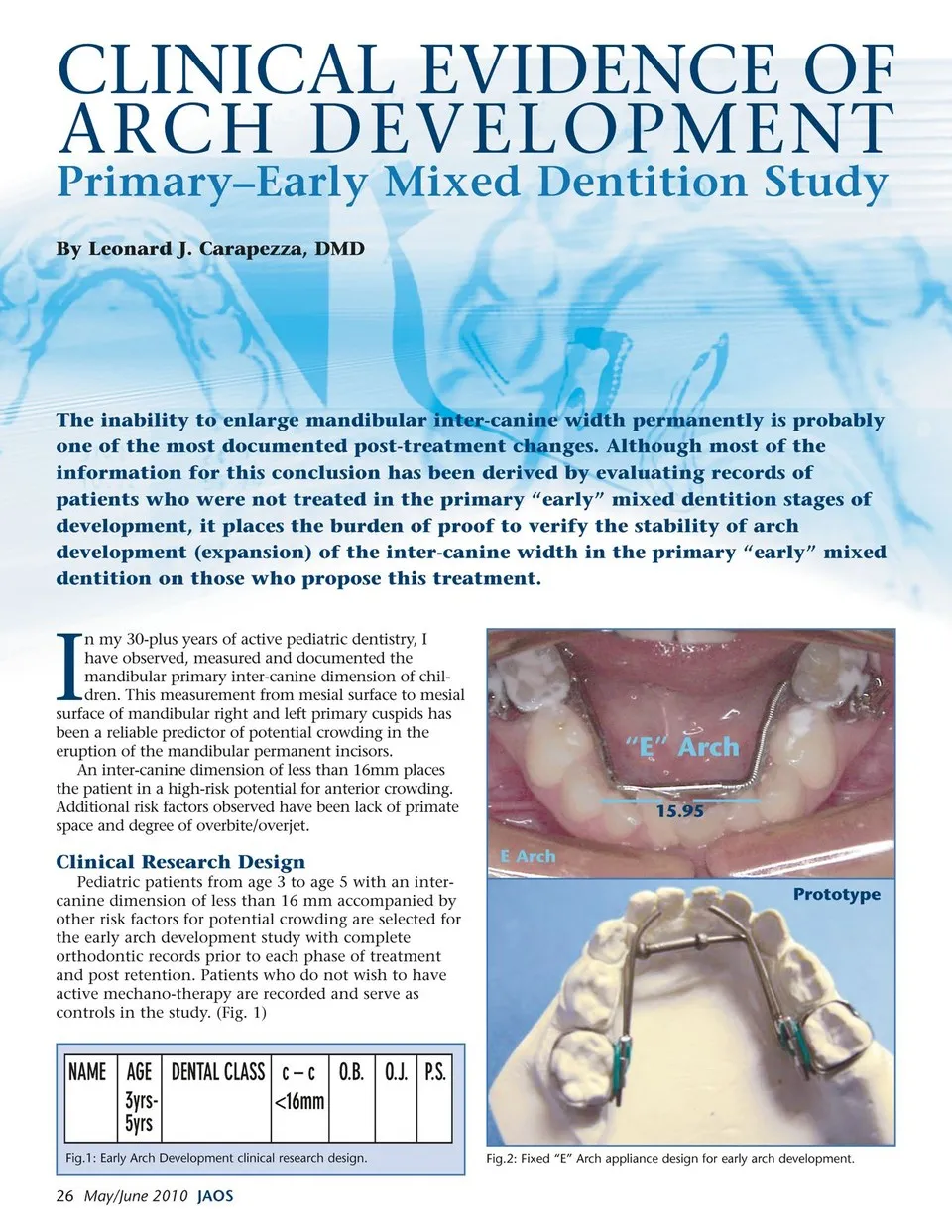
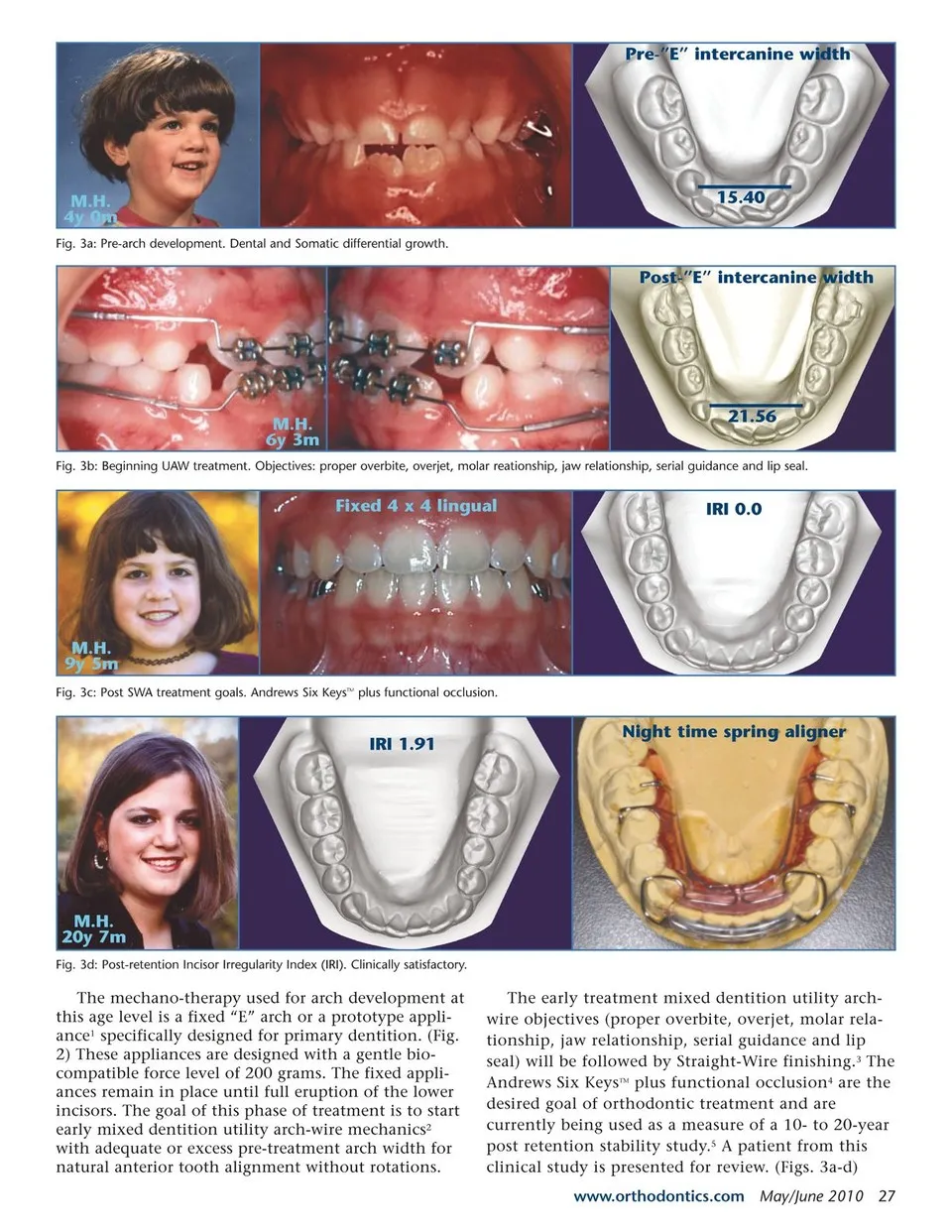
Pre-”E” intercanine width M.H. 4y 0m Fig. 3a: Pre-arch development. Dental and Somatic differential growth. Post-”E” intercanine width 15.40 M.H. 6y 3m Fixed 4 x 4 lingual 21.56 Fig. 3b: Beginning UAW treatment. Objectives: proper overbite, overjet, molar reationship, jaw relationship, serial guidance and lip seal. IRI 0.0 M.H. 9y 5m Fig. 3c: Post SWA treatment goals. Andrews Six KeysTM plus functional occlusion. IRI 1.91 Night time spring aligner 20y 7m M.H. Fig. 3d: Post-retention Incisor Irregularity Index (IRI). Clinically satisfactory. specifically designed for primary dentition. (Fig. 2) These appliances are designed with a gentle bio- compatible force level of 200 grams. The fixed appli- ances remain in place until full eruption of the lower incisors. The goal of this phase of treatment is to start early mixed dentition utility arch-wire mechanics2 with adequate or excess pre-treatment arch width for natural anterior tooth alignment without rotations. The mechano-therapy used for arch development at this age level is a fixed “E” arch or a prototype appli- ance1 The early treatment mixed dentition utility arch- wire objectives (proper overbite, overjet, molar rela- tionship, jaw relationship, serial guidance and lip seal) will be followed by Straight-Wire finishing.3 Andrews Six Keys TM plus functional occlusion4 A patient from this The are the desired goal of orthodontic treatment and are currently being used as a measure of a 10- to 20-year post retention stability study.5 clinical study is presented for review. (Figs. 3a-d) www.orthodontics.com May/June 2010 27
Journal of the American Orthodontic Society May-June 2010: Page 27