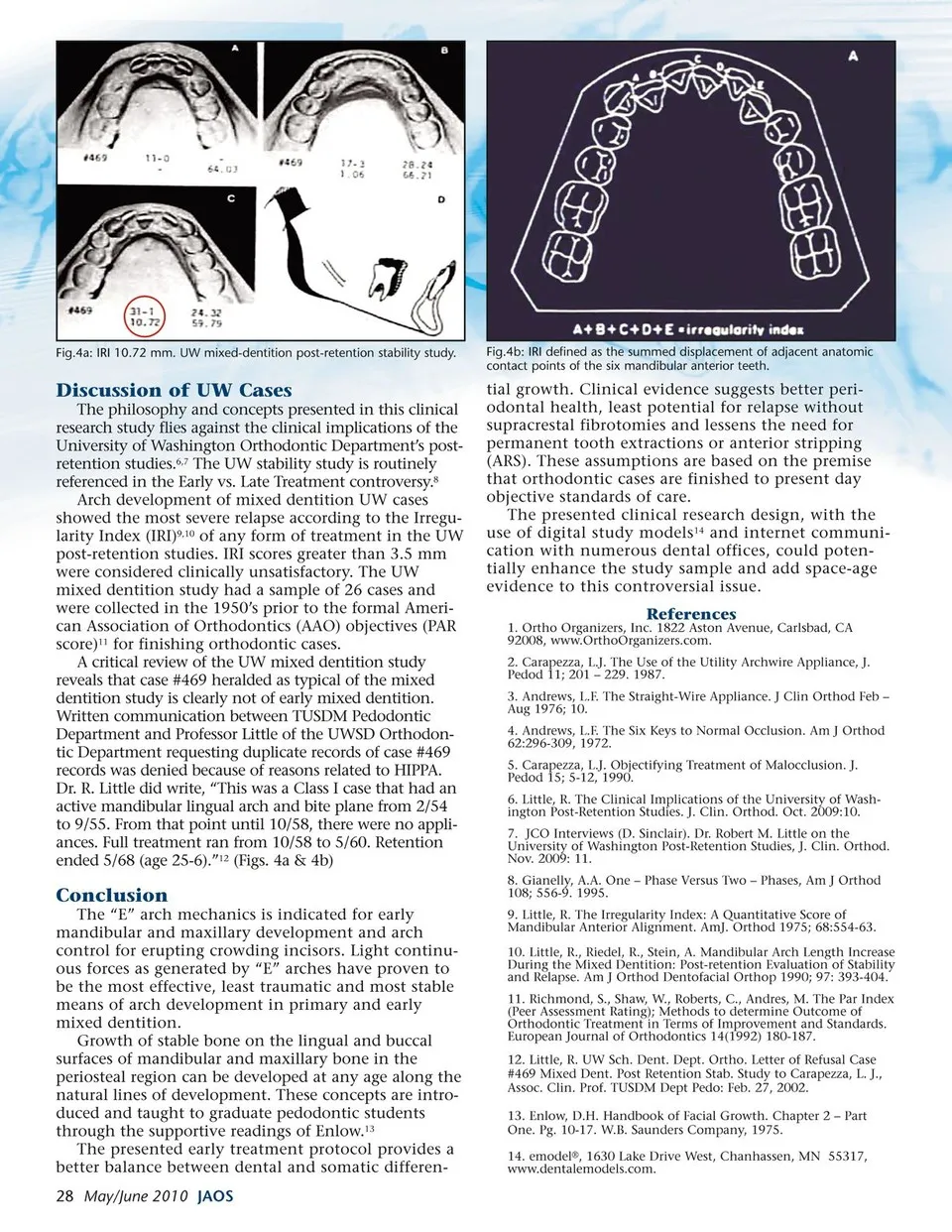
Fig.4a: IRI 10.72 mm. UW mixed-dentition post-retention stability study. Discussion of UW Cases The philosophy and concepts presented in this clinical research study flies against the clinical implications of the University of Washington Orthodontic Department’s post- retention studies.6,7 The UW stability study is routinely referenced in the Early vs. Late Treatment controversy.8 Arch development of mixed dentition UW cases showed the most severe relapse according to the Irregu- larity Index (IRI)9,10 post-retention studies. IRI scores greater than 3.5 mm were considered clinically unsatisfactory. The UW mixed dentition study had a sample of 26 cases and were collected in the 1950’s prior to the formal Ameri- can Association of Orthodontics (AAO) objectives (PAR score)11 for finishing orthodontic cases. A critical review of the UW mixed dentition study reveals that case #469 heralded as typical of the mixed dentition study is clearly not of early mixed dentition. Written communication between TUSDM Pedodontic Department and Professor Little of the UWSD Orthodon- tic Department requesting duplicate records of case #469 records was denied because of reasons related to HIPPA. Dr. R. Little did write, “This was a Class I case that had an active mandibular lingual arch and bite plane from 2/54 to 9/55. From that point until 10/58, there were no appli- ances. Full treatment ran from 10/58 to 5/60. Retention ended 5/68 (age 25-6).”12 (Figs. 4a & 4b) Conclusion The “E” arch mechanics is indicated for early mandibular and maxillary development and arch control for erupting crowding incisors. Light continu- ous forces as generated by “E” arches have proven to be the most effective, least traumatic and most stable means of arch development in primary and early mixed dentition. Growth of stable bone on the lingual and buccal surfaces of mandibular and maxillary bone in the periosteal region can be developed at any age along the natural lines of development. These concepts are intro- duced and taught to graduate pedodontic students through the supportive readings of Enlow.13 The presented early treatment protocol provides a better balance between dental and somatic differen- 28 May/June 2010 JAOS of any form of treatment in the UW Fig.4b: IRI defined as the summed displacement of adjacent anatomic contact points of the six mandibular anterior teeth. tial growth. Clinical evidence suggests better peri- odontal health, least potential for relapse without supracrestal fibrotomies and lessens the need for permanent tooth extractions or anterior stripping (ARS). These assumptions are based on the premise that orthodontic cases are finished to present day objective standards of care. The presented clinical research design, with the use of digital study models14 and internet communi- cation with numerous dental offices, could poten- tially enhance the study sample and add space-age evidence to this controversial issue. 1. Ortho Organizers, Inc. 1822 Aston Avenue, Carlsbad, CA 92008, www.OrthoOrganizers.com. References 2. Carapezza, L.J. The Use of the Utility Archwire Appliance, J. Pedod 11; 201 – 229. 1987. 3. Andrews, L.F. The Straight-Wire Appliance. J Clin Orthod Feb – Aug 1976; 10. 4. Andrews, L.F. The Six Keys to Normal Occlusion. Am J Orthod 62:296-309, 1972. 5. Carapezza, L.J. Objectifying Treatment of Malocclusion. J. Pedod 15; 5-12, 1990. 6. Little, R. The Clinical Implications of the University of Wash- ington Post-Retention Studies. J. Clin. Orthod. Oct. 2009:10. 7. JCO Interviews (D. Sinclair). Dr. Robert M. Little on the University of Washington Post-Retention Studies, J. Clin. Orthod. Nov. 2009: 11. 8. Gianelly, A.A. One – Phase Versus Two – Phases, Am J Orthod 108; 556-9. 1995. 9. Little, R. The Irregularity Index: A Quantitative Score of Mandibular Anterior Alignment. AmJ. Orthod 1975; 68:554-63. 10. Little, R., Riedel, R., Stein, A. Mandibular Arch Length Increase During the Mixed Dentition: Post-retention Evaluation of Stability and Relapse. Am J Orthod Dentofacial Orthop 1990; 97: 393-404. 11. Richmond, S., Shaw,W., Roberts, C., Andres, M. The Par Index (Peer Assessment Rating); Methods to determine Outcome of Orthodontic Treatment in Terms of Improvement and Standards. European Journal of Orthodontics 14(1992) 180-187. 12. Little, R. UW Sch. Dent. Dept. Ortho. Letter of Refusal Case #469 Mixed Dent. Post Retention Stab. Study to Carapezza, L. J., Assoc. Clin. Prof. TUSDM Dept Pedo: Feb. 27, 2002. 13. Enlow, D.H. Handbook of Facial Growth. Chapter 2 – Part One. Pg. 10-17. W.B. Saunders Company, 1975. 14. emodel®, 1630 Lake Drive West, Chanhassen, MN 55317, www.dentalemodels.com.
Journal of the American Orthodontic Society May-June 2010: Page 28