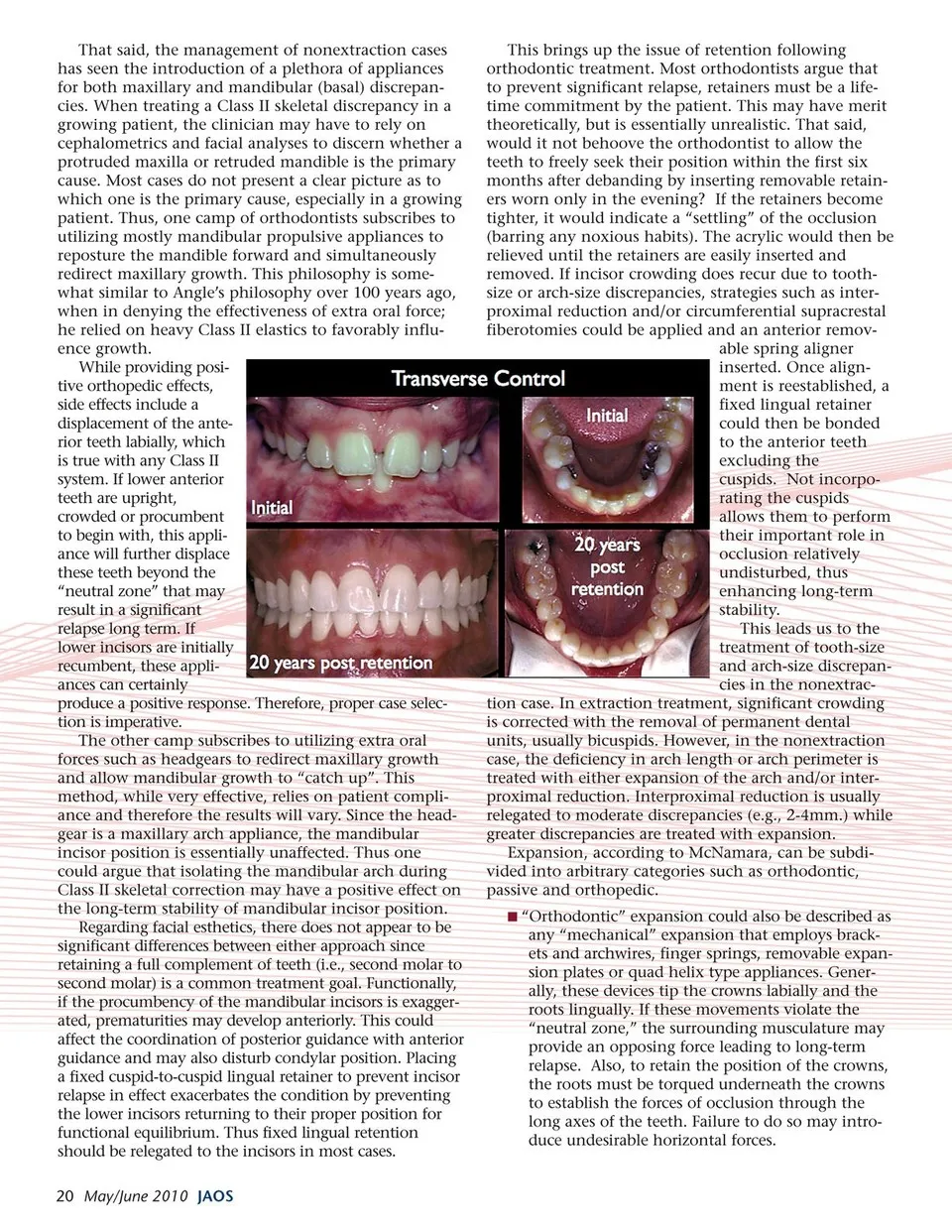
“Passive” expansion refers to the blocking of the labial and buccal musculature from the arches. By temporarily removing their influence on the teeth, a widening of the dental arches will frequently occur. This expansion is not produced via biomechanical forces, but rather intrinsic forces such as the tongue. Examples include the lip bumper and the Fränkel appliance. “Orthopedic” expansion refers to changes that primarily occur in the underlying skeletal struc- tures rather than the movements of teeth within the alveolus. Orthopedic expansion not only separates the midpalatal suture, but it also affects the circumzygomatic and circummaxillary sutural systems. New bone is deposited at the expansion site within three to six months to reestablish the integrity of the suture. Orthopedic expansion, simi- lar to orthodontic expansion, does not directly influence the opposing forces of the surrounding soft tissue enve- lope. Thus the general consen- sus of the orthodontic commu- nity, realizing the possibility of significant relapse, is to “over- expand” the maxilla to almost a complete buccal cross bite. Although limited orthodontic and passive expan- sion is possible at any age, its efficacy decreases with the age of the patient. to 15 years of age in females and 15 to 16 years for males. Since the transverse dimension is the first dimension to mature, its treatment should be addressed sooner than later. After the completion of transverse growth, orthopedic expansion is essentially composed of alveolar remodeling or dental tipping with little or no basal skeletal movement. Also, RME may cause severe pain and/or a compromised periodontium of the maxillary posterior teeth. “The greatest efficacy of maxillary expansion at both the skeletal and alveolar levels is usually during the mixed and adolescent dentitions,...” The greatest efficacy of maxillary expansion at both the skeletal and alveolar levels is usually during the mixed and adolescent dentitions, prior to the pubertal peak of growth and development. Maxillary adapta- tions to expansion in patients treated after the pubertal growth peak exhibited a shift from the skeletal level to the alveolar level. Patients treated with rapid maxillary expansion, using a Haas-type fixed expander turned ¼ turn per day, followed by fixed appliance therapy, achieved a high degree of stability eight years following the completion of expansion. Rapid maxillary expan- sion appears to resolve transverse deficiencies and normalize the dental and skeletal components of the craniofacial complex. Also, rapid maxillary expansion does not appear to be contraindicated in patients with predominantly vertical growth patterns and/or convex facial profiles. Any exacerbation of these discrepancies at the conclusion of RME appears to be temporary in nature, since long-term data does not support signifi- cant undesirable changes. In skeletally mature patients, the possibility of successful rapid maxillary expansion progressively decreases as sutures close and the resistance to mechan- ical forces increases. Transverse maxillary growth signif- icantly slows and the maxillary sutures close about 14 Surgically assisted RME has been suggested to produce better treatment results in adults by prevent- ing complications due to its release of sutural resistance to expansion forces. From the most recent studies, surgically assisted rapid maxillary expansion does appear to be a simpler and more effective approach for the resolution of transverse maxillary discrepancies in the mature maxilla. However, when comparing the clinical results of orthopedic maxillary expansion to surgi- cally assisted maxillary expan- sion, there appeared to be no significant difference. When comparing rapid maxillary expansion to “slow” maxillary expansion long- term, there were no clinically significant differences in anteroposterior and vertical maxillary changes or mandibu- lar behavior. One adolescent dentition study initially used RME (1/4 turn twice a day), until the suture was deter- mined to be opened from occlusal films (5-7 days). The screw was then turned three times a week until a 2mm. overexpansion was achieved (about four months). After evaluating the patient sample about two years after retention, the dental and skeletal changes in the transverse dimension exhibited a high degree of stability. Their hypothesis was that slower expansion produced less tissue resistance and stimu- lated the adaptation process in the circummaxillary structures. These events would minimize any relapse tendency long-term. Maxillary expansive forces appear not to be restricted to intermaxillary sutures, but are also distributed to the sphenoid and zygomatic bones and other related structures in the craniofacial complex. Histologic studies on animals have also demonstrated signs of increased cellular activity at vari- ous cranial sutures. The available data on suture mechanics appears to have a common theme that mechanical forces regulate sutural growth by inducing sutural mechanical strain. Various orthopedic devices, including but not limited to headgear, facemask, and functional appliances may induce sutural strain, result- ing in a modification of natural sutural growth. Utilizing the effects of expansion on modifying natu- ral, sutural growth, several investigators have applied www.orthodontics.com May/June 2010 21
Journal of the American Orthodontic Society May-June 2010: Page 21