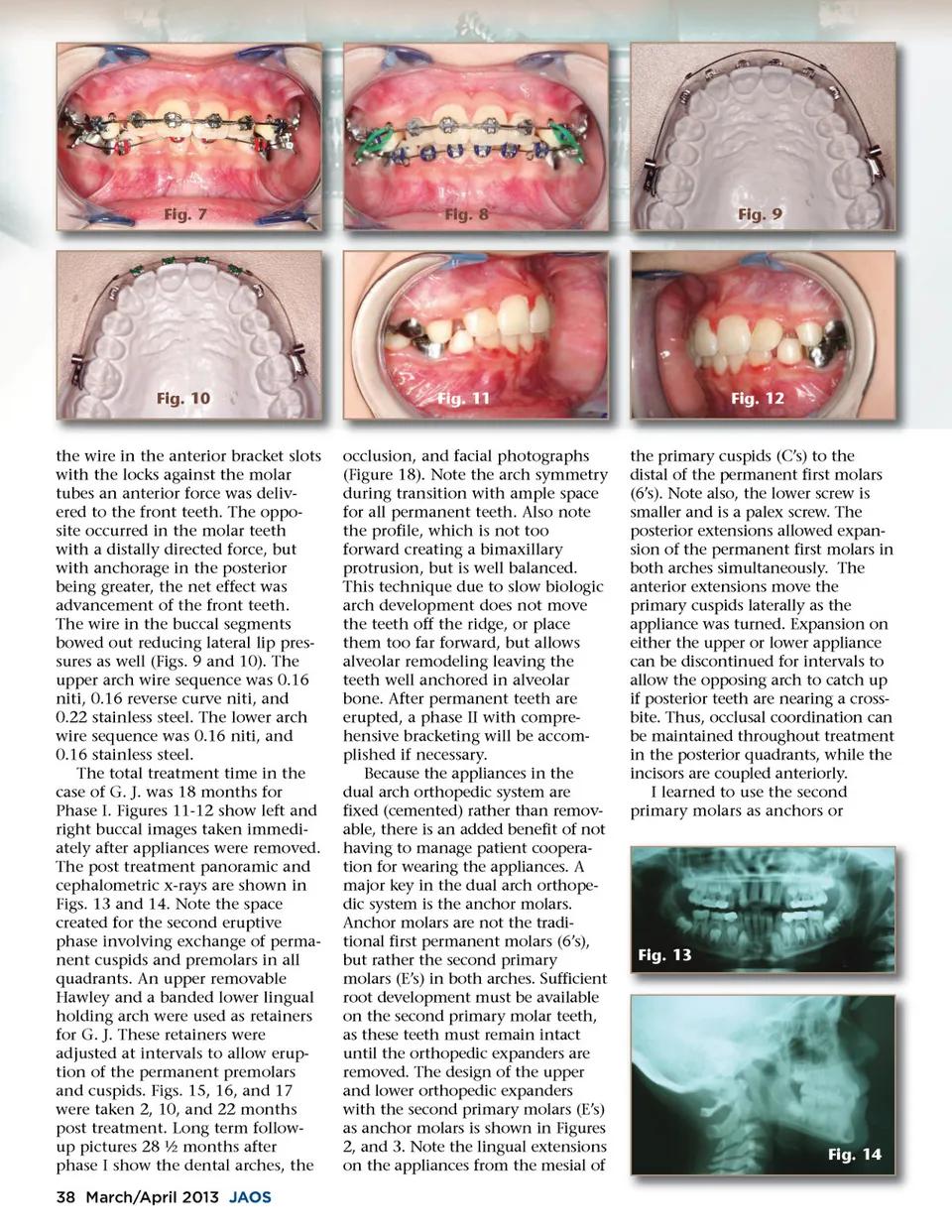
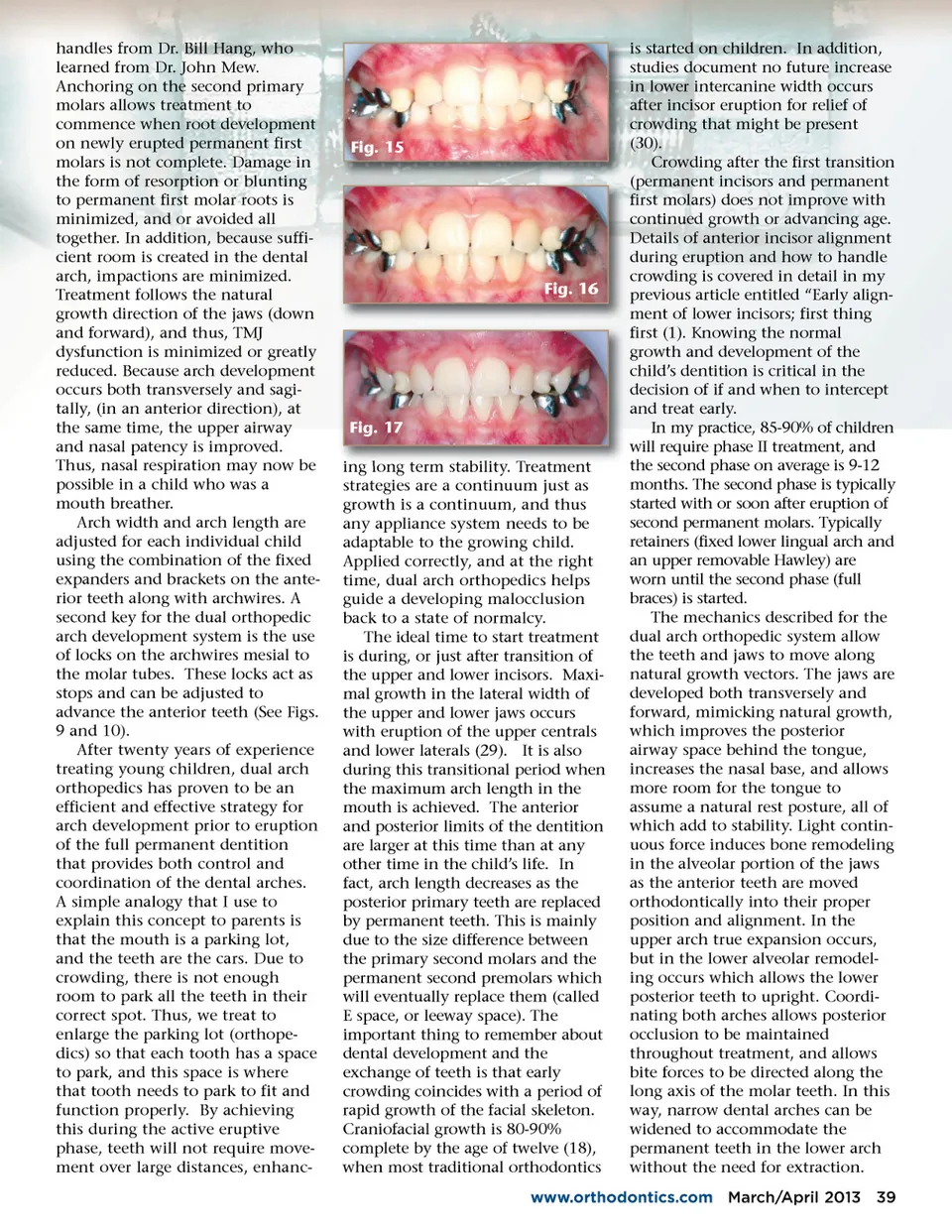
handles from Dr. Bill Hang, who learned from Dr. John Mew. Anchoring on the second primary molars allows treatment to commence when root development on newly erupted permanent first molars is not complete. Damage in the form of resorption or blunting to permanent first molar roots is minimized, and or avoided all together. In addition, because suffi-cient room is created in the dental arch, impactions are minimized. Treatment follows the natural growth direction of the jaws (down and forward), and thus, TMJ dysfunction is minimized or greatly reduced. Because arch development occurs both transversely and sagi-tally, (in an anterior direction), at the same time, the upper airway and nasal patency is improved. Thus, nasal respiration may now be possible in a child who was a mouth breather. Arch width and arch length are adjusted for each individual child using the combination of the fixed expanders and brackets on the ante-rior teeth along with archwires. A second key for the dual orthopedic arch development system is the use of locks on the archwires mesial to the molar tubes. These locks act as stops and can be adjusted to advance the anterior teeth (See Figs. 9 and 10). After twenty years of experience treating young children, dual arch orthopedics has proven to be an efficient and effective strategy for arch development prior to eruption of the full permanent dentition that provides both control and coordination of the dental arches. A simple analogy that I use to explain this concept to parents is that the mouth is a parking lot, and the teeth are the cars. Due to crowding, there is not enough room to park all the teeth in their correct spot. Thus, we treat to enlarge the parking lot (orthope-dics) so that each tooth has a space to park, and this space is where that tooth needs to park to fit and function properly. By achieving this during the active eruptive phase, teeth will not require move-ment over large distances, enhanc-Fig. 15 Fig. 16 Fig. 17 stability. Tr Treatment ing long term stability T eatment strategies are a continuum just as growth is a continuum, and thus any appliance system needs to be adaptable to the growing child. Applied correctly, and at the right time, dual arch orthopedics helps guide a developing malocclusion back to a state of normalcy. The ideal time to start treatment is during, or just after transition of the upper and lower incisors. Maxi-mal growth in the lateral width of the upper and lower jaws occurs with eruption of the upper centrals and lower laterals (29). It is also during this transitional period when the maximum arch length in the mouth is achieved. The anterior and posterior limits of the dentition are larger at this time than at any other time in the child’s life. In fact, arch length decreases as the posterior primary teeth are replaced by permanent teeth. This is mainly due to the size difference between the primary second molars and the permanent second premolars which will eventually replace them (called E space, or leeway space). The important thing to remember about dental development and the exchange of teeth is that early crowding coincides with a period of rapid growth of the facial skeleton. Craniofacial growth is 80-90% complete by the age of twelve (18), when most traditional orthodontics is started on children. In addition, studies document no future increase in lower intercanine width occurs after incisor eruption for relief of crowding that might be present (30). Crowding after the first transition (permanent incisors and permanent first molars) does not improve with continued growth or advancing age. Details of anterior incisor alignment during eruption and how to handle crowding is covered in detail in my previous article entitled “Early align-ment of lower incisors; first thing first (1). Knowing the normal growth and development of the child’s dentition is critical in the decision of if and when to intercept and treat early. In my practice, 85-90% of children will require phase II treatment, and the second phase on average is 9-12 months. The second phase is typically started with or soon after eruption of second permanent molars. Typically retainers (fixed lower lingual arch and an upper removable Hawley) are worn until the second phase (full braces) is started. The mechanics described for the dual arch orthopedic system allow the teeth and jaws to move along natural growth vectors. The jaws are developed both transversely and forward, mimicking natural growth, which improves the posterior airway space behind the tongue, increases the nasal base, and allows more room for the tongue to assume a natural rest posture, all of which add to stability. Light contin-uous force induces bone remodeling in the alveolar portion of the jaws as the anterior teeth are moved orthodontically into their proper position and alignment. In the upper arch true expansion occurs, but in the lower alveolar remodel-ing occurs which allows the lower posterior teeth to upright. Coordi-nating both arches allows posterior occlusion to be maintained throughout treatment, and allows bite forces to be directed along the long axis of the molar teeth. In this way, narrow dental arches can be widened to accommodate the permanent teeth in the lower arch without the need for extraction. www.orthodontics.com March/April 2013 39
Journal of the American Orthodontic Society March-April 2013: Page 39