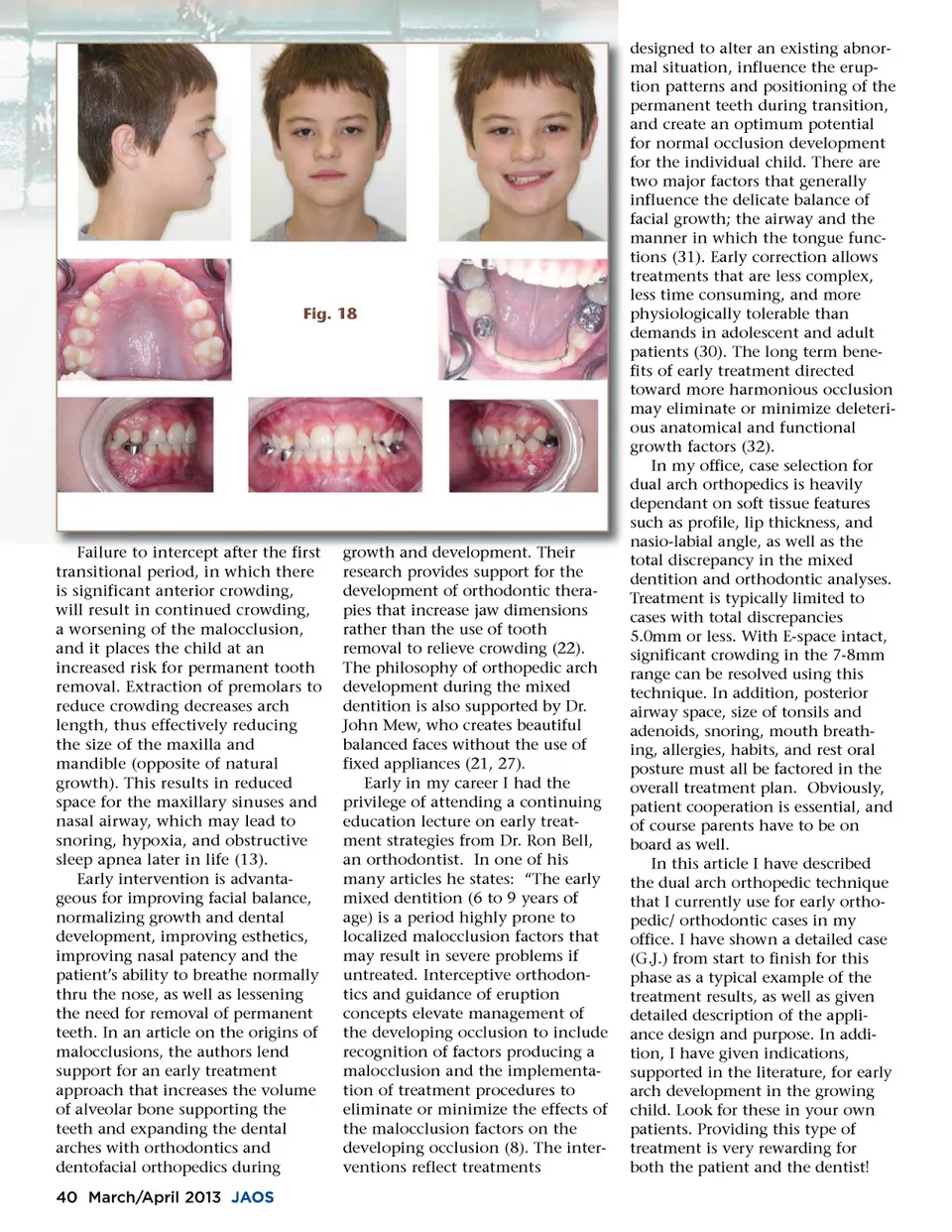
Fig. 18 Failure to intercept after the first transitional period, in which there is significant anterior crowding, will result in continued crowding, a worsening of the malocclusion, and it places the child at an increased risk for permanent tooth removal. Extraction of premolars to reduce crowding decreases arch length, thus effectively reducing the size of the maxilla and mandible (opposite of natural growth). This results in reduced space for the maxillary sinuses and nasal airway, which may lead to snoring, hypoxia, and obstructive sleep apnea later in life (13). Early intervention is advanta-geous for improving facial balance, normalizing growth and dental development, improving esthetics, improving nasal patency and the patient’s ability to breathe normally thru the nose, as well as lessening the need for removal of permanent teeth. In an article on the origins of malocclusions, the authors lend support for an early treatment approach that increases the volume of alveolar bone supporting the teeth and expanding the dental arches with orthodontics and dentofacial orthopedics during 40 March/April 2013 JAOS growth and development development. Their research provides support for the development of orthodontic thera-pies that increase jaw dimensions rather than the use of tooth removal to relieve crowding (22). The philosophy of orthopedic arch development during the mixed dentition is also supported by Dr. John Mew, who creates beautiful balanced faces without the use of fixed appliances (21, 27). Early in my career I had the privilege of attending a continuing education lecture on early treat-ment strategies from Dr. Ron Bell, an orthodontist. In one of his many articles he states: “The early mixed dentition (6 to 9 years of age) is a period highly prone to localized malocclusion factors that may result in severe problems if untreated. Interceptive orthodon-tics and guidance of eruption concepts elevate management of the developing occlusion to include recognition of factors producing a malocclusion and the implementa-tion of treatment procedures to eliminate or minimize the effects of the malocclusion factors on the developing occlusion (8). The inter-ventions reflect treatments designed to alter an existing abnor-mal situation, influence the erup-tion patterns and positioning of the permanent teeth during transition, and create an optimum potential for normal occlusion development for the individual child. There are two major factors that generally influence the delicate balance of facial growth; the airway and the manner in which the tongue func-tions (31). Early correction allows treatments that are less complex, less time consuming, and more physiologically tolerable than demands in adolescent and adult patients (30). The long term bene-fits of early treatment directed toward more harmonious occlusion may eliminate or minimize deleteri-ous anatomical and functional growth factors (32). In my office, case selection for dual arch orthopedics is heavily dependant on soft tissue features such as profile, lip thickness, and nasio-labial angle, as well as the total discrepancy in the mixed dentition and orthodontic analyses. Treatment is typically limited to cases with total discrepancies 5.0mm or less. With E-space intact, significant crowding in the 7-8mm range can be resolved using this technique. In addition, posterior airway space, size of tonsils and adenoids, snoring, mouth breath-ing, allergies, habits, and rest oral posture must all be factored in the overall treatment plan. Obviously, patient cooperation is essential, and of course parents have to be on board as well. In this article I have described the dual arch orthopedic technique that I currently use for early ortho-pedic/ orthodontic cases in my office. I have shown a detailed case (G.J.) from start to finish for this phase as a typical example of the treatment results, as well as given detailed description of the appli-ance design and purpose. In addi-tion, I have given indications, supported in the literature, for early arch development in the growing child. Look for these in your own patients. Providing this type of treatment is very rewarding for both the patient and the dentist!
Journal of the American Orthodontic Society March-April 2013: Page 40