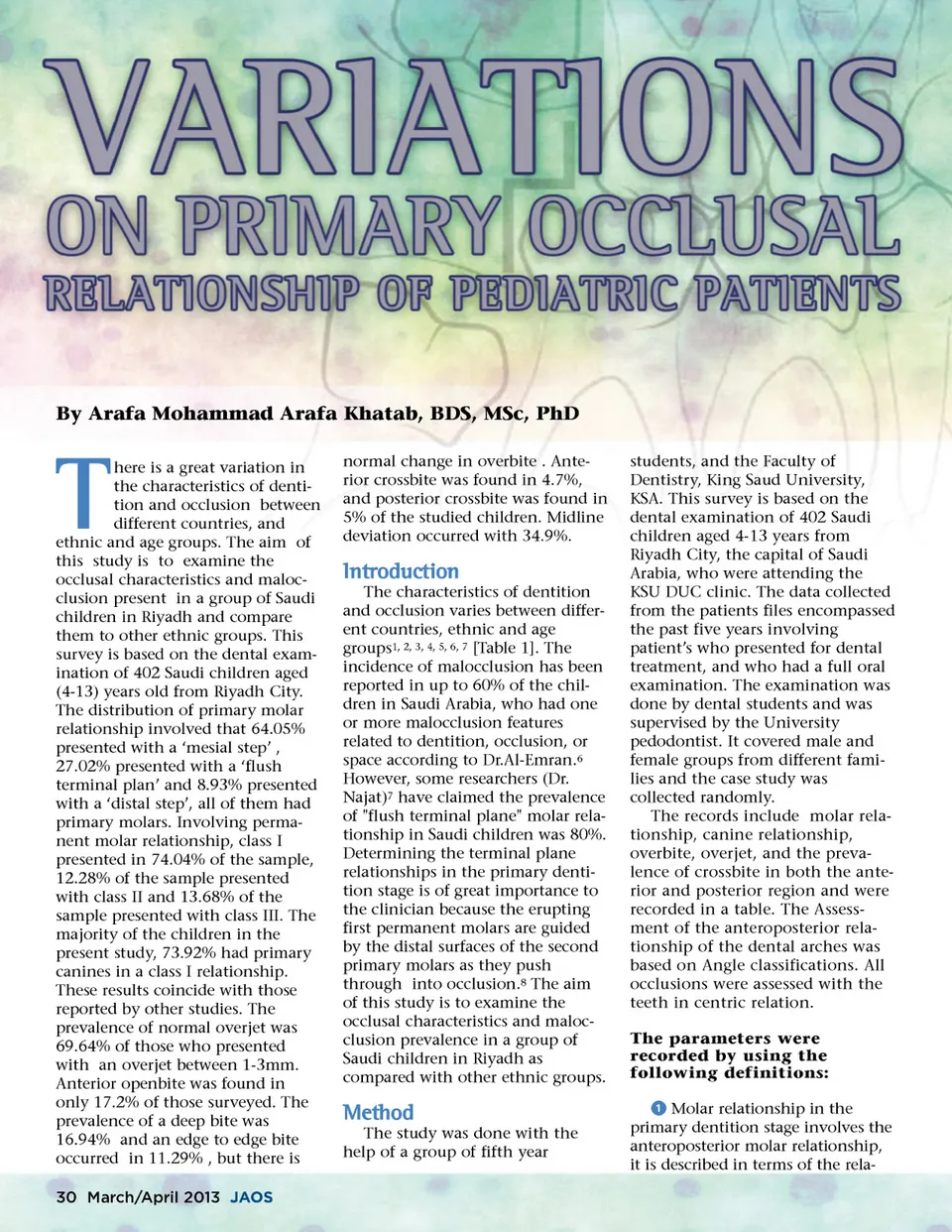
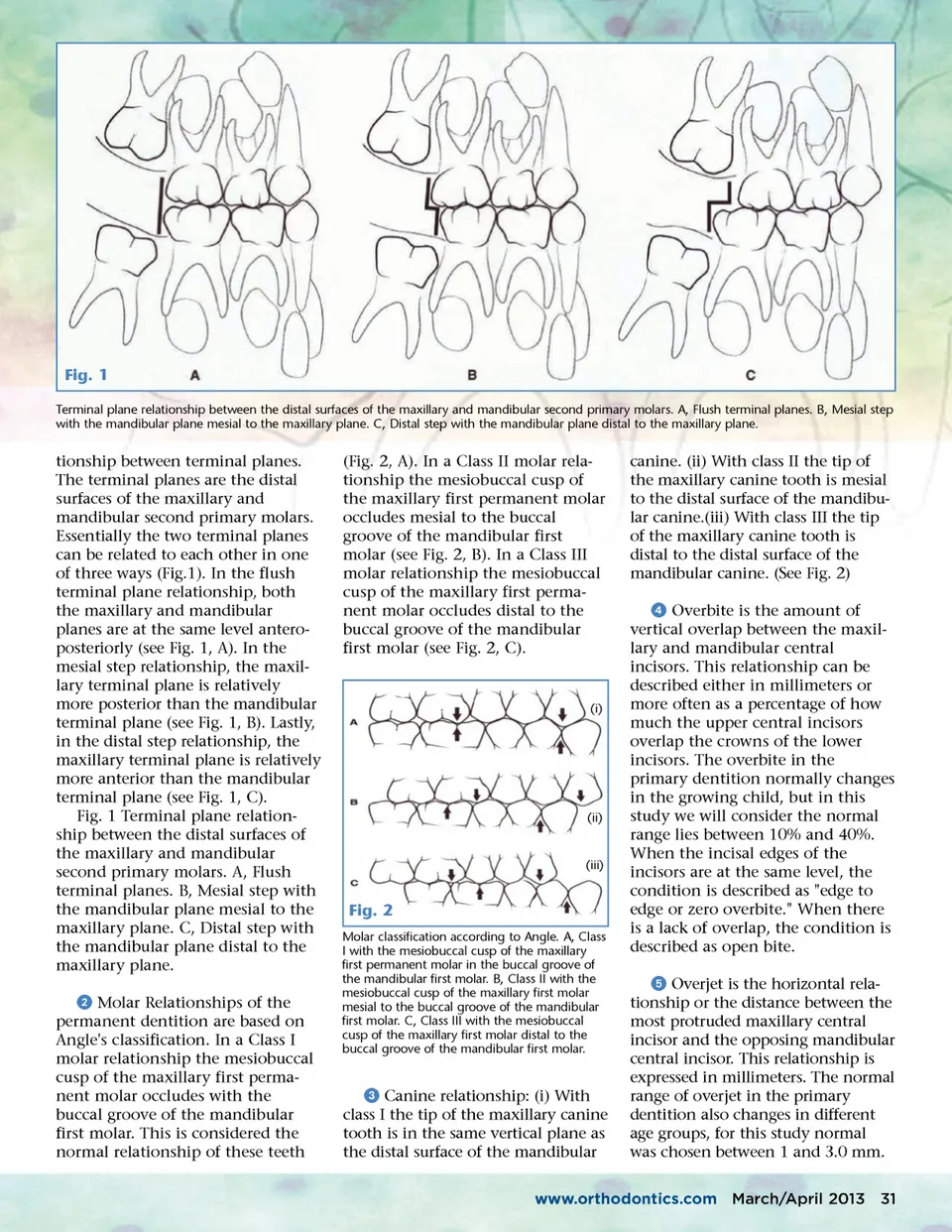
Fig. 1 Terminal plane relationship between the distal surfaces of the maxillary and mandibular second primary molars. A, Flush terminal planes. B, Mesial step with the mandibular plane mesial to the maxillary plane. C, Distal step with the mandibular plane distal to the maxillary plane. tionship between terminal planes. The terminal planes are the distal surfaces of the maxillary and mandibular second primary molars. Essentially the two terminal planes can be related to each other in one of three ways (Fig.1). In the flush terminal plane relationship, both the maxillary and mandibular planes are at the same level antero-posteriorly (see Fig. 1, A). In the mesial step relationship, the maxil-lary terminal plane is relatively more posterior than the mandibular terminal plane (see Fig. 1, B). Lastly, in the distal step relationship, the maxillary terminal plane is relatively more anterior than the mandibular terminal plane (see Fig. 1, C). Fig. 1 Terminal plane relation-ship between the distal surfaces of the maxillary and mandibular second primary molars. A, Flush terminal planes. B, Mesial step with the mandibular plane mesial to the maxillary plane. C, Distal step with the mandibular plane distal to the maxillary plane. ᕢ Molar Relationships of the permanent dentition are based on Angle's classification. In a Class I molar relationship the mesiobuccal cusp of the maxillary first perma-nent molar occludes with the buccal groove of the mandibular first molar. This is considered the normal relationship of these teeth (Fig. 2, A). In a Class II molar rela-tionship the mesiobuccal cusp of the maxillary first permanent molar occludes mesial to the buccal groove of the mandibular first molar (see Fig. 2, B). In a Class III molar relationship the mesiobuccal cusp of the maxillary first perma-nent molar occludes distal to the buccal groove of the mandibular first molar (see Fig. 2, C). canine. (ii) With class II the tip of the maxillary canine tooth is mesial to the distal surface of the mandibu-lar canine.(iii) With class III the tip of the maxillary canine tooth is distal to the distal surface of the mandibular canine. (See Fig. 2) ᕤ Overbite is the amount of vertical overlap between the maxil-lary and mandibular central incisors. This relationship can be described either in millimeters or more often as a percentage of how much the upper central incisors overlap the crowns of the lower incisors. The overbite in the primary dentition normally changes in the growing child, but in this study we will consider the normal range lies between 10% and 40%. When the incisal edges of the incisors are at the same level, the condition is described as "edge to edge or zero overbite." When there is a lack of overlap, the condition is described as open bite. ᕥ Overjet is the horizontal rela-tionship or the distance between the most protruded maxillary central incisor and the opposing mandibular central incisor. This relationship is expressed in millimeters. The normal range of overjet in the primary dentition also changes in different age groups, for this study normal was chosen between 1 and 3.0 mm. (i) (ii) (iii) Fig. 2 Molar classification according to Angle. A, Class I with the mesiobuccal cusp of the maxillary first permanent molar in the buccal groove of the mandibular first molar. B, Class II with the mesiobuccal cusp of the maxillary first molar mesial to the buccal groove of the mandibular first molar. C, Class III with the mesiobuccal cusp of the maxillary first molar distal to the buccal groove of the mandibular first molar. ᕣ Canine relationship: (i) With class I the tip of the maxillary canine tooth is in the same vertical plane as the distal surface of the mandibular www.orthodontics.com March/April 2013 31
Journal of the American Orthodontic Society March-April 2013: Page 31