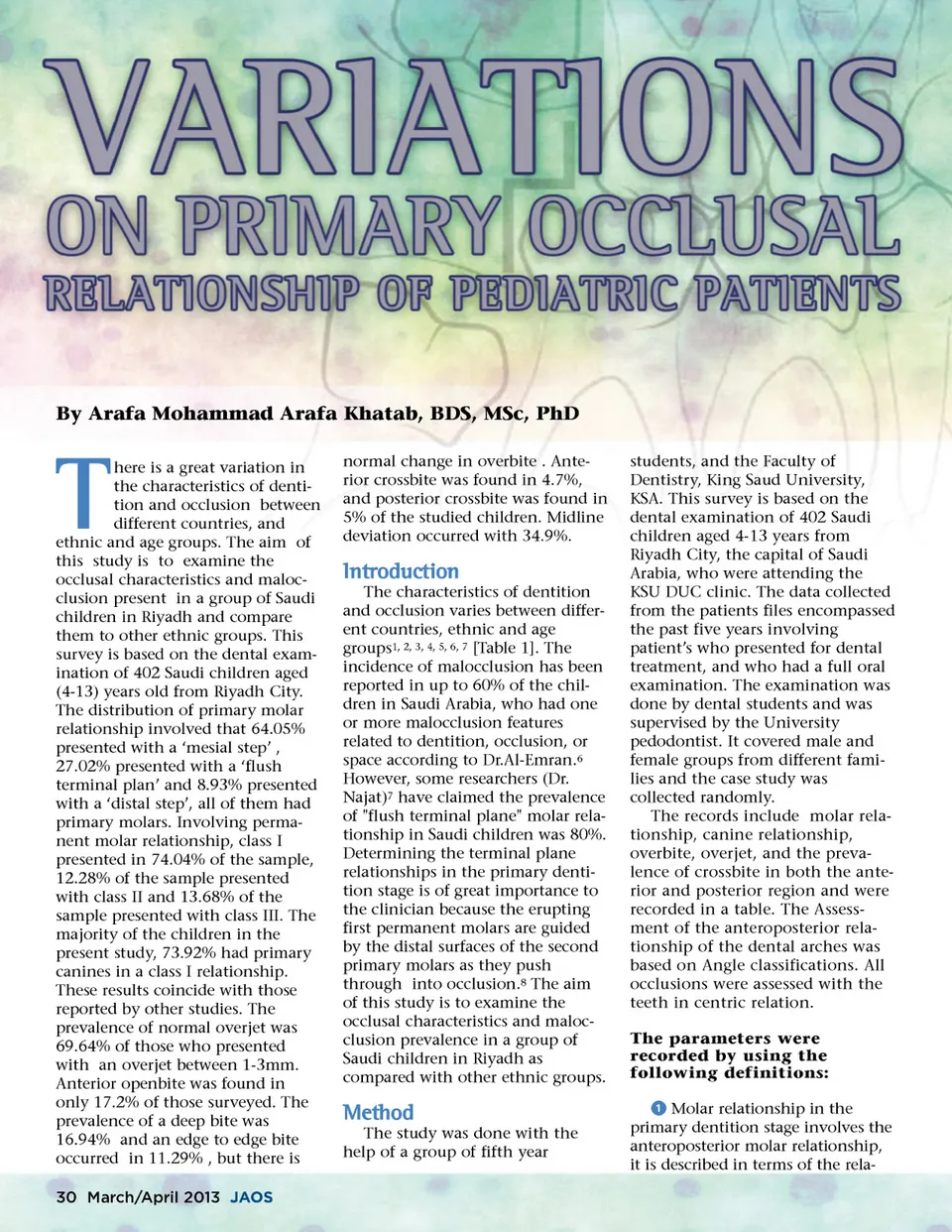
By Arafa Mohammad Arafa Khatab, BDS, MSc, PhD T here is a great variation in the characteristics of denti-tion and occlusion between different countries, and ethnic and age groups. The aim of this study is to examine the occlusal characteristics and maloc-clusion present in a group of Saudi children in Riyadh and compare them to other ethnic groups. This survey is based on the dental exam-ination of 402 Saudi children aged (4-13) years old from Riyadh City. The distribution of primary molar relationship involved that 64.05% presented with a ‘mesial step’ , 27.02% presented with a ‘flush terminal plan’ and 8.93% presented with a ‘distal step’, all of them had primary molars. Involving perma-nent molar relationship, class I presented in 74.04% of the sample, 12.28% of the sample presented with class II and 13.68% of the sample presented with class III. The majority of the children in the present study, 73.92% had primary canines in a class I relationship. These results coincide with those reported by other studies. The prevalence of normal overjet was 69.64% of those who presented with an overjet between 1-3mm. Anterior openbite was found in only 17.2% of those surveyed. The prevalence of a deep bite was 16.94% and an edge to edge bite occurred in 11.29% , but there is 30 March/April 2013 JAOS normal change in overbite . Ante-rior crossbite was found in 4.7%, and posterior crossbite was found in 5% of the studied children. Midline deviation occurred with 34.9%. I ntroduction The characteristics of dentition and occlusion varies between differ-ent countries, ethnic and age groups 1, 2, 3, 4, 5, 6, 7 [Table 1]. The incidence of malocclusion has been reported in up to 60% of the chil-dren in Saudi Arabia, who had one or more malocclusion features related to dentition, occlusion, or space according to Dr.Al-Emran. 6 However, some researchers (Dr. Najat) 7 have claimed the prevalence of "flush terminal plane" molar rela-tionship in Saudi children was 80%. Determining the terminal plane relationships in the primary denti-tion stage is of great importance to the clinician because the erupting first permanent molars are guided by the distal surfaces of the second primary molars as they push through into occlusion. 8 The aim of this study is to examine the occlusal characteristics and maloc-clusion prevalence in a group of Saudi children in Riyadh as compared with other ethnic groups. students, and the Faculty of Dentistry, King Saud University, KSA. This survey is based on the dental examination of 402 Saudi children aged 4-13 years from Riyadh City, the capital of Saudi Arabia, who were attending the KSU DUC clinic. The data collected from the patients files encompassed the past five years involving patient’s who presented for dental treatment, and who had a full oral examination. The examination was done by dental students and was supervised by the University pedodontist. It covered male and female groups from different fami-lies and the case study was collected randomly. The records include molar rela-tionship, canine relationship, overbite, overjet, and the preva-lence of crossbite in both the ante-rior and posterior region and were recorded in a table. The Assess-ment of the anteroposterior rela-tionship of the dental arches was based on Angle classifications. All occlusions were assessed with the teeth in centric relation. The parameters were recorded by using the following definitions: ᕡ Molar relationship in the primary dentition stage involves the anteroposterior molar relationship, it is described in terms of the rela-Method The study was done with the help of a group of fifth year
Journal of the American Orthodontic Society March-April 2013: Page 30