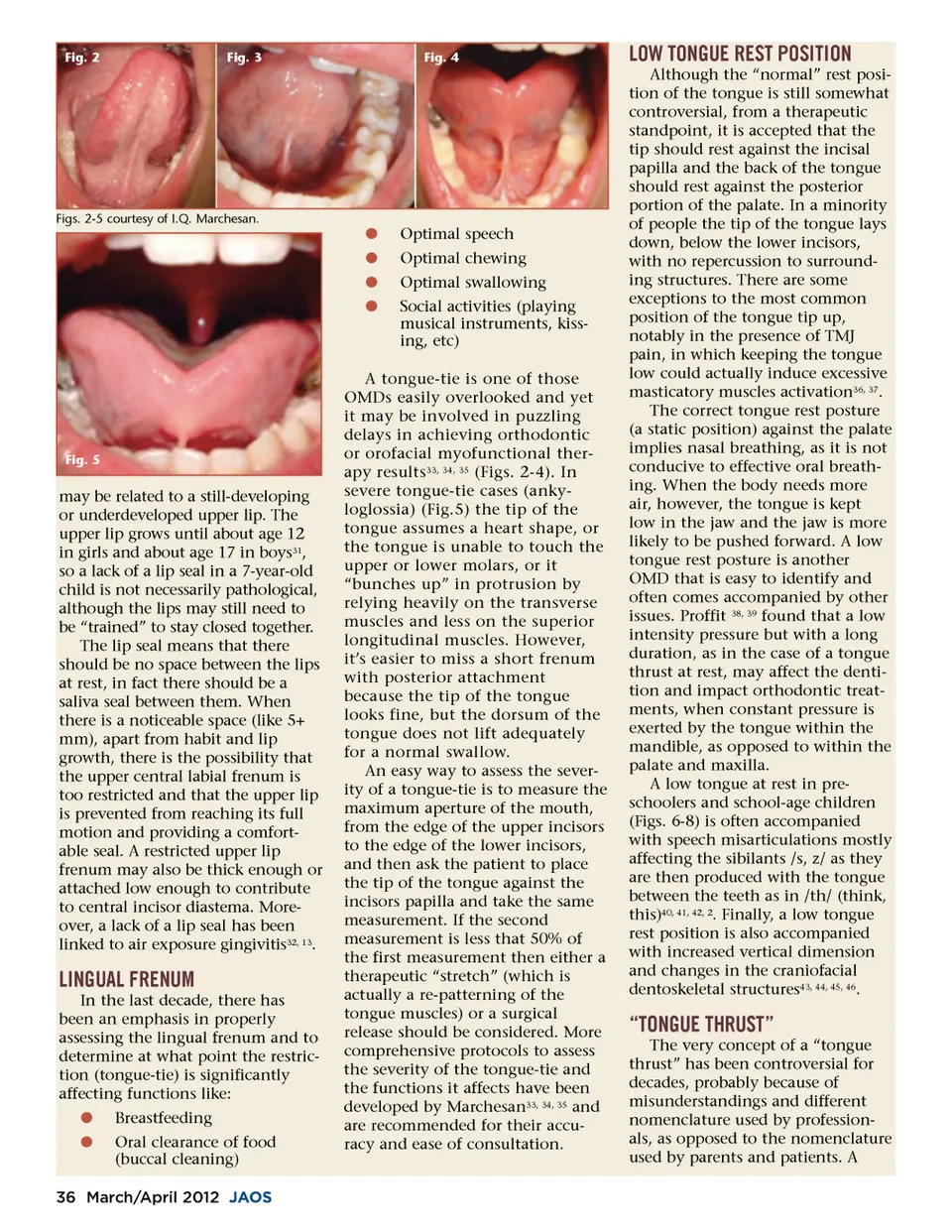
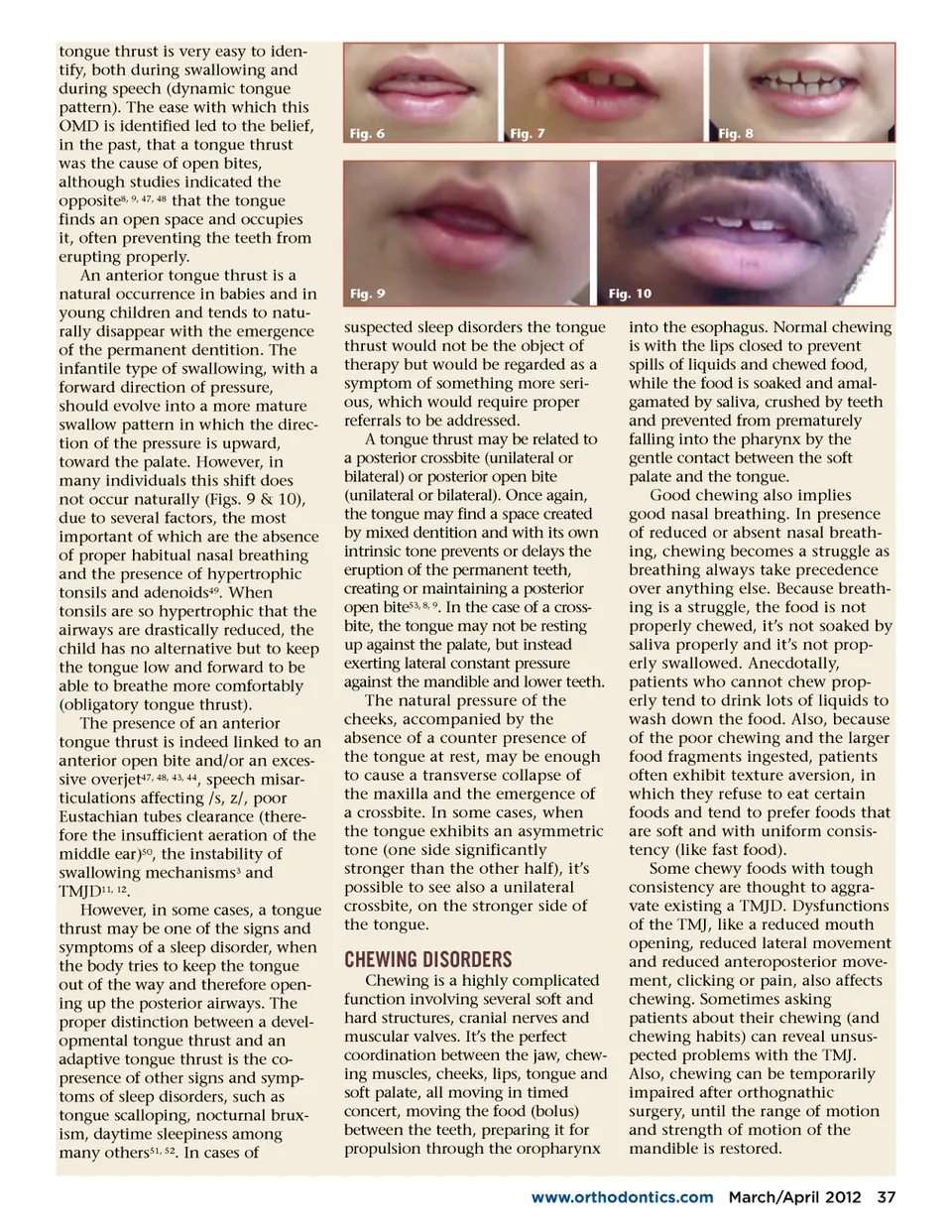
tongue thrust is very easy to iden-tify, both during swallowing and during speech (dynamic tongue pattern). The ease with which this OMD is identified led to the belief, in the past, that a tongue thrust was the cause of open bites, although studies indicated the opposite 8, 9, 47, 48 that the tongue finds an open space and occupies it, often preventing the teeth from erupting properly. An anterior tongue thrust is a natural occurrence in babies and in young children and tends to natu-rally disappear with the emergence of the permanent dentition. The infantile type of swallowing, with a forward direction of pressure, should evolve into a more mature swallow pattern in which the direc-tion of the pressure is upward, toward the palate. However, in many individuals this shift does not occur naturally (Figs. 9 & 10), due to several factors, the most important of which are the absence of proper habitual nasal breathing and the presence of hypertrophic tonsils and adenoids 49 . When tonsils are so hypertrophic that the airways are drastically reduced, the child has no alternative but to keep the tongue low and forward to be able to breathe more comfortably (obligatory tongue thrust). The presence of an anterior tongue thrust is indeed linked to an anterior open bite and/or an exces-sive overjet 47, 48, 43, 44 , speech misar-ticulations affecting /s, z/, poor Eustachian tubes clearance (there-fore the insufficient aeration of the middle ear) 50 , the instability of swallowing mechanisms 3 and TMJD 11, 12 . However, in some cases, a tongue thrust may be one of the signs and symptoms of a sleep disorder, when the body tries to keep the tongue out of the way and therefore open-ing up the posterior airways. The proper distinction between a devel-opmental tongue thrust and an adaptive tongue thrust is the co-presence of other signs and symp-toms of sleep disorders, such as tongue scalloping, nocturnal brux-ism, daytime sleepiness among many others 51, 52 . In cases of Fig. 6 Fig. 7 Fig. 8 Fig. 9 Fig. 10 suspected sleep disorders the tongue thrust would not be the object of therapy but would be regarded as a symptom of something more seri-ous, which would require proper referrals to be addressed. A tongue thrust may be related to a posterior crossbite (unilateral or bilateral) or posterior open bite (unilateral or bilateral). Once again, the tongue may find a space created by mixed dentition and with its own intrinsic tone prevents or delays the eruption of the permanent teeth, creating or maintaining a posterior open bite 53, 8, 9 . In the case of a cross-bite, the tongue may not be resting up against the palate, but instead exerting lateral constant pressure against the mandible and lower teeth. The natural pressure of the cheeks, accompanied by the absence of a counter presence of the tongue at rest, may be enough to cause a transverse collapse of the maxilla and the emergence of a crossbite. In some cases, when the tongue exhibits an asymmetric tone (one side significantly stronger than the other half), it’s possible to see also a unilateral crossbite, on the stronger side of the tongue. CHEWING DISORDERS Chewing is a highly complicated function involving several soft and hard structures, cranial nerves and muscular valves. It’s the perfect coordination between the jaw, chew-ing muscles, cheeks, lips, tongue and soft palate, all moving in timed concert, moving the food (bolus) between the teeth, preparing it for propulsion through the oropharynx into the esophagus. Normal chewing is with the lips closed to prevent spills of liquids and chewed food, while the food is soaked and amal-gamated by saliva, crushed by teeth and prevented from prematurely falling into the pharynx by the gentle contact between the soft palate and the tongue. Good chewing also implies good nasal breathing. In presence of reduced or absent nasal breath-ing, chewing becomes a struggle as breathing always take precedence over anything else. Because breath-ing is a struggle, the food is not properly chewed, it’s not soaked by saliva properly and it’s not prop-erly swallowed. Anecdotally, patients who cannot chew prop-erly tend to drink lots of liquids to wash down the food. Also, because of the poor chewing and the larger food fragments ingested, patients often exhibit texture aversion, in which they refuse to eat certain foods and tend to prefer foods that are soft and with uniform consis-tency (like fast food). Some chewy foods with tough consistency are thought to aggra-vate existing a TMJD. Dysfunctions of the TMJ, like a reduced mouth opening, reduced lateral movement and reduced anteroposterior move-ment, clicking or pain, also affects chewing. Sometimes asking patients about their chewing (and chewing habits) can reveal unsus-pected problems with the TMJ. Also, chewing can be temporarily impaired after orthognathic surgery, until the range of motion and strength of motion of the mandible is restored. www.orthodontics.com March/April 2012 37
Journal of the American Orthodontic Society March-April 2012: Page 37