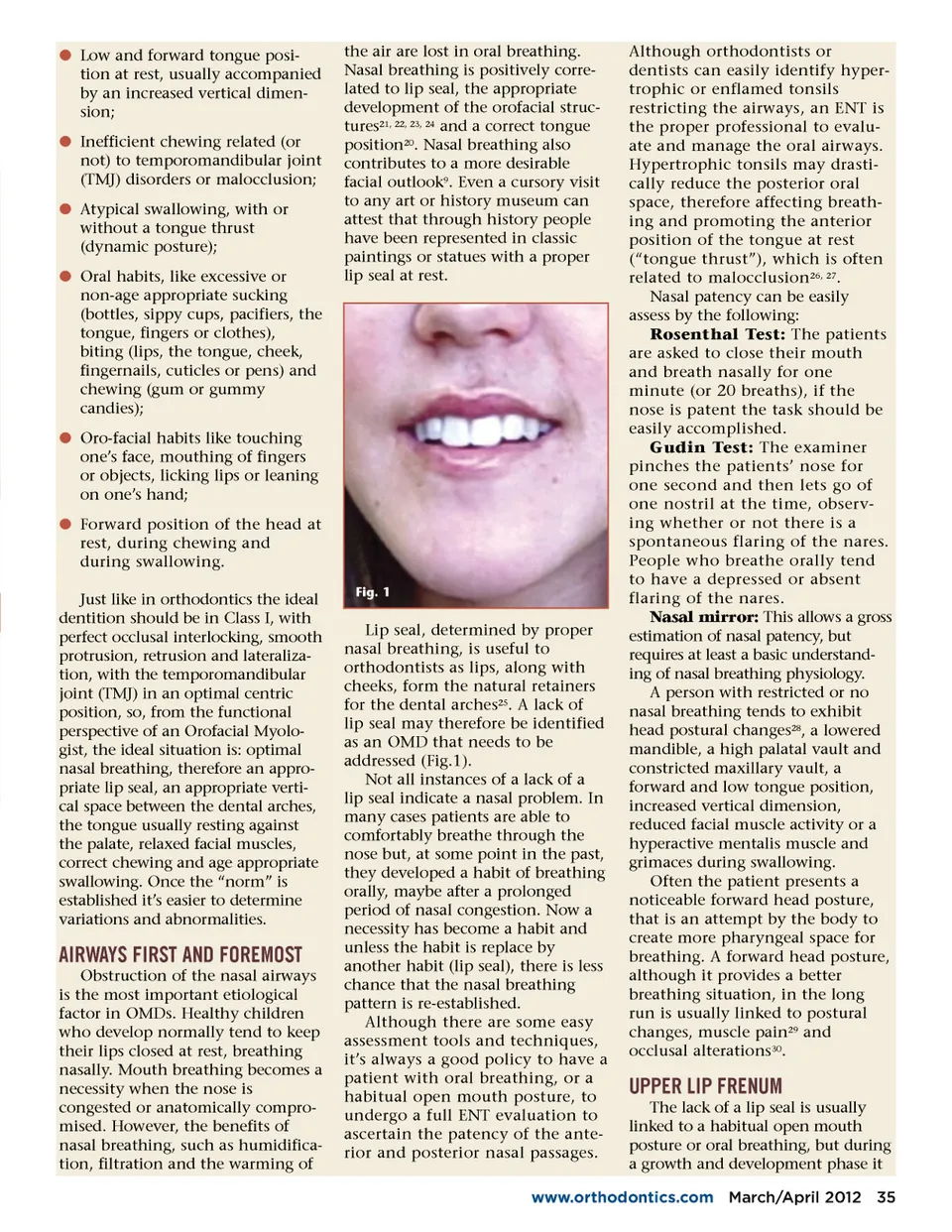
b Low and forward tongue posi-tion at rest, usually accompanied by an increased vertical dimen-sion; b Inefficient chewing related (or not) to temporomandibular joint (TMJ) disorders or malocclusion; b Atypical swallowing, with or without a tongue thrust (dynamic posture); b Oral habits, like excessive or non-age appropriate sucking (bottles, sippy cups, pacifiers, the tongue, fingers or clothes), biting (lips, the tongue, cheek, fingernails, cuticles or pens) and chewing (gum or gummy candies); b Oro-facial habits like touching one’s face, mouthing of fingers or objects, licking lips or leaning on one’s hand; b Forward position of the head at rest, during chewing and during swallowing. Just like in orthodontics the ideal dentition should be in Class I, with perfect occlusal interlocking, smooth protrusion, retrusion and lateraliza-tion, with the temporomandibular joint (TMJ) in an optimal centric position, so, from the functional perspective of an Orofacial Myolo-gist, the ideal situation is: optimal nasal breathing, therefore an appro-priate lip seal, an appropriate verti-cal space between the dental arches, the tongue usually resting against the palate, relaxed facial muscles, correct chewing and age appropriate swallowing. Once the “norm” is established it’s easier to determine variations and abnormalities. the air are lost in oral breathing. Nasal breathing is positively corre-lated to lip seal, the appropriate development of the orofacial struc-tures 21, 22, 23, 24 and a correct tongue position 20 . Nasal breathing also contributes to a more desirable facial outlook 9 . Even a cursory visit to any art or history museum can attest that through history people have been represented in classic paintings or statues with a proper lip seal at rest. Fig. 1 AIRWAYS FIRST AND FOREMOST Obstruction of the nasal airways is the most important etiological factor in OMDs. Healthy children who develop normally tend to keep their lips closed at rest, breathing nasally. Mouth breathing becomes a necessity when the nose is congested or anatomically compro-mised. However, the benefits of nasal breathing, such as humidifica-tion, filtration and the warming of Lip seal, determined by proper nasal breathing, is useful to orthodontists as lips, along with cheeks, form the natural retainers for the dental arches 25 . A lack of lip seal may therefore be identified as an OMD that needs to be addressed (Fig.1). Not all instances of a lack of a lip seal indicate a nasal problem. In many cases patients are able to comfortably breathe through the nose but, at some point in the past, they developed a habit of breathing orally, maybe after a prolonged period of nasal congestion. Now a necessity has become a habit and unless the habit is replace by another habit (lip seal), there is less chance that the nasal breathing pattern is re-established. Although there are some easy assessment tools and techniques, it’s always a good policy to have a patient with oral breathing, or a habitual open mouth posture, to undergo a full ENT evaluation to ascertain the patency of the ante-rior and posterior nasal passages. Although orthodontists or dentists can easily identify hyper-trophic or enflamed tonsils restricting the airways, an ENT is the proper professional to evalu-ate and manage the oral airways. Hypertrophic tonsils may drasti-cally reduce the posterior oral space, therefore affecting breath-ing and promoting the anterior position of the tongue at rest (“tongue thrust”), which is often related to malocclusion 26, 27 . Nasal patency can be easily assess by the following: Rosenthal Test: The patients are asked to close their mouth and breath nasally for one minute (or 20 breaths), if the nose is patent the task should be easily accomplished. Gudin Test: The examiner pinches the patients’ nose for one second and then lets go of one nostril at the time, observ-ing whether or not there is a spontaneous flaring of the nares. People who breathe orally tend to have a depressed or absent flaring of the nares. Nasal mirror: This allows a gross estimation of nasal patency, but requires at least a basic understand-ing of nasal breathing physiology. A person with restricted or no nasal breathing tends to exhibit head postural changes 28 , a lowered mandible, a high palatal vault and constricted maxillary vault, a forward and low tongue position, increased vertical dimension, reduced facial muscle activity or a hyperactive mentalis muscle and grimaces during swallowing. Often the patient presents a noticeable forward head posture, that is an attempt by the body to create more pharyngeal space for breathing. A forward head posture, although it provides a better breathing situation, in the long run is usually linked to postural changes, muscle pain 29 and occlusal alterations 30 . UPPER LIP FRENUM The lack of a lip seal is usually linked to a habitual open mouth posture or oral breathing, but during a growth and development phase it www.orthodontics.com March/April 2012 35
Journal of the American Orthodontic Society March-April 2012: Page 35