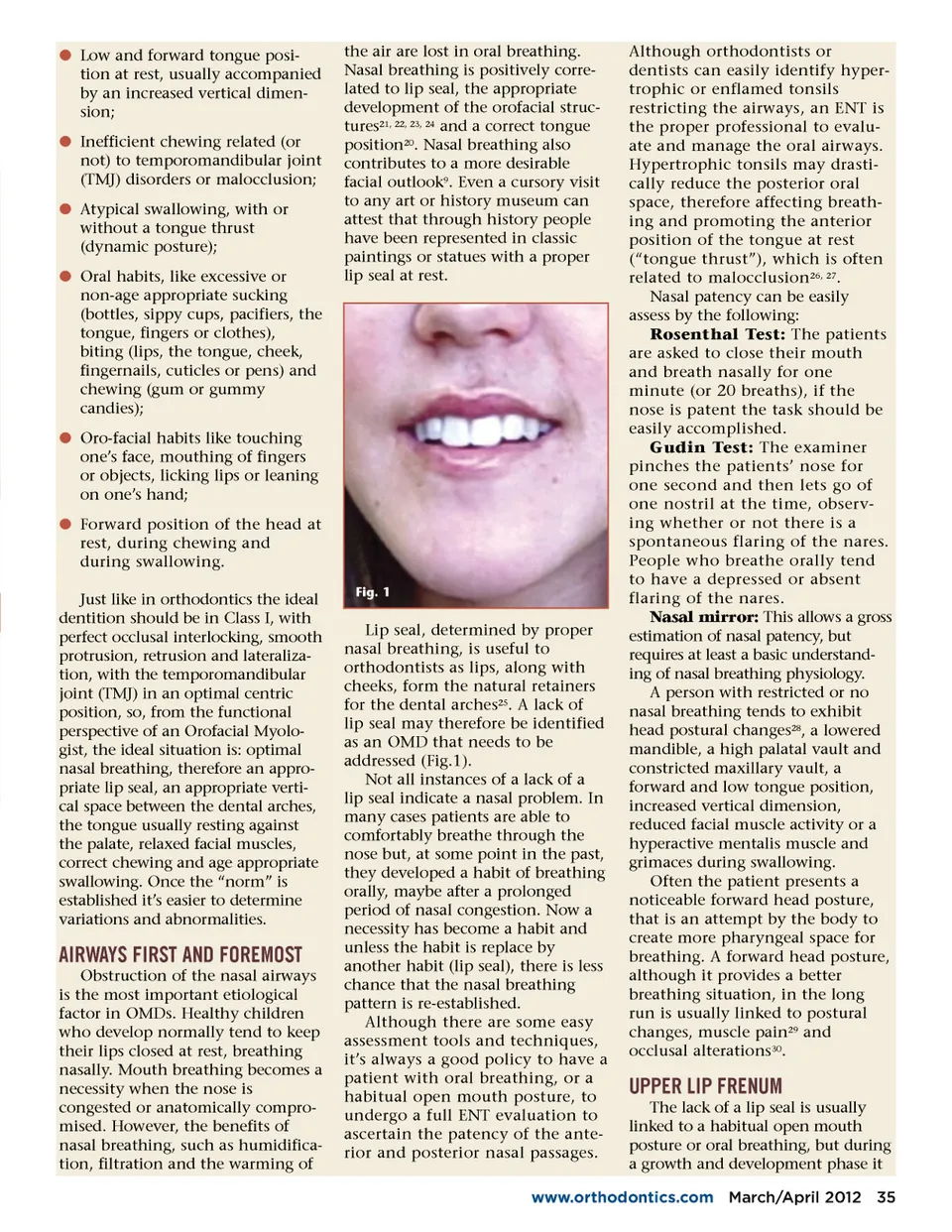
OMD OROFACIAL MYOFUNCTIONAL DISORDERS: Assessment, Prevention and Treatment identified in older children, teenagers and adults, a multidisci-plinary approach of their treatment would ensure the best care results, by involving the orthodontist, the orofacial myologist, the dental hygienist and other professionals such as ear-nose-throat specialists, allergists and osteopathic physi-cians to name a few. With the unprecedented expan-sion of medical knowledge and the need to become highly specialized, medical and health professionals are often unaware of the contribu-tions offered by another disciplines in the treatment of patients with multiple disorders. For instance, a speech pathologist might find it difficult to address the correction of certain speech sounds like /s, z/ or /ch, j, sh/ when the child has no habitual nasal breathing, no lip competence, has an excessive ante-rior overjet or wears a bulky oral appliance. Conversely, an By Licia Coceani Paskay, MS, CCC-SLP, COM O rofacial Myofunctional Disorders (OMDs) are disorders pertaining to the face and mouth and may affect, directly and indirectly, chewing 1 , swallowing 2, 3 , speech 4, 5, 6 , occlusion 7, 8, 9, 10 , temporomandibu-lar joint movement 11, 12 , oral hygiene 13, 14 , stability of orthodontic treatment 15, 16, 8, 17 , facial esthetics 18, 9 , and facial skeletal growth 19, 20 . Orofacial Myofunctional Disorders may have an impact on treatment by orthodontists, dentists, dental hygienists, speech-language pathol-ogists and other professionals work-ing in the same anatomical and physiological area. Most OMDs can be easily assessed by dentists and orthodon-tists and, in many cases, they can be prevented, especially in young children with deciduous dentition still in place, thus promoting a more harmonious growth of the orofacial complex. When OMDs are orthodontist might be frustrated by an unstable occlusion, stubborn anterior open bites or unexpected treatment relapses. The natural bridge is Orofacial Myology or the study of orofacial myofunctional disorders and its application, orofa-cial myofunctional therapy, which has been around in various forms for many decades. What are OMDs? The most common are: b Oral breathing or lack of habit-ual nasal breathing; b Habitual open mouth posture and lack of lip seal, with patent nasal passages; b Reduced upper lip movement, with or without a restricted labial frenum; b Restricted lingual frenum, from borderline to ankyloglossia; b Anterior or lateral tongue thrust at rest (static posture); 34 March/April 2012 JAOS
Journal of the American Orthodontic Society March-April 2012: Page 34