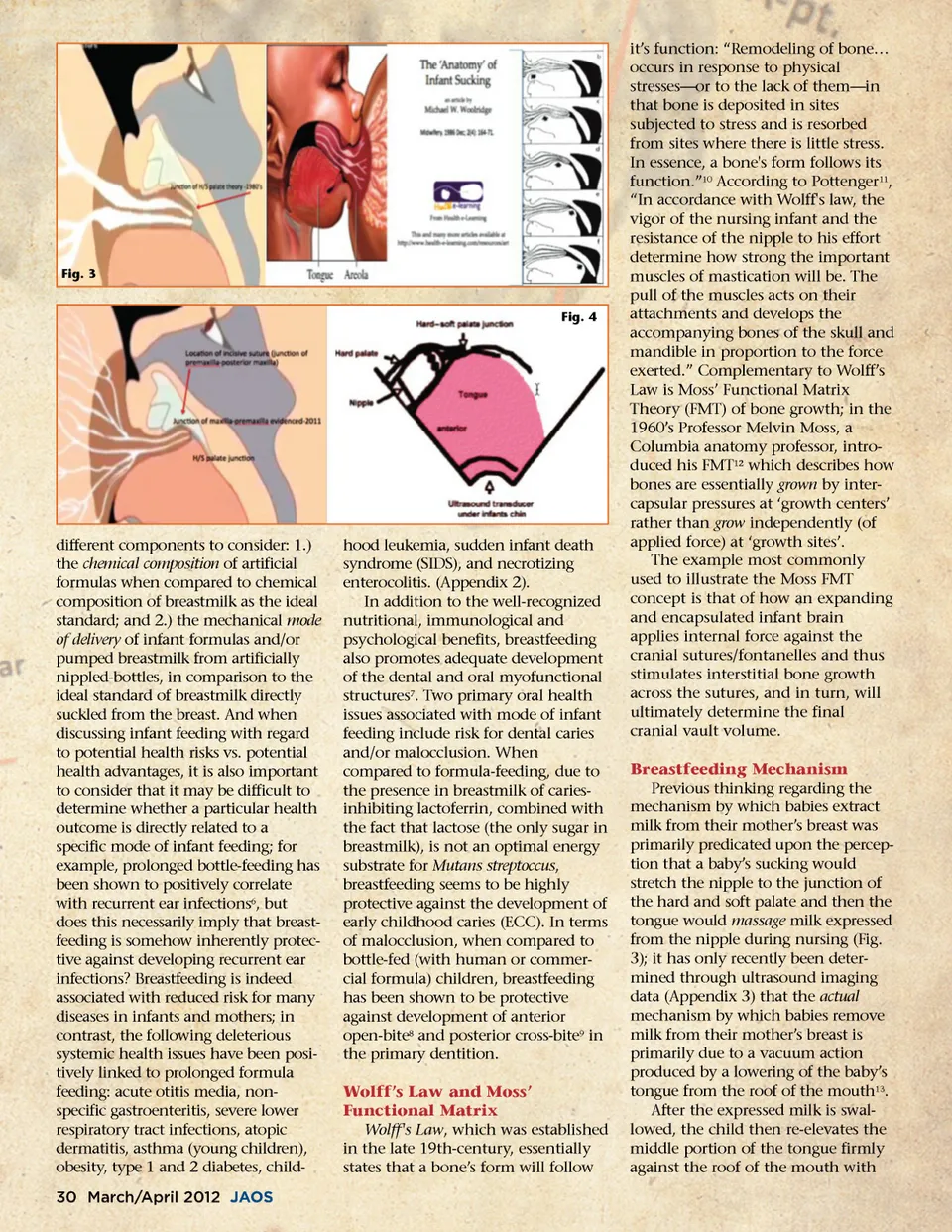
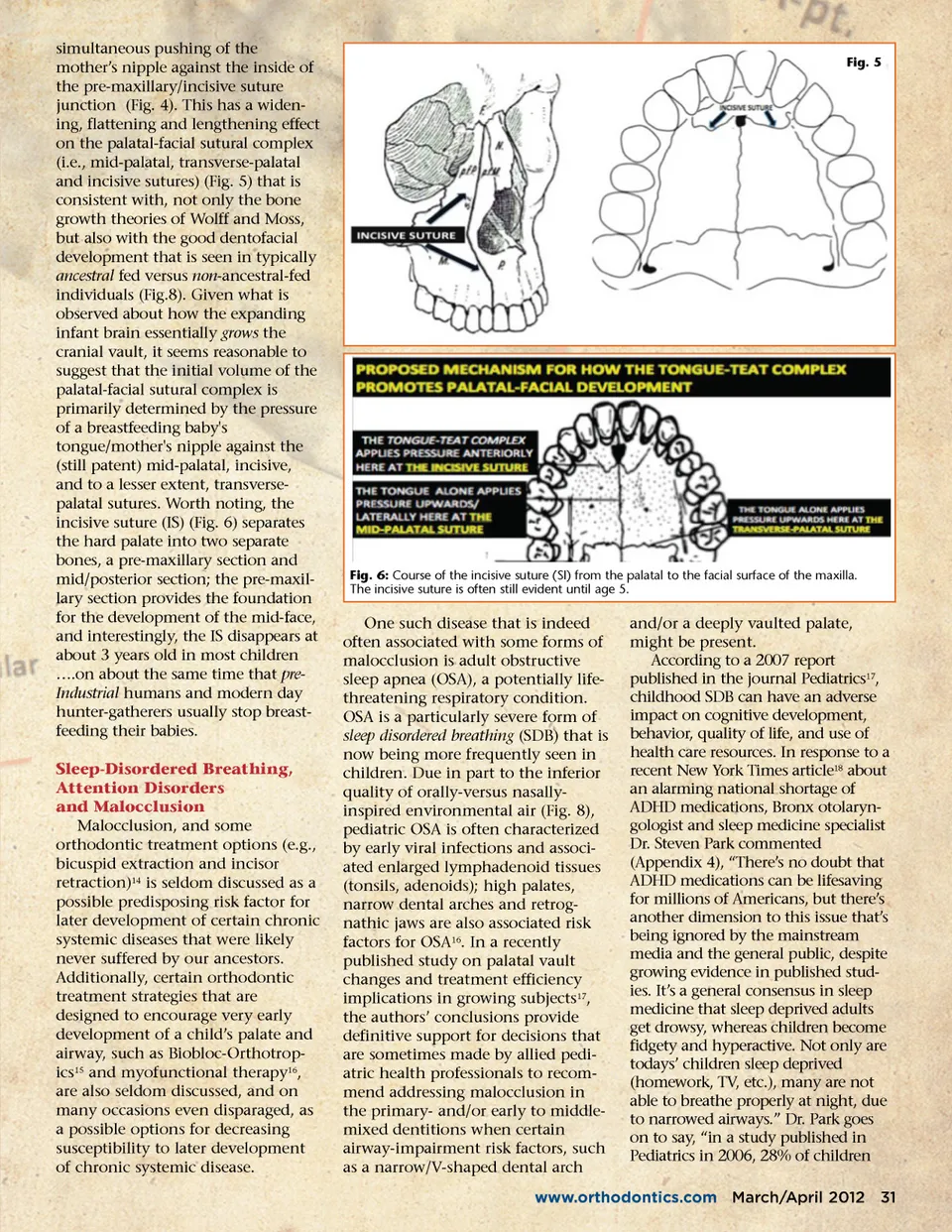
simultaneous pushing of the mother’s nipple against the inside of the pre-maxillary/incisive suture junction (Fig. 4). This has a widen-ing, flattening and lengthening effect on the palatal-facial sutural complex (i.e., mid-palatal, transverse-palatal and incisive sutures) (Fig. 5) that is consistent with, not only the bone growth theories of Wolff and Moss, but also with the good dentofacial development that is seen in typically ancestral fed versus non -ancestral-fed individuals (Fig.8). Given what is observed about how the expanding infant brain essentially grows the cranial vault, it seems reasonable to suggest that the initial volume of the palatal-facial sutural complex is primarily determined by the pressure of a breastfeeding baby's tongue/mother's nipple against the (still patent) mid-palatal, incisive, and to a lesser extent, transverse-palatal sutures. Worth noting, the incisive suture (IS) (Fig. 6) separates the hard palate into two separate bones, a pre-maxillary section and mid/posterior section; the pre-maxil-lary section provides the foundation for the development of the mid-face, and interestingly, the IS disappears at about 3 years old in most children ….on about the same time that pre-Industrial humans and modern day hunter-gatherers usually stop breast-feeding their babies. Sleep-Disordered Breathing, Attention Disorders and Malocclusion Malocclusion, and some orthodontic treatment options (e.g., bicuspid extraction and incisor retraction) 14 is seldom discussed as a possible predisposing risk factor for later development of certain chronic systemic diseases that were likely never suffered by our ancestors. Additionally, certain orthodontic treatment strategies that are designed to encourage very early development of a child’s palate and airway, such as Biobloc-Orthotrop-ics 15 and myofunctional therapy 16 , are also seldom discussed, and on many occasions even disparaged, as a possible options for decreasing susceptibility to later development of chronic systemic disease. Fig. 5 Fig. 6: Course of the incisive suture (SI) from the palatal to the facial surface of the maxilla. The incisive suture is often still evident until age 5. One such disease that is indeed often associated with some forms of malocclusion is adult obstructive sleep apnea (OSA), a potentially life-threatening respiratory condition. OSA is a particularly severe form of sleep disordered breathing (SDB) that is now being more frequently seen in children. Due in part to the inferior quality of orally-versus nasally-inspired environmental air (Fig. 8), pediatric OSA is often characterized by early viral infections and associ-ated enlarged lymphadenoid tissues (tonsils, adenoids); high palates, narrow dental arches and retrog-nathic jaws are also associated risk factors for OSA 16 . In a recently published study on palatal vault changes and treatment efficiency implications in growing subjects 17 , the authors’ conclusions provide definitive support for decisions that are sometimes made by allied pedi-atric health professionals to recom-mend addressing malocclusion in the primary-and/or early to middle-mixed dentitions when certain airway-impairment risk factors, such as a narrow/V-shaped dental arch and/or a deeply vaulted palate, might be present. According to a 2007 report published in the journal Pediatrics 17 , childhood SDB can have an adverse impact on cognitive development, behavior, quality of life, and use of health care resources. In response to a recent New York Times article 18 about an alarming national shortage of ADHD medications, Bronx otolaryn-gologist and sleep medicine specialist Dr. Steven Park commented (Appendix 4), “There’s no doubt that ADHD medications can be lifesaving for millions of Americans, but there’s another dimension to this issue that’s being ignored by the mainstream media and the general public, despite growing evidence in published stud-ies. It’s a general consensus in sleep medicine that sleep deprived adults get drowsy, whereas children become fidgety and hyperactive. Not only are todays’ children sleep deprived (homework, TV, etc.), many are not able to breathe properly at night, due to narrowed airways.” Dr. Park goes on to say, “in a study published in Pediatrics in 2006, 28% of children www.orthodontics.com March/April 2012 31
Journal of the American Orthodontic Society March-April 2012: Page 31