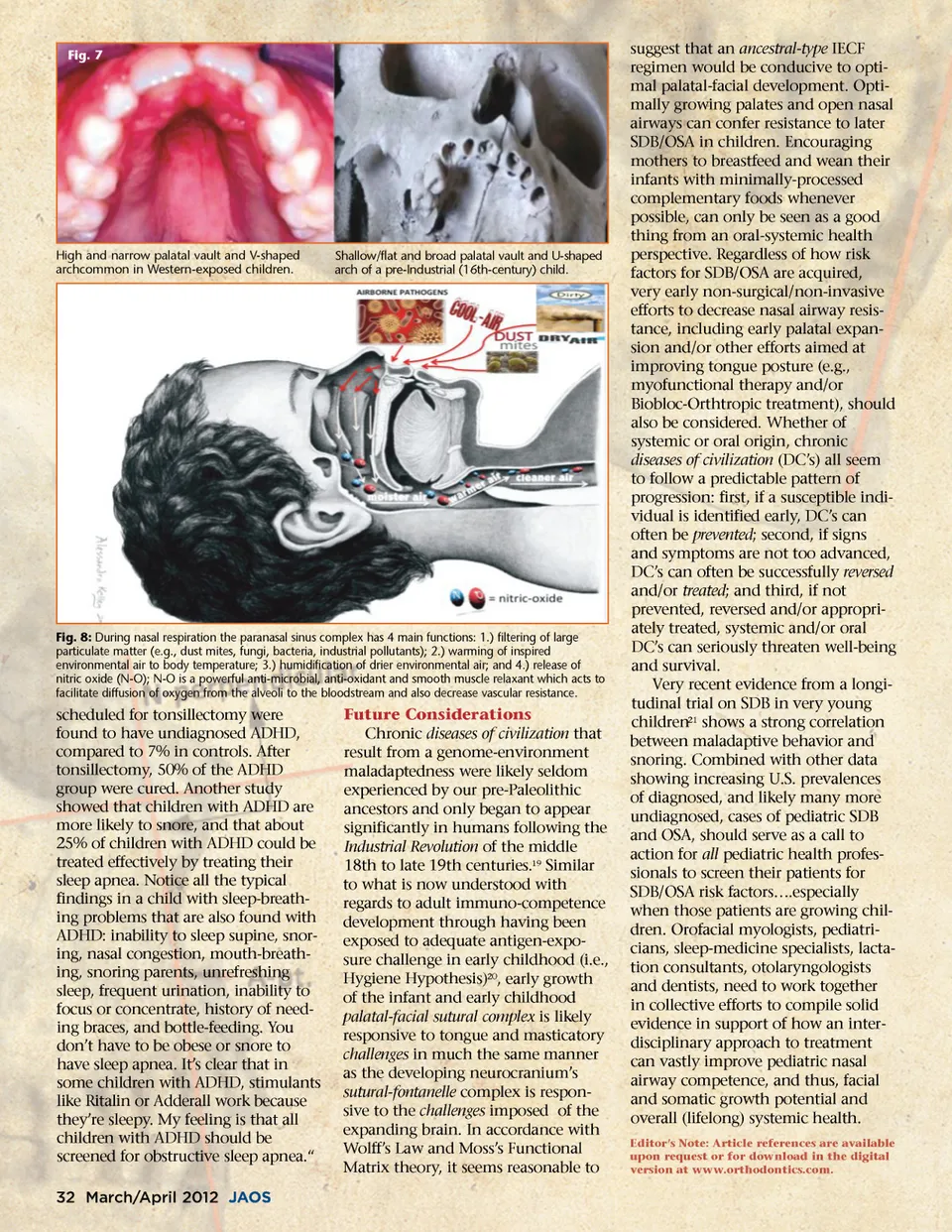
Fig. 7 High and narrow palatal vault and V-shaped archcommon in Western-exposed children. Shallow/flat and broad palatal vault and U-shaped arch of a pre-Industrial (16th-century) child. Fig. 8: During nasal respiration the paranasal sinus complex has 4 main functions: 1.) filtering of large particulate matter (e.g., dust mites, fungi, bacteria, industrial pollutants); 2.) warming of inspired environmental air to body temperature; 3.) humidification of drier environmental air; and 4.) release of nitric oxide (N-O); N-O is a powerful anti-microbial, anti-oxidant and smooth muscle relaxant which acts to facilitate diffusion of oxygen from the alveoli to the bloodstream and also decrease vascular resistance. scheduled for tonsillectomy were found to have undiagnosed ADHD, compared to 7% in controls. After tonsillectomy, 50% of the ADHD group were cured. Another study showed that children with ADHD are more likely to snore, and that about 25% of children with ADHD could be treated effectively by treating their sleep apnea. Notice all the typical findings in a child with sleep-breath-ing problems that are also found with ADHD: inability to sleep supine, snor-ing, nasal congestion, mouth-breath-ing, snoring parents, unrefreshing sleep, frequent urination, inability to focus or concentrate, history of need-ing braces, and bottle-feeding. You don’t have to be obese or snore to have sleep apnea. It’s clear that in some children with ADHD, stimulants like Ritalin or Adderall work because they’re sleepy. My feeling is that all children with ADHD should be screened for obstructive sleep apnea.“ 32 March/April 2012 JAOS Future Considerations Chronic diseases of civilization that result from a genome-environment maladaptedness were likely seldom experienced by our pre-Paleolithic ancestors and only began to appear significantly in humans following the Industrial Revolution of the middle 18th to late 19th centuries. 19 Similar to what is now understood with regards to adult immuno-competence development through having been exposed to adequate antigen-expo-sure challenge in early childhood (i.e., Hygiene Hypothesis) 20 , early growth of the infant and early childhood palatal-facial sutural complex is likely responsive to tongue and masticatory challenges in much the same manner as the developing neurocranium’s sutural-fontanelle complex is respon-sive to the challenges imposed of the expanding brain. In accordance with Wolff’s Law and Moss’s Functional Matrix theory, it seems reasonable to suggest that an ancestral-type IECF regimen would be conducive to opti-mal palatal-facial development. Opti-mally growing palates and open nasal airways can confer resistance to later SDB/OSA in children. Encouraging mothers to breastfeed and wean their infants with minimally-processed complementary foods whenever possible, can only be seen as a good thing from an oral-systemic health perspective. Regardless of how risk factors for SDB/OSA are acquired, very early non-surgical/non-invasive efforts to decrease nasal airway resis-tance, including early palatal expan-sion and/or other efforts aimed at improving tongue posture (e.g., myofunctional therapy and/or Biobloc-Orthtropic treatment), should also be considered. Whether of systemic or oral origin, chronic diseases of civilization (DC’s) all seem to follow a predictable pattern of progression: first, if a susceptible indi-vidual is identified early, DC’s can often be prevented ; second, if signs and symptoms are not too advanced, DC’s can often be successfully reversed and/or treated ; and third, if not prevented, reversed and/or appropri-ately treated, systemic and/or oral DC’s can seriously threaten well-being and survival. Very recent evidence from a longi-tudinal trial on SDB in very young children 21 shows a strong correlation between maladaptive behavior and snoring. Combined with other data showing increasing U.S. prevalences of diagnosed, and likely many more undiagnosed, cases of pediatric SDB and OSA, should serve as a call to action for all pediatric health profes-sionals to screen their patients for SDB/OSA risk factors….especially when those patients are growing chil-dren. Orofacial myologists, pediatri-cians, sleep-medicine specialists, lacta-tion consultants, otolaryngologists and dentists, need to work together in collective efforts to compile solid evidence in support of how an inter-disciplinary approach to treatment can vastly improve pediatric nasal airway competence, and thus, facial and somatic growth potential and overall (lifelong) systemic health. Editor’s Note: Article references are available upon request or for download in the digital version at www.orthodontics.com.
Journal of the American Orthodontic Society March-April 2012: Page 32