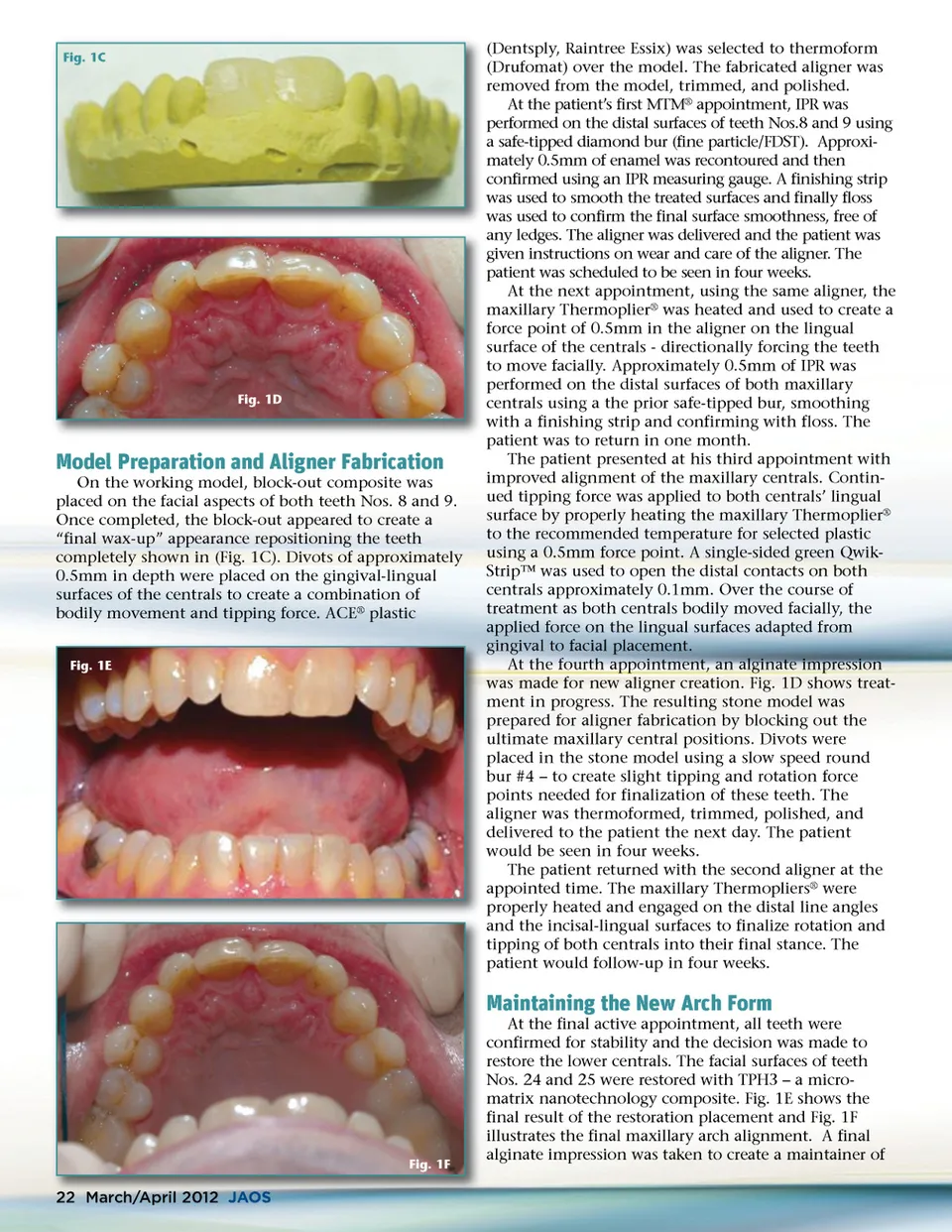
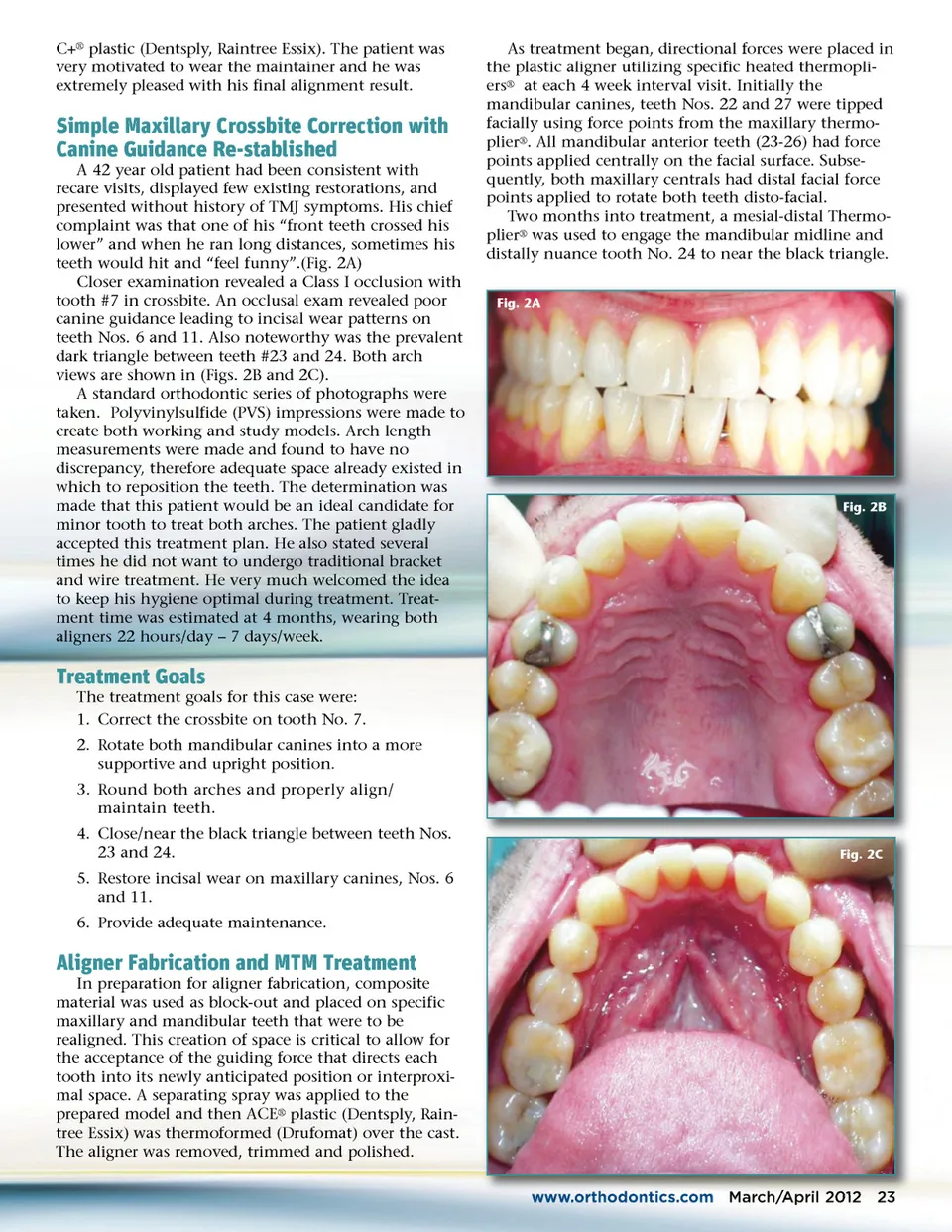
C+ ® plastic (Dentsply, Raintree Essix). The patient was very motivated to wear the maintainer and he was extremely pleased with his final alignment result. Simple Maxillary Crossbite Correction with Canine Guidance Re-stablished A 42 year old patient had been consistent with recare visits, displayed few existing restorations, and presented without history of TMJ symptoms. His chief complaint was that one of his “front teeth crossed his lower” and when he ran long distances, sometimes his teeth would hit and “feel funny”.(Fig. 2A) Closer examination revealed a Class I occlusion with tooth #7 in crossbite. An occlusal exam revealed poor canine guidance leading to incisal wear patterns on teeth Nos. 6 and 11. Also noteworthy was the prevalent dark triangle between teeth #23 and 24. Both arch views are shown in (Figs. 2B and 2C). A standard orthodontic series of photographs were taken. Polyvinylsulfide (PVS) impressions were made to create both working and study models. Arch length measurements were made and found to have no discrepancy, therefore adequate space already existed in which to reposition the teeth. The determination was made that this patient would be an ideal candidate for minor tooth to treat both arches. The patient gladly accepted this treatment plan. He also stated several times he did not want to undergo traditional bracket and wire treatment. He very much welcomed the idea to keep his hygiene optimal during treatment. Treat-ment time was estimated at 4 months, wearing both aligners 22 hours/day – 7 days/week. As treatment began, directional forces were placed in the plastic aligner utilizing specific heated thermopli-ers ® at each 4 week interval visit. Initially the mandibular canines, teeth Nos. 22 and 27 were tipped facially using force points from the maxillary thermo-plier ® . All mandibular anterior teeth (23-26) had force points applied centrally on the facial surface. Subse-quently, both maxillary centrals had distal facial force points applied to rotate both teeth disto-facial. Two months into treatment, a mesial-distal Thermo-plier ® was used to engage the mandibular midline and distally nuance tooth No. 24 to near the black triangle. Fig. 2A Fig. 2B Treatment Goals The treatment goals for this case were: 1. Correct the crossbite on tooth No. 7. 2. Rotate both mandibular canines into a more supportive and upright position. 3. Round both arches and properly align/ maintain teeth. 4. Close/near the black triangle between teeth Nos. 23 and 24. 5. Restore incisal wear on maxillary canines, Nos. 6 and 11. 6. Provide adequate maintenance. Fig. 2C Aligner Fabrication and MTM Treatment In preparation for aligner fabrication, composite material was used as block-out and placed on specific maxillary and mandibular teeth that were to be realigned. This creation of space is critical to allow for the acceptance of the guiding force that directs each tooth into its newly anticipated position or interproxi-mal space. A separating spray was applied to the prepared model and then ACE ® plastic (Dentsply, Rain-tree Essix) was thermoformed (Drufomat) over the cast. The aligner was removed, trimmed and polished. www.orthodontics.com www orthodontics com March/A March/April / pril 2012 23
Journal of the American Orthodontic Society March-April 2012: Page 23