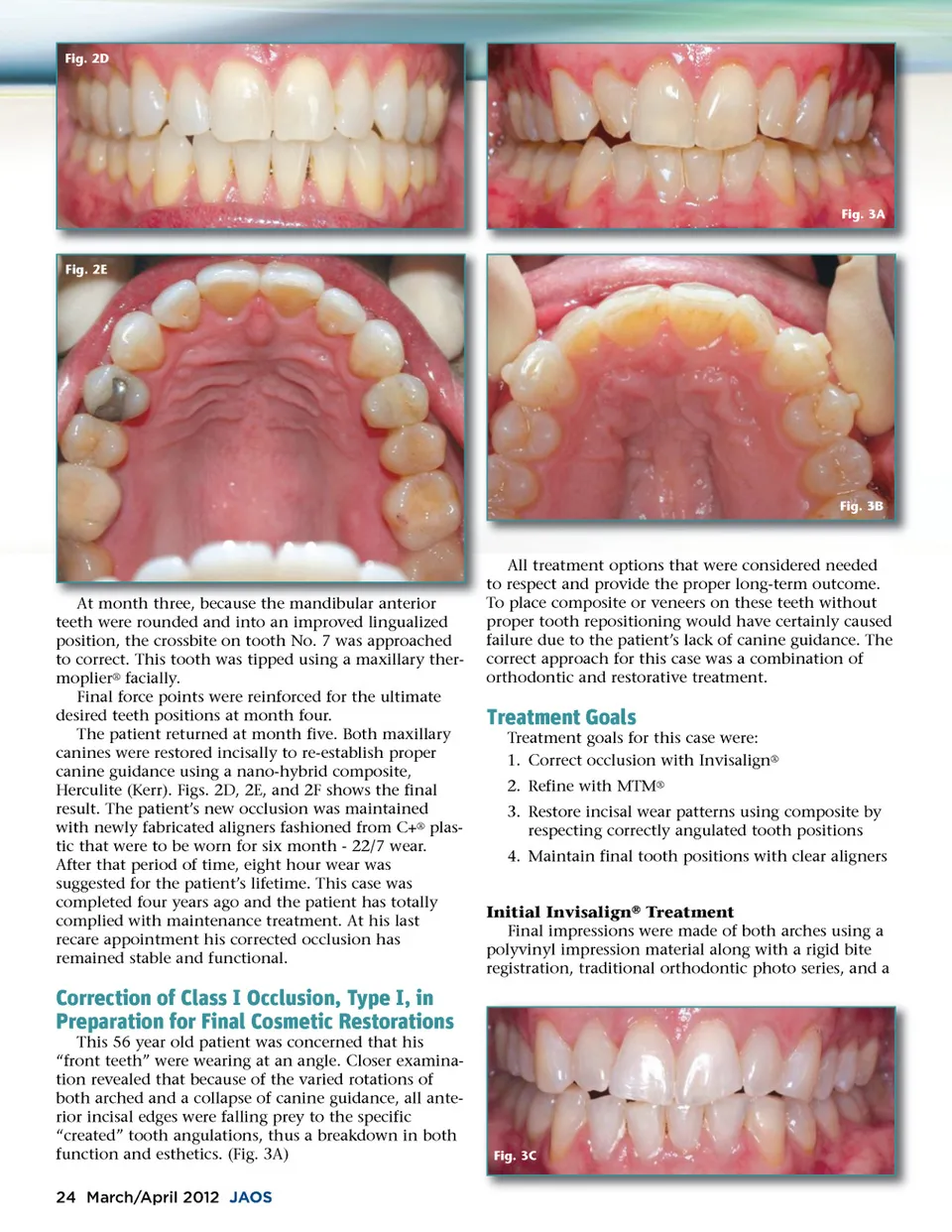
Fig. 2D Fig. 3A Fig. 2E Fig. 3B At month three three, because the mandibular anterior teeth were rounded and into an improved lingualized position, the crossbite on tooth No. 7 was approached to correct. This tooth was tipped using a maxillary ther-moplier ® facially. Final force points were reinforced for the ultimate desired teeth positions at month four. The patient returned at month five. Both maxillary canines were restored incisally to re-establish proper canine guidance using a nano-hybrid composite, Herculite (Kerr). Figs. 2D, 2E, and 2F shows the final result. The patient’s new occlusion was maintained with newly fabricated aligners fashioned from C+ ® plas-tic that were to be worn for six month -22/7 wear. After that period of time, eight hour wear was suggested for the patient’s lifetime. This case was completed four years ago and the patient has totally complied with maintenance treatment. At his last recare appointment his corrected occlusion has remained stable and functional. All treatment options that were considered needed to respect and provide the proper long-term outcome. To place composite or veneers on these teeth without proper tooth repositioning would have certainly caused failure due to the patient’s lack of canine guidance. The correct approach for this case was a combination of orthodontic and restorative treatment. Treatment Goals Treatment goals for this case were: 1. Correct occlusion with Invisalign ® 2. Refine with MTM ® 3. Restore incisal wear patterns using composite by respecting correctly angulated tooth positions 4. Maintain final tooth positions with clear aligners Initial Invisalign ® Treatment Final impressions were made of both arches using a polyvinyl impression material along with a rigid bite registration, traditional orthodontic photo series, and a Correction of Class I Occlusion, Type I, in Preparation for Final Cosmetic Restorations This 56 year old patient was concerned that his “front teeth” were wearing at an angle. Closer examina-tion revealed that because of the varied rotations of both arched and a collapse of canine guidance, all ante-rior incisal edges were falling prey to the specific “created” tooth angulations, thus a breakdown in both function and esthetics. (Fig. 3A) 24 March/April 2012 JAOS Fig. 3C
Journal of the American Orthodontic Society March-April 2012: Page 24