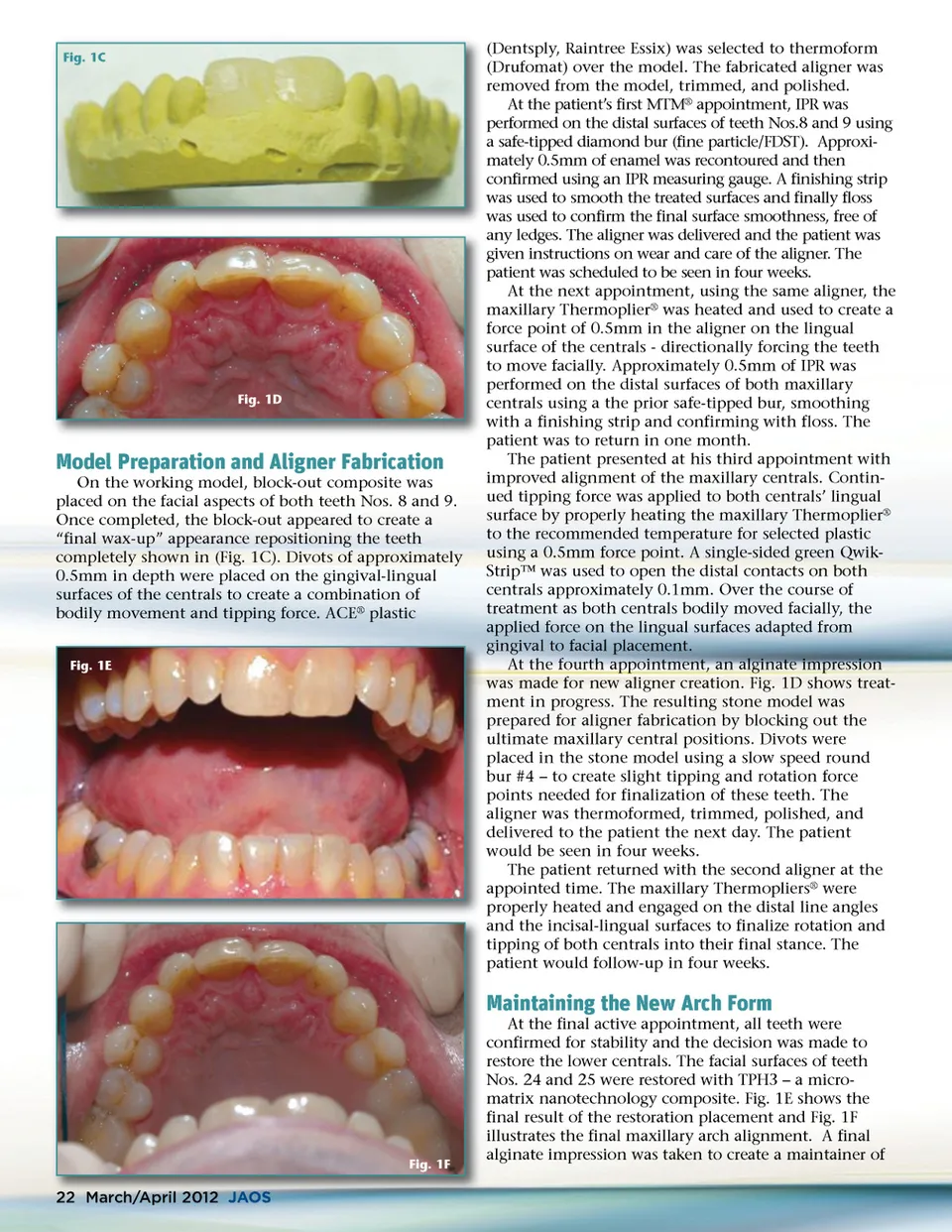
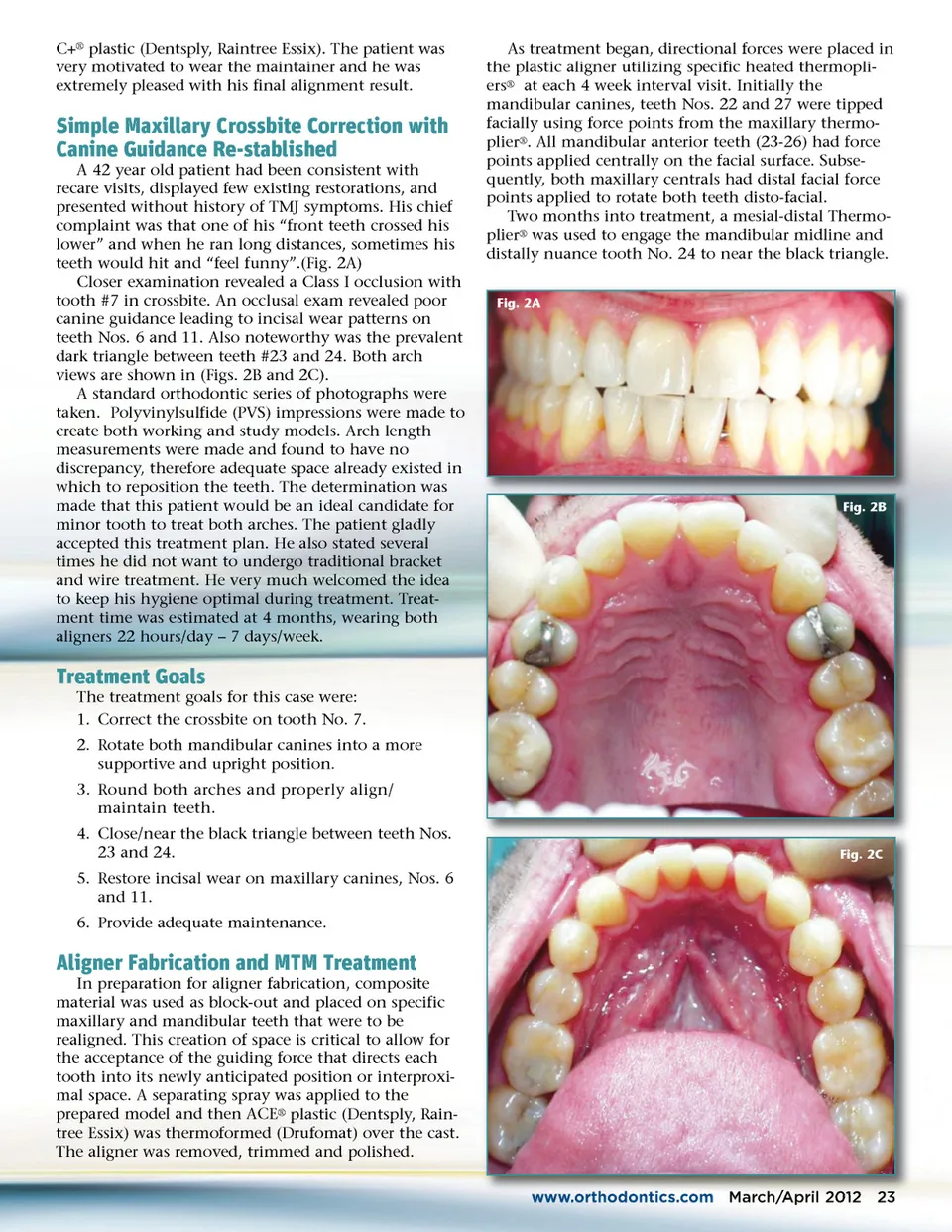
Fig. 1C Fig. 1D Model Preparation and Aligner Fabrication On the working model, block-out composite was placed on the facial aspects of both teeth Nos. 8 and 9. Once completed, the block-out appeared to create a “final wax-up” appearance repositioning the teeth completely shown in (Fig. 1C). Divots of approximately 0.5mm in depth were placed on the gingival-lingual surfaces of the centrals to create a combination of bodily movement and tipping force. ACE ® plastic Fig. 1E (Dentsply, Raintree Essix) was selected to thermoform (Drufomat) over the model. The fabricated aligner was removed from the model, trimmed, and polished. At the patient’s first MTM ® appointment, IPR was performed on the distal surfaces of teeth Nos.8 and 9 using a safe-tipped diamond bur (fine particle/FDST). Approxi-mately 0.5mm of enamel was recontoured and then confirmed using an IPR measuring gauge. A finishing strip was used to smooth the treated surfaces and finally floss was used to confirm the final surface smoothness, free of any ledges. The aligner was delivered and the patient was given instructions on wear and care of the aligner. The patient was scheduled to be seen in four weeks. At the next appointment, using the same aligner, the maxillary Thermoplier ® was heated and used to create a force point of 0.5mm in the aligner on the lingual surface of the centrals -directionally forcing the teeth to move facially. Approximately 0.5mm of IPR was performed on the distal surfaces of both maxillary centrals using a the prior safe-tipped bur, smoothing with a finishing strip and confirming with floss. The patient was to return in one month. The patient presented at his third appointment with improved alignment of the maxillary centrals. Contin-ued tipping force was applied to both centrals’ lingual surface by properly heating the maxillary Thermoplier ® to the recommended temperature for selected plastic using a 0.5mm force point. A single-sided green Qwik-Strip™ was used to open the distal contacts on both centrals approximately 0.1mm. Over the course of treatment as both centrals bodily moved facially, the applied force on the lingual surfaces adapted from gingival to facial placement. At the fourth appointment, an alginate impression was made for new aligner creation. Fig. 1D shows treat-ment in progress. The resulting stone model was prepared for aligner fabrication by blocking out the ultimate maxillary central positions. Divots were placed in the stone model using a slow speed round bur #4 – to create slight tipping and rotation force points needed for finalization of these teeth. The aligner was thermoformed, trimmed, polished, and delivered to the patient the next day. The patient would be seen in four weeks. The patient returned with the second aligner at the appointed time. The maxillary Thermopliers ® were properly heated and engaged on the distal line angles and the incisal-lingual surfaces to finalize rotation and tipping of both centrals into their final stance. The patient would follow-up in four weeks. Maintaining the New Arch Form At the final active appointment, all teeth were confirmed for stability and the decision was made to restore the lower centrals. The facial surfaces of teeth Nos. 24 and 25 were restored with TPH3 – a micro-matrix nanotechnology composite. Fig. 1E shows the final result of the restoration placement and Fig. 1F illustrates the final maxillary arch alignment. A final alginate impression was taken to create a maintainer of Fig. 1F 22 March/April March/A / pril 2012 JAOS
Journal of the American Orthodontic Society March-April 2012: Page 22