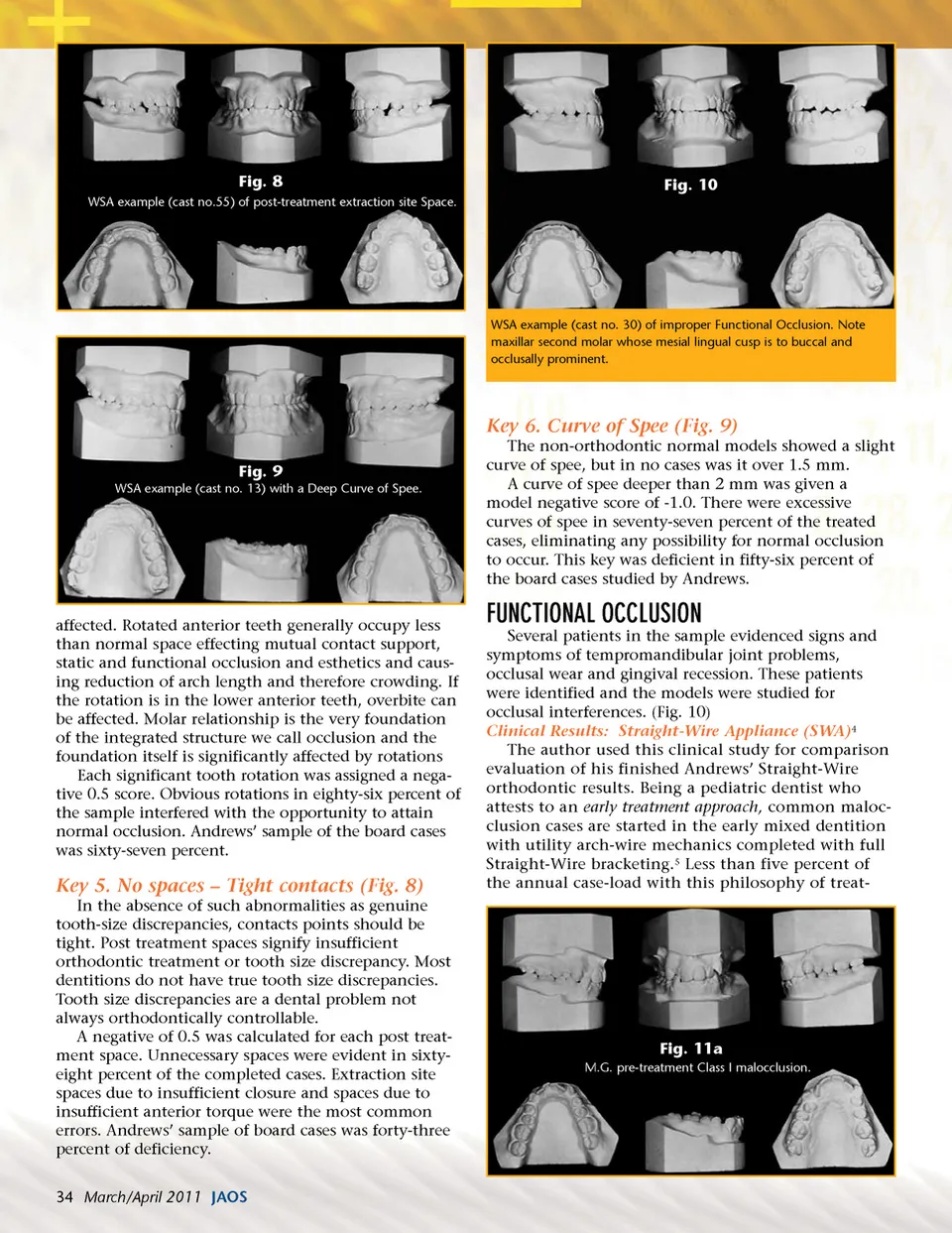
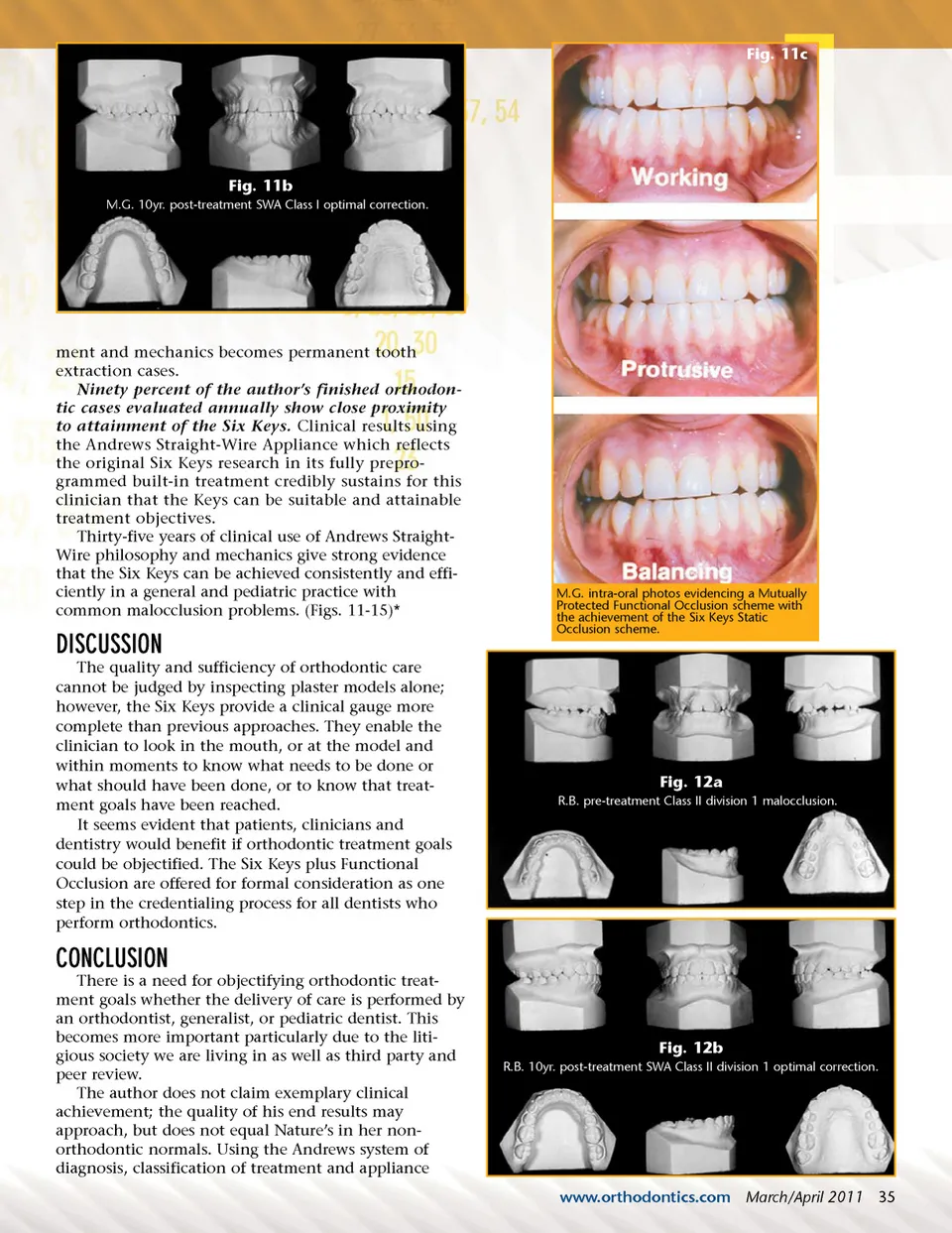
Fig. 11c Fig. 11b M.G. 10yr. post-treatment SWA Class I optimal correction. ment and mechanics becomes permanent tooth extraction cases. Ninety percent of the author’s finished orthodon-tic cases evaluated annually show close proximity to attainment of the Six Keys. Clinical results using the Andrews Straight-Wire Appliance which reflects the original Six Keys research in its fully prepro-grammed built-in treatment credibly sustains for this clinician that the Keys can be suitable and attainable treatment objectives. Thirty-five years of clinical use of Andrews Straight-Wire philosophy and mechanics give strong evidence that the Six Keys can be achieved consistently and effi-ciently in a general and pediatric practice with common malocclusion problems. (Figs. 11-15)* DISCUSSION The quality and sufficiency of orthodontic care cannot be judged by inspecting plaster models alone; however, the Six Keys provide a clinical gauge more complete than previous approaches. They enable the clinician to look in the mouth, or at the model and within moments to know what needs to be done or what should have been done, or to know that treat-ment goals have been reached. It seems evident that patients, clinicians and dentistry would benefit if orthodontic treatment goals could be objectified. The Six Keys plus Functional Occlusion are offered for formal consideration as one step in the credentialing process for all dentists who perform orthodontics. M.G. intra-oral photos evidencing a Mutually Protected Functional Occlusion scheme with the achievement of the Six Keys Static Occlusion scheme. Fig. 12a R.B. pre-treatment Class II division 1 malocclusion. CONCLUSION There is a need for objectifying orthodontic treat-ment goals whether the delivery of care is performed by an orthodontist, generalist, or pediatric dentist. This becomes more important particularly due to the liti-gious society we are living in as well as third party and peer review. The author does not claim exemplary clinical achievement; the quality of his end results may approach, but does not equal Nature’s in her non-orthodontic normals. Using the Andrews system of diagnosis, classification of treatment and appliance Fig. 12b R.B. 10yr. post-treatment SWA Class II division 1 optimal correction. www.orthodontics.com March/April 2011 35
Journal of the American Orthodontic Society March-April 2011: Page 35