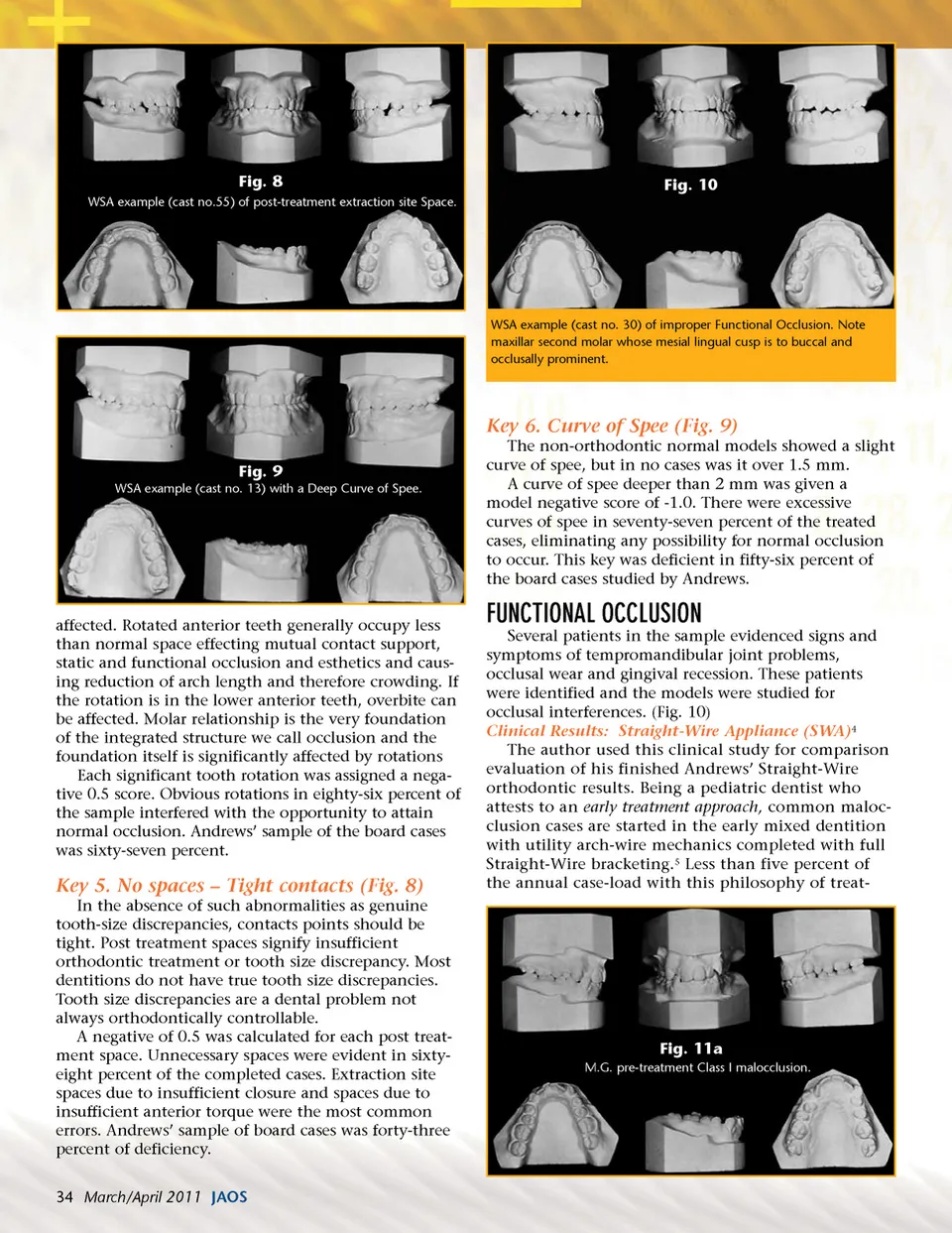
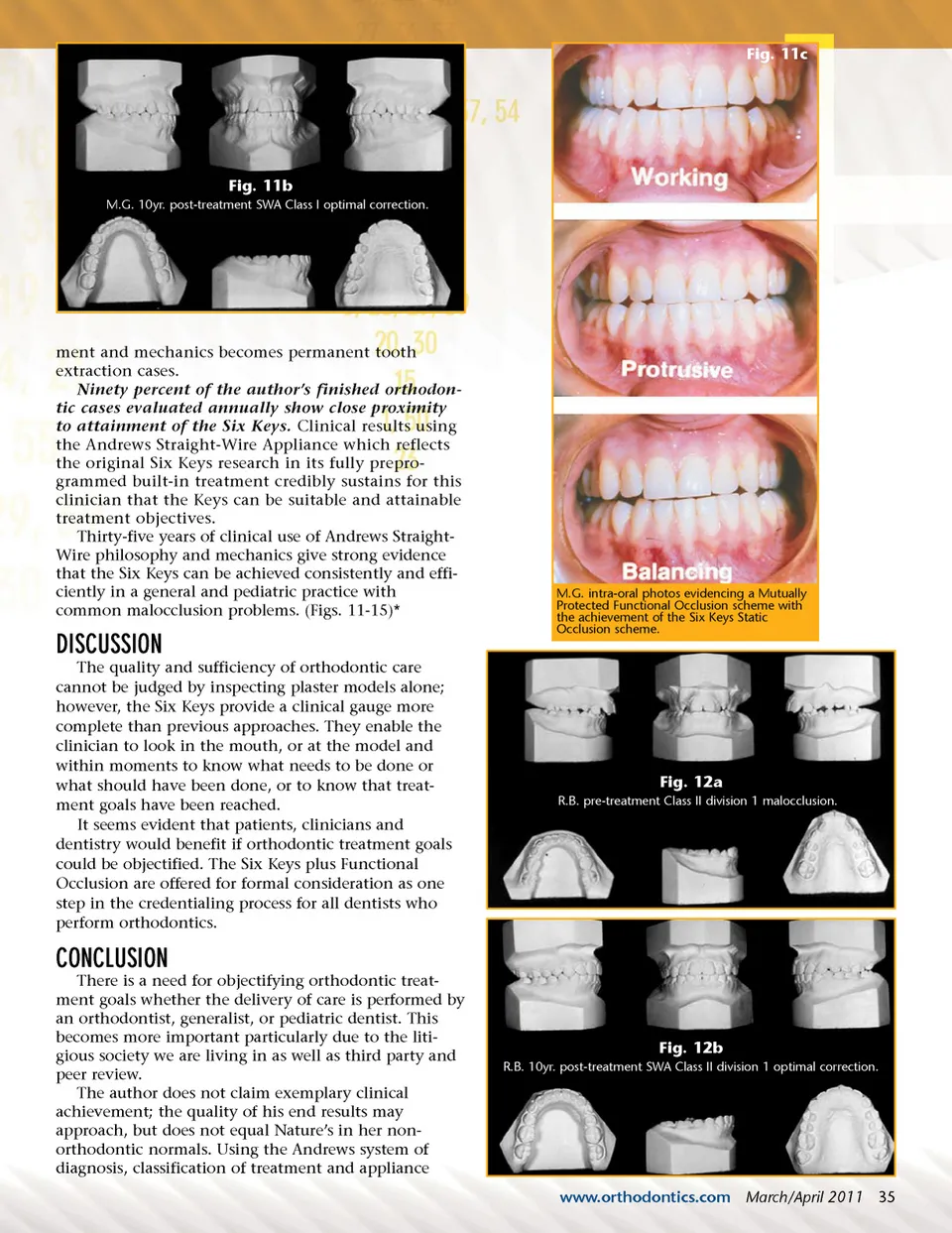
Fig. 8 WSA example (cast no.55) of post-treatment extraction site Space. Fig. 10 WSA example (cast no. 30) of improper Functional Occlusion. Note maxillar second molar whose mesial lingual cusp is to buccal and occlusally prominent. Key 6. Curve of Spee (Fig. 9) Fig. 9 WSA example (cast no. 13) with a Deep Curve of Spee. The non-orthodontic normal models showed a slight curve of spee, but in no cases was it over 1.5 mm. A curve of spee deeper than 2 mm was given a model negative score of -1.0. There were excessive curves of spee in seventy-seven percent of the treated cases, eliminating any possibility for normal occlusion to occur. This key was deficient in fifty-six percent of the board cases studied by Andrews. affected. Rotated anterior teeth generally occupy less than normal space effecting mutual contact support, static and functional occlusion and esthetics and caus-ing reduction of arch length and therefore crowding. If the rotation is in the lower anterior teeth, overbite can be affected. Molar relationship is the very foundation of the integrated structure we call occlusion and the foundation itself is significantly affected by rotations Each significant tooth rotation was assigned a nega-tive 0.5 score. Obvious rotations in eighty-six percent of the sample interfered with the opportunity to attain normal occlusion. Andrews’ sample of the board cases was sixty-seven percent. FUNCTIONAL OCCLUSION Several patients in the sample evidenced signs and symptoms of tempromandibular joint problems, occlusal wear and gingival recession. These patients were identified and the models were studied for occlusal interferences. (Fig. 10) Clinical Results: Straight-Wire Appliance (SWA) 4 The author used this clinical study for comparison evaluation of his finished Andrews’ Straight-Wire orthodontic results. Being a pediatric dentist who attests to an early treatment approach, common maloc-clusion cases are started in the early mixed dentition with utility arch-wire mechanics completed with full Straight-Wire bracketing. 5 Less than five percent of the annual case-load with this philosophy of treat-Key 5. No spaces – Tight contacts (Fig. 8) In the absence of such abnormalities as genuine tooth-size discrepancies, contacts points should be tight. Post treatment spaces signify insufficient orthodontic treatment or tooth size discrepancy. Most dentitions do not have true tooth size discrepancies. Tooth size discrepancies are a dental problem not always orthodontically controllable. A negative of 0.5 was calculated for each post treat-ment space. Unnecessary spaces were evident in sixty-eight percent of the completed cases. Extraction site spaces due to insufficient closure and spaces due to insufficient anterior torque were the most common errors. Andrews’ sample of board cases was forty-three percent of deficiency. 34 March/April 2011 JAOS Fig. 11a M.G. pre-treatment Class I malocclusion.
Journal of the American Orthodontic Society March-April 2011: Page 34