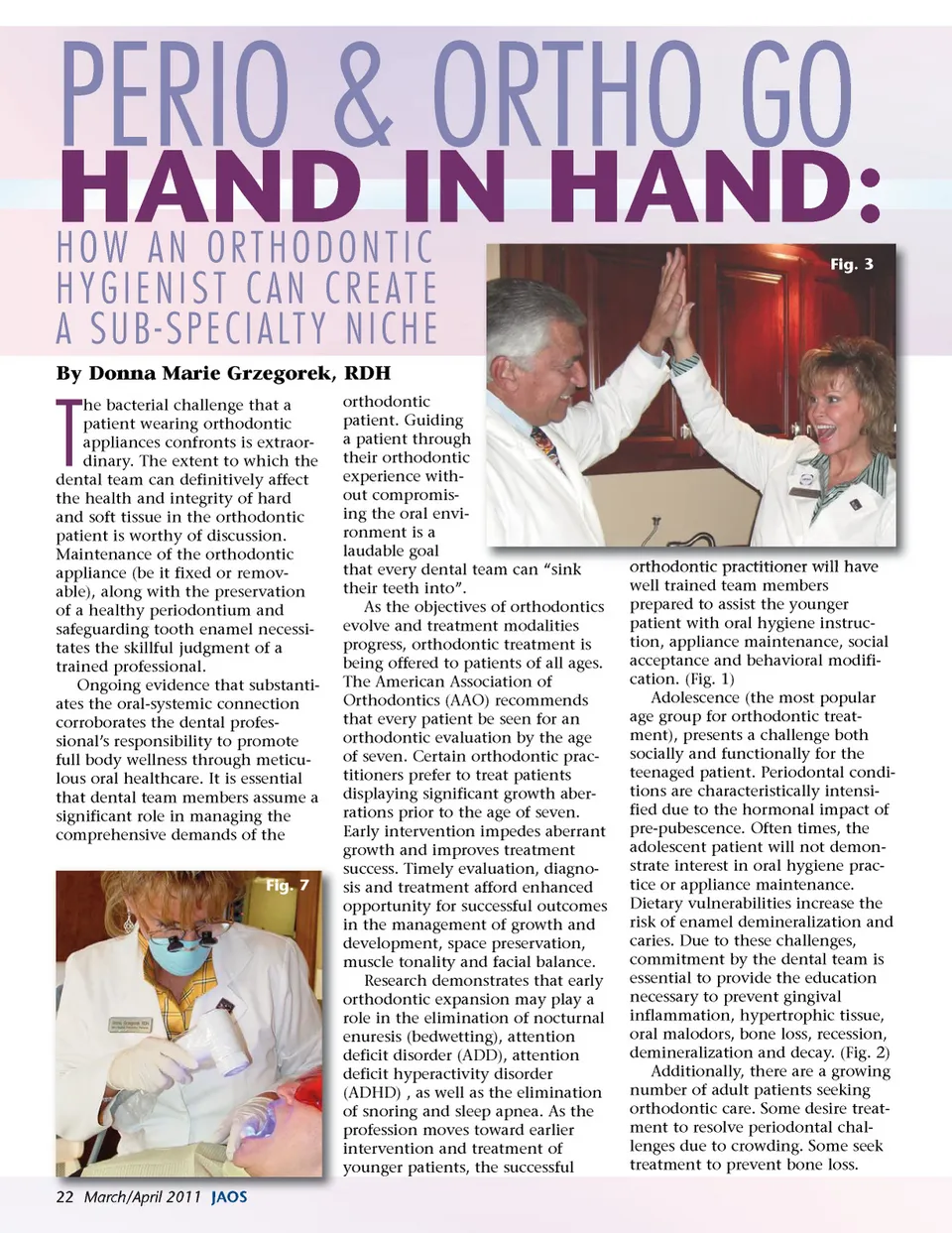
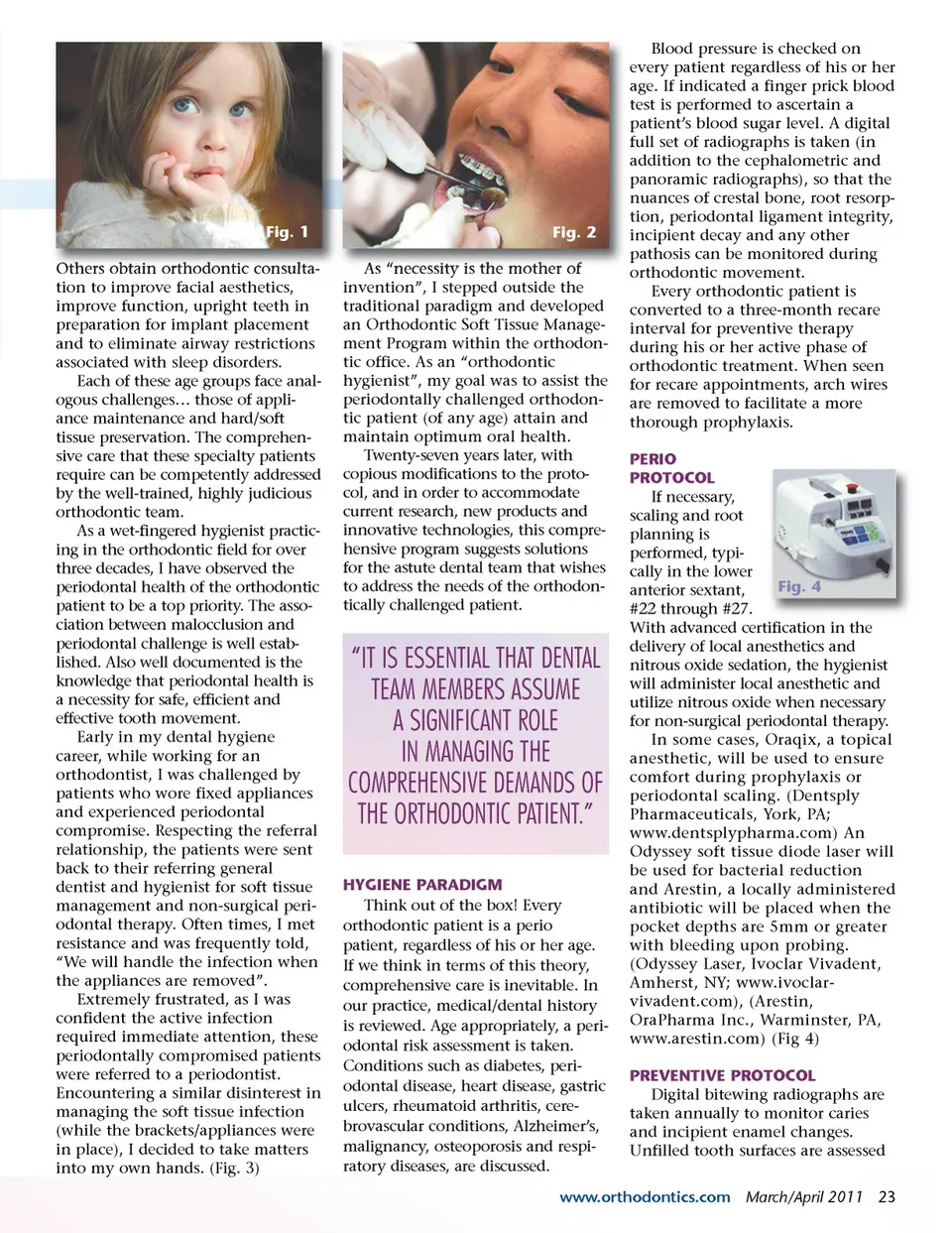
Fig. 1 Others obtain orthodontic consulta-tion to improve facial aesthetics, improve function, upright teeth in preparation for implant placement and to eliminate airway restrictions associated with sleep disorders. Each of these age groups face anal-ogous challenges… those of appli-ance maintenance and hard/soft tissue preservation. The comprehen-sive care that these specialty patients require can be competently addressed by the well-trained, highly judicious orthodontic team. As a wet-fingered hygienist practic-ing in the orthodontic field for over three decades, I have observed the periodontal health of the orthodontic patient to be a top priority. The asso-ciation between malocclusion and periodontal challenge is well estab-lished. Also well documented is the knowledge that periodontal health is a necessity for safe, efficient and effective tooth movement. Early in my dental hygiene career, while working for an orthodontist, I was challenged by patients who wore fixed appliances and experienced periodontal compromise. Respecting the referral relationship, the patients were sent back to their referring general dentist and hygienist for soft tissue management and non-surgical peri-odontal therapy. Often times, I met resistance and was frequently told, “We will handle the infection when the appliances are removed”. Extremely frustrated, as I was confident the active infection required immediate attention, these periodontally compromised patients were referred to a periodontist. Encountering a similar disinterest in managing the soft tissue infection (while the brackets/appliances were in place), I decided to take matters into my own hands. (Fig. 3) Fig. 2 As “necessity is the mother of invention”, I stepped outside the traditional paradigm and developed an Orthodontic Soft Tissue Manage-ment Program within the orthodon-tic office. As an “orthodontic hygienist”, my goal was to assist the periodontally challenged orthodon-tic patient (of any age) attain and maintain optimum oral health. Twenty-seven years later, with copious modifications to the proto-col, and in order to accommodate current research, new products and innovative technologies, this compre-hensive program suggests solutions for the astute dental team that wishes to address the needs of the orthodon-tically challenged patient. Blood pressure is checked on every patient regardless of his or her age. If indicated a finger prick blood test is performed to ascertain a patient’s blood sugar level. A digital full set of radiographs is taken (in addition to the cephalometric and panoramic radiographs), so that the nuances of crestal bone, root resorp-tion, periodontal ligament integrity, incipient decay and any other pathosis can be monitored during orthodontic movement. Every orthodontic patient is converted to a three-month recare interval for preventive therapy during his or her active phase of orthodontic treatment. When seen for recare appointments, arch wires are removed to facilitate a more thorough prophylaxis. PERIO PROTOCOL If necessary, scaling and root planning is performed, typi-cally in the lower Fig. 4 anterior sextant, #22 through #27. With advanced certification in the delivery of local anesthetics and nitrous oxide sedation, the hygienist will administer local anesthetic and utilize nitrous oxide when necessary for non-surgical periodontal therapy. In some cases, Oraqix, a topical anesthetic, will be used to ensure comfort during prophylaxis or periodontal scaling. (Dentsply Pharmaceuticals, York, PA; www.dentsplypharma.com) An Odyssey soft tissue diode laser will be used for bacterial reduction and Arestin, a locally administered antibiotic will be placed when the pocket depths are 5mm or greater with bleeding upon probing. (Odyssey Laser, Ivoclar Vivadent, Amherst, NY; www.ivoclar-vivadent.com), (Arestin, OraPharma Inc., Warminster, PA, www.arestin.com) (Fig 4) PREVENTIVE PROTOCOL Digital bitewing radiographs are taken annually to monitor caries and incipient enamel changes. Unfilled tooth surfaces are assessed “IT IS ESSENTIAL THAT DENTAL TEAM MEMBERS ASSUME A SIGNIFICANT ROLE IN MANAGING THE COMPREHENSIVE DEMANDS OF THE ORTHODONTIC PATIENT.” HYGIENE PARADIGM Think out of the box! Every orthodontic patient is a perio patient, regardless of his or her age. If we think in terms of this theory, comprehensive care is inevitable. In our practice, medical/dental history is reviewed. Age appropriately, a peri-odontal risk assessment is taken. Conditions such as diabetes, peri-odontal disease, heart disease, gastric ulcers, rheumatoid arthritis, cere-brovascular conditions, Alzheimer’s, malignancy, osteoporosis and respi-ratory diseases, are discussed. www.orthodontics.com March/April 2011 23
Journal of the American Orthodontic Society March-April 2011: Page 23