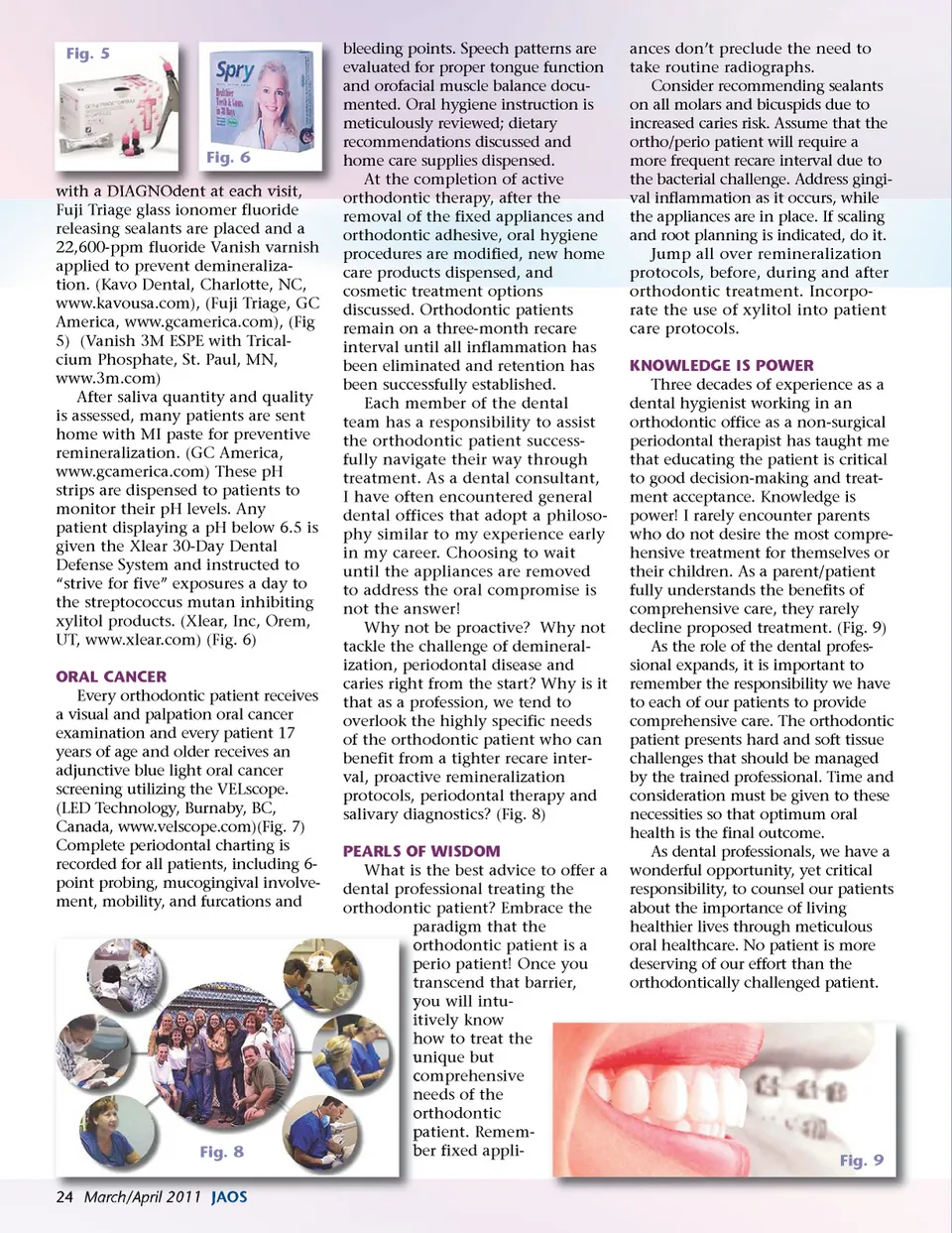
Fig. 5 Fig. 6 with a DIAGNOdent at each visit, Fuji Triage glass ionomer fluoride releasing sealants are placed and a 22,600-ppm fluoride Vanish varnish applied to prevent demineraliza-tion. (Kavo Dental, Charlotte, NC, www.kavousa.com), (Fuji Triage, GC America, www.gcamerica.com), (Fig 5) (Vanish 3M ESPE with Trical-cium Phosphate, St. Paul, MN, www.3m.com) After saliva quantity and quality is assessed, many patients are sent home with MI paste for preventive remineralization. (GC America, www.gcamerica.com) These pH strips are dispensed to patients to monitor their pH levels. Any patient displaying a pH below 6.5 is given the Xlear 30-Day Dental Defense System and instructed to “strive for five” exposures a day to the streptococcus mutan inhibiting xylitol products. (Xlear, Inc, Orem, UT, www.xlear.com) (Fig. 6) ORAL CANCER Every orthodontic patient receives a visual and palpation oral cancer examination and every patient 17 years of age and older receives an adjunctive blue light oral cancer screening utilizing the VELscope. (LED Technology, Burnaby, BC, Canada, www.velscope.com)(Fig. 7) Complete periodontal charting is recorded for all patients, including 6-point probing, mucogingival involve-ment, mobility, and furcations and bleeding points. Speech patterns are evaluated for proper tongue function and orofacial muscle balance docu-mented. Oral hygiene instruction is meticulously reviewed; dietary recommendations discussed and home care supplies dispensed. At the completion of active orthodontic therapy, after the removal of the fixed appliances and orthodontic adhesive, oral hygiene procedures are modified, new home care products dispensed, and cosmetic treatment options discussed. Orthodontic patients remain on a three-month recare interval until all inflammation has been eliminated and retention has been successfully established. Each member of the dental team has a responsibility to assist the orthodontic patient success-fully navigate their way through treatment. As a dental consultant, I have often encountered general dental offices that adopt a philoso-phy similar to my experience early in my career. Choosing to wait until the appliances are removed to address the oral compromise is not the answer! Why not be proactive? Why not tackle the challenge of demineral-ization, periodontal disease and caries right from the start? Why is it that as a profession, we tend to overlook the highly specific needs of the orthodontic patient who can benefit from a tighter recare inter-val, proactive remineralization protocols, periodontal therapy and salivary diagnostics? (Fig. 8) PEARLS OF WISDOM What is the best advice to offer a dental professional treating the orthodontic patient? Embrace the paradigm that the orthodontic patient is a perio patient! Once you transcend that barrier, you will intu-itively know how to treat the unique but comprehensive needs of the orthodontic patient. Remem-ber fixed appli-ances don’t preclude the need to take routine radiographs. Consider recommending sealants on all molars and bicuspids due to increased caries risk. Assume that the ortho/perio patient will require a more frequent recare interval due to the bacterial challenge. Address gingi-val inflammation as it occurs, while the appliances are in place. If scaling and root planning is indicated, do it. Jump all over remineralization protocols, before, during and after orthodontic treatment. Incorpo-rate the use of xylitol into patient care protocols. KNOWLEDGE IS POWER Three decades of experience as a dental hygienist working in an orthodontic office as a non-surgical periodontal therapist has taught me that educating the patient is critical to good decision-making and treat-ment acceptance. Knowledge is power! I rarely encounter parents who do not desire the most compre-hensive treatment for themselves or their children. As a parent/patient fully understands the benefits of comprehensive care, they rarely decline proposed treatment. (Fig. 9) As the role of the dental profes-sional expands, it is important to remember the responsibility we have to each of our patients to provide comprehensive care. The orthodontic patient presents hard and soft tissue challenges that should be managed by the trained professional. Time and consideration must be given to these necessities so that optimum oral health is the final outcome. As dental professionals, we have a wonderful opportunity, yet critical responsibility, to counsel our patients about the importance of living healthier lives through meticulous oral healthcare. No patient is more deserving of our effort than the orthodontically challenged patient. Fig. 8 24 March/April 2011 JAOS Fig. 9
Journal of the American Orthodontic Society March-April 2011: Page 24