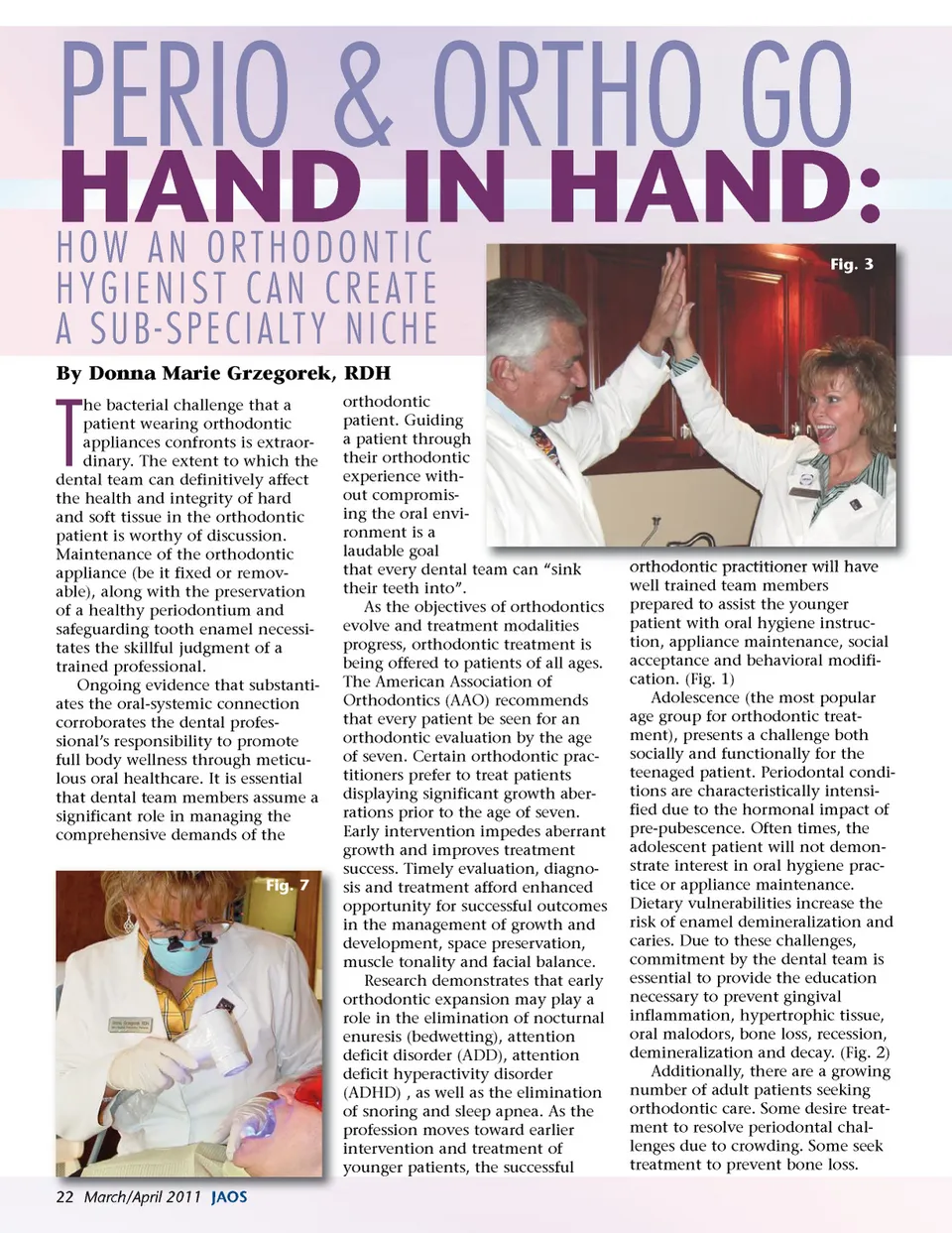
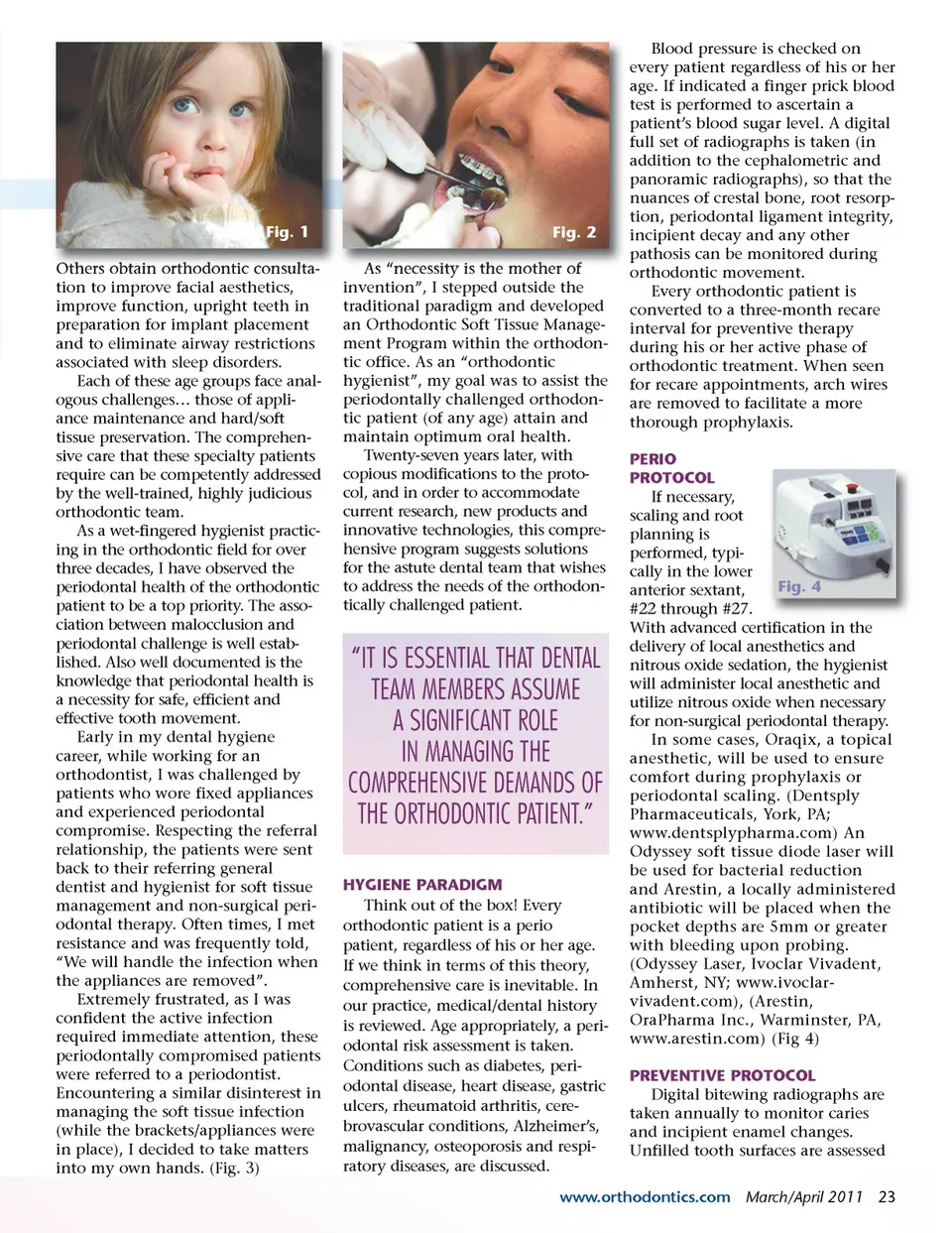
PERIO & ORTHO GO HYGIENIST CAN CREATE A SUB-SPECIALTY NICHE By Donna Marie Grzegorek, RDH HAND IN HAND: HOW AN OR THODONTIC Fig. 3 T he bacterial challenge that a patient wearing orthodontic appliances confronts is extraor-dinary. The extent to which the dental team can definitively affect the health and integrity of hard and soft tissue in the orthodontic patient is worthy of discussion. Maintenance of the orthodontic appliance (be it fixed or remov-able), along with the preservation of a healthy periodontium and safeguarding tooth enamel necessi-tates the skillful judgment of a trained professional. Ongoing evidence that substanti-ates the oral-systemic connection corroborates the dental profes-sional’s responsibility to promote full body wellness through meticu-lous oral healthcare. It is essential that dental team members assume a significant role in managing the comprehensive demands of the Fig. 7 orthodontic patient. Guiding a patient through their orthodontic experience with-out compromis-ing the oral envi-ronment is a laudable goal that every dental team can “sink their teeth into”. As the objectives of orthodontics evolve and treatment modalities progress, orthodontic treatment is being offered to patients of all ages. The American Association of Orthodontics (AAO) recommends that every patient be seen for an orthodontic evaluation by the age of seven. Certain orthodontic prac-titioners prefer to treat patients displaying significant growth aber-rations prior to the age of seven. Early intervention impedes aberrant growth and improves treatment success. Timely evaluation, diagno-sis and treatment afford enhanced opportunity for successful outcomes in the management of growth and development, space preservation, muscle tonality and facial balance. Research demonstrates that early orthodontic expansion may play a role in the elimination of nocturnal enuresis (bedwetting), attention deficit disorder (ADD), attention deficit hyperactivity disorder (ADHD) , as well as the elimination of snoring and sleep apnea. As the profession moves toward earlier intervention and treatment of younger patients, the successful orthodontic practitioner will have well trained team members prepared to assist the younger patient with oral hygiene instruc-tion, appliance maintenance, social acceptance and behavioral modifi-cation. (Fig. 1) Adolescence (the most popular age group for orthodontic treat-ment), presents a challenge both socially and functionally for the teenaged patient. Periodontal condi-tions are characteristically intensi-fied due to the hormonal impact of pre-pubescence. Often times, the adolescent patient will not demon-strate interest in oral hygiene prac-tice or appliance maintenance. Dietary vulnerabilities increase the risk of enamel demineralization and caries. Due to these challenges, commitment by the dental team is essential to provide the education necessary to prevent gingival inflammation, hypertrophic tissue, oral malodors, bone loss, recession, demineralization and decay. (Fig. 2) Additionally, there are a growing number of adult patients seeking orthodontic care. Some desire treat-ment to resolve periodontal chal-lenges due to crowding. Some seek treatment to prevent bone loss. 22 March/April 2011 JAOS
Journal of the American Orthodontic Society March-April 2011: Page 22