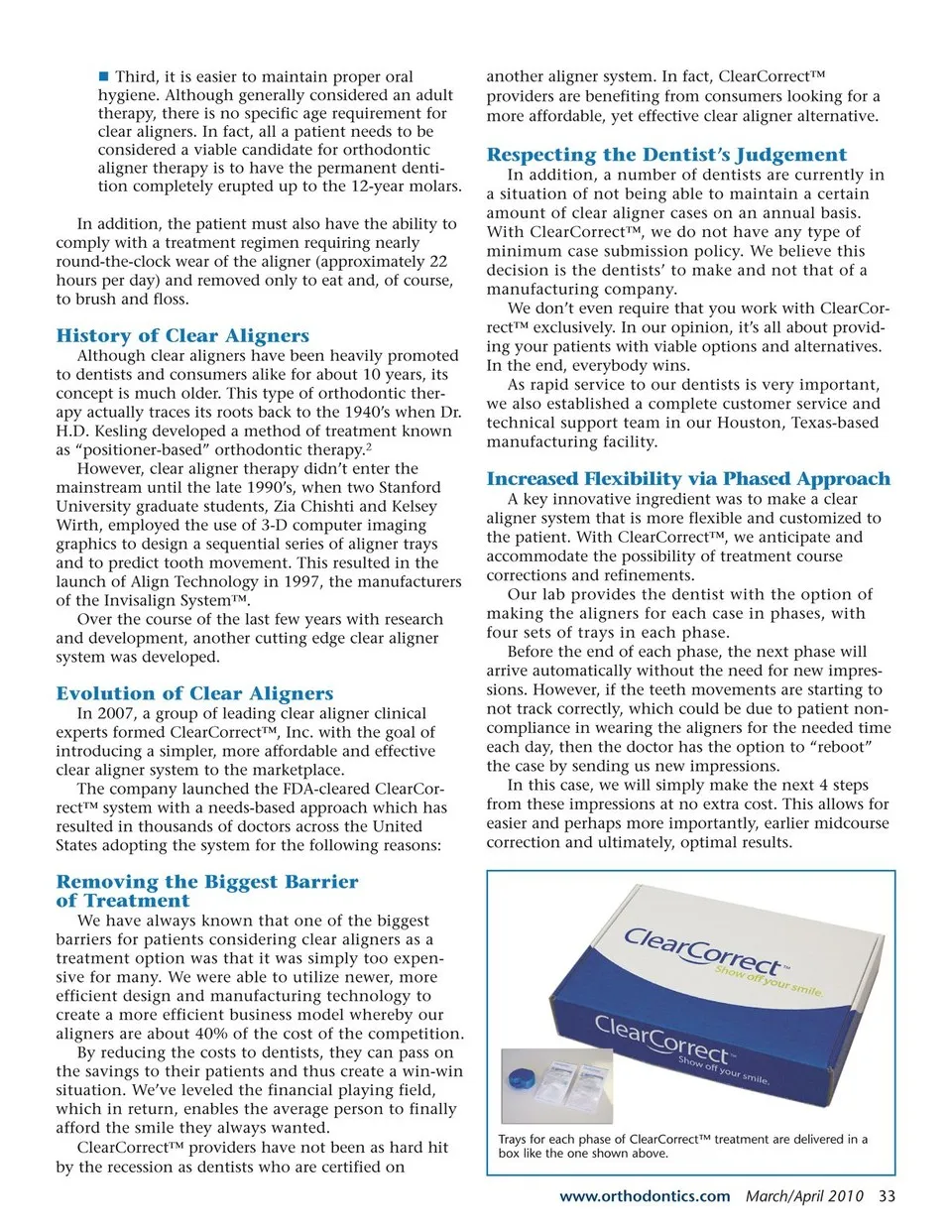
n Third, it is easier to maintain proper oral hygiene. Although generally considered an adult therapy, there is no specific age requirement for clear aligners. In fact, all a patient needs to be considered a viable candidate for orthodontic aligner therapy is to have the permanent denti- tion completely erupted up to the 12-year molars. In addition, the patient must also have the ability to comply with a treatment regimen requiring nearly round-the-clock wear of the aligner (approximately 22 hours per day) and removed only to eat and, of course, to brush and floss. History of Clear Aligners Although clear aligners have been heavily promoted to dentists and consumers alike for about 10 years, its concept is much older. This type of orthodontic ther- apy actually traces its roots back to the 1940’s when Dr. H.D. Kesling developed a method of treatment known as “positioner-based” orthodontic therapy.2 However, clear aligner therapy didn’t enter the mainstream until the late 1990’s, when two Stanford University graduate students, Zia Chishti and Kelsey Wirth, employed the use of 3-D computer imaging graphics to design a sequential series of aligner trays and to predict tooth movement. This resulted in the launch of Align Technology in 1997, the manufacturers of the Invisalign System™. Over the course of the last few years with research and development, another cutting edge clear aligner system was developed. Evolution of Clear Aligners In 2007, a group of leading clear aligner clinical experts formed ClearCorrect™, Inc. with the goal of introducing a simpler, more affordable and effective clear aligner system to the marketplace. The company launched the FDA-cleared ClearCor- rect™ system with a needs-based approach which has resulted in thousands of doctors across the United States adopting the system for the following reasons: Removing the Biggest Barrier of Treatment We have always known that one of the biggest barriers for patients considering clear aligners as a treatment option was that it was simply too expen- sive for many. We were able to utilize newer, more efficient design and manufacturing technology to create a more efficient business model whereby our aligners are about 40% of the cost of the competition. By reducing the costs to dentists, they can pass on the savings to their patients and thus create a win-win situation. We’ve leveled the financial playing field, which in return, enables the average person to finally afford the smile they always wanted. ClearCorrect™ providers have not been as hard hit by the recession as dentists who are certified on another aligner system. In fact, ClearCorrect™ providers are benefiting from consumers looking for a more affordable, yet effective clear aligner alternative. Respecting the Dentist’s Judgement In addition, a number of dentists are currently in a situation of not being able to maintain a certain amount of clear aligner cases on an annual basis. With ClearCorrect™, we do not have any type of minimum case submission policy. We believe this decision is the dentists’ to make and not that of a manufacturing company. We don’t even require that you work with ClearCor- rect™ exclusively. In our opinion, it’s all about provid- ing your patients with viable options and alternatives. In the end, everybody wins. As rapid service to our dentists is very important, we also established a complete customer service and technical support team in our Houston, Texas-based manufacturing facility. Increased Flexibility via Phased Approach A key innovative ingredient was to make a clear aligner system that is more flexible and customized to the patient. With ClearCorrect™, we anticipate and accommodate the possibility of treatment course corrections and refinements. Our lab provides the dentist with the option of making the aligners for each case in phases, with four sets of trays in each phase. Before the end of each phase, the next phase will arrive automatically without the need for new impres- sions. However, if the teeth movements are starting to not track correctly, which could be due to patient non- compliance in wearing the aligners for the needed time each day, then the doctor has the option to “reboot” the case by sending us new impressions. In this case, we will simply make the next 4 steps from these impressions at no extra cost. This allows for easier and perhaps more importantly, earlier midcourse correction and ultimately, optimal results. Trays for each phase of ClearCorrect™ treatment are delivered in a box like the one shown above. www.orthodontics.com March/April 2010 33
Journal of the American Orthodontic Society March - April 2010: Page 33