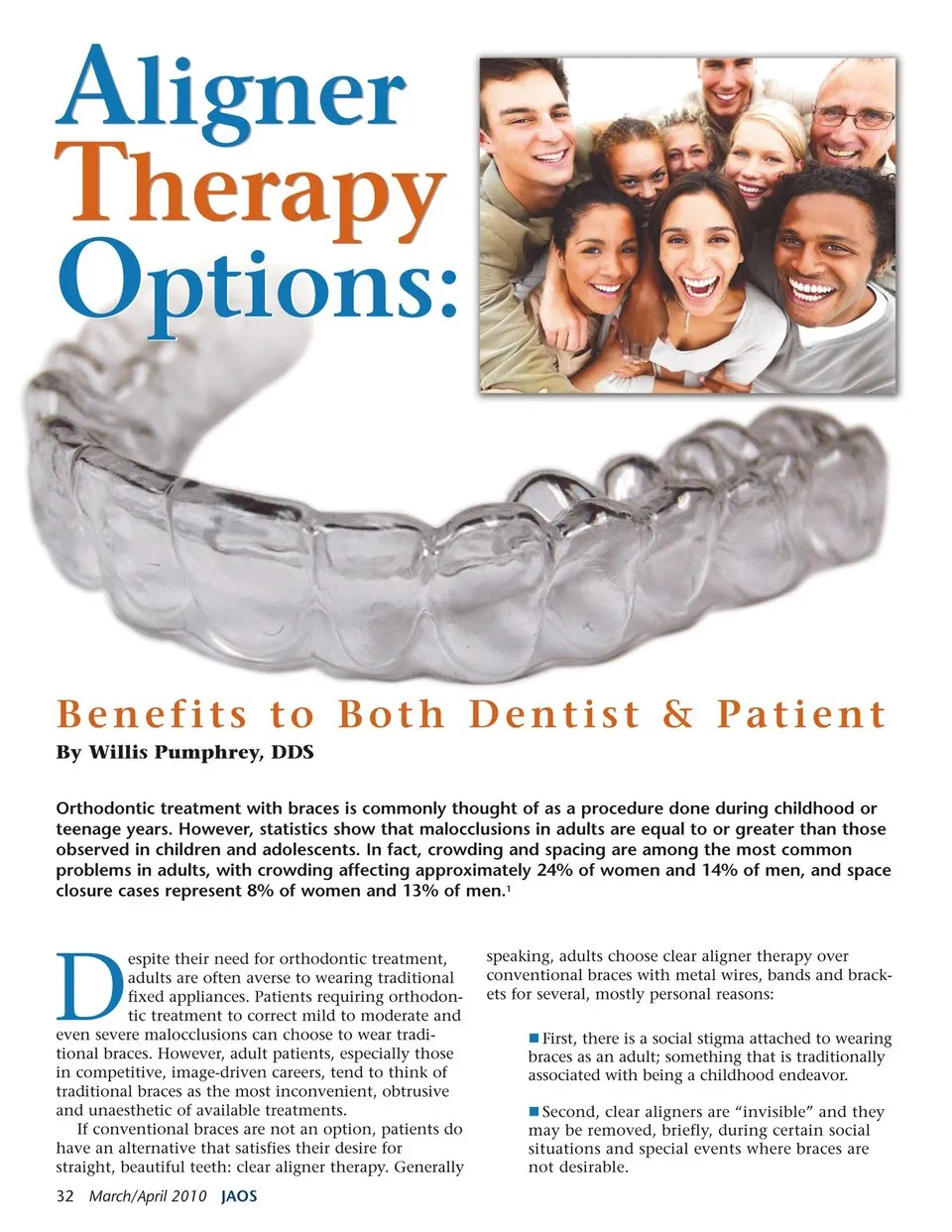
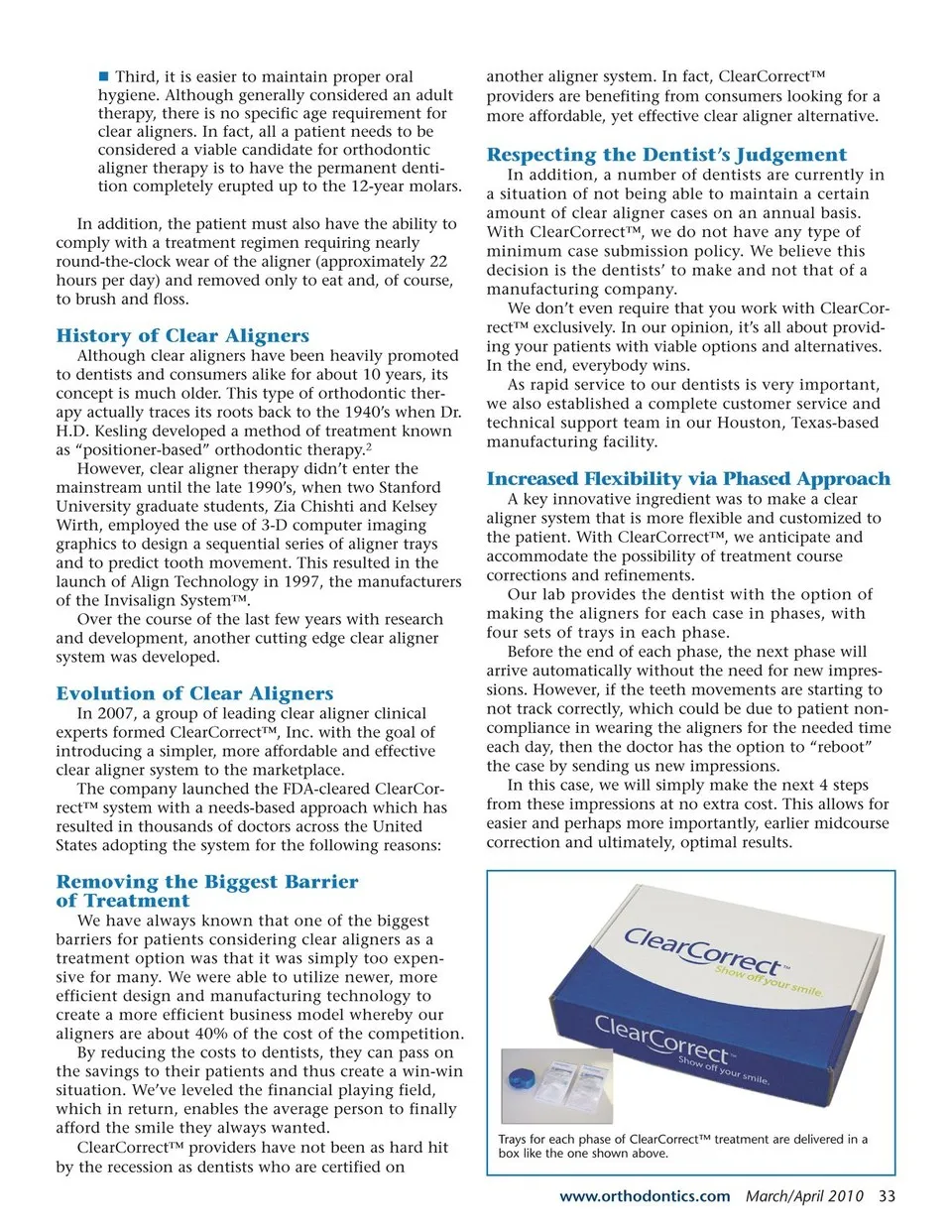
Aligner Therapy Options: Benefits to Both Dentist & Patient By Willis Pumphrey, DDS Orthodontic treatment with braces is commonly thought of as a procedure done during childhood or teenage years. However, statistics show that malocclusions in adults are equal to or greater than those observed in children and adolescents. In fact, crowding and spacing are among the most common problems in adults, with crowding affecting approximately 24% of women and 14% of men, and space closure cases represent 8% of women and 13% of men.1 D espite their need for orthodontic treatment, adults are often averse to wearing traditional fixed appliances. Patients requiring orthodon- tic treatment to correct mild to moderate and even severe malocclusions can choose to wear tradi- tional braces. However, adult patients, especially those in competitive, image-driven careers, tend to think of traditional braces as the most inconvenient, obtrusive and unaesthetic of available treatments. If conventional braces are not an option, patients do have an alternative that satisfies their desire for straight, beautiful teeth: clear aligner therapy. Generally 32 March/April 2010 JAOS speaking, adults choose clear aligner therapy over conventional braces with metal wires, bands and brack- ets for several, mostly personal reasons: nFirst, there is a social stigma attached to wearing braces as an adult; something that is traditionally associated with being a childhood endeavor. nSecond, clear aligners are “invisible” and they may be removed, briefly, during certain social situations and special events where braces are not desirable.
Journal of the American Orthodontic Society March - April 2010: Page 32