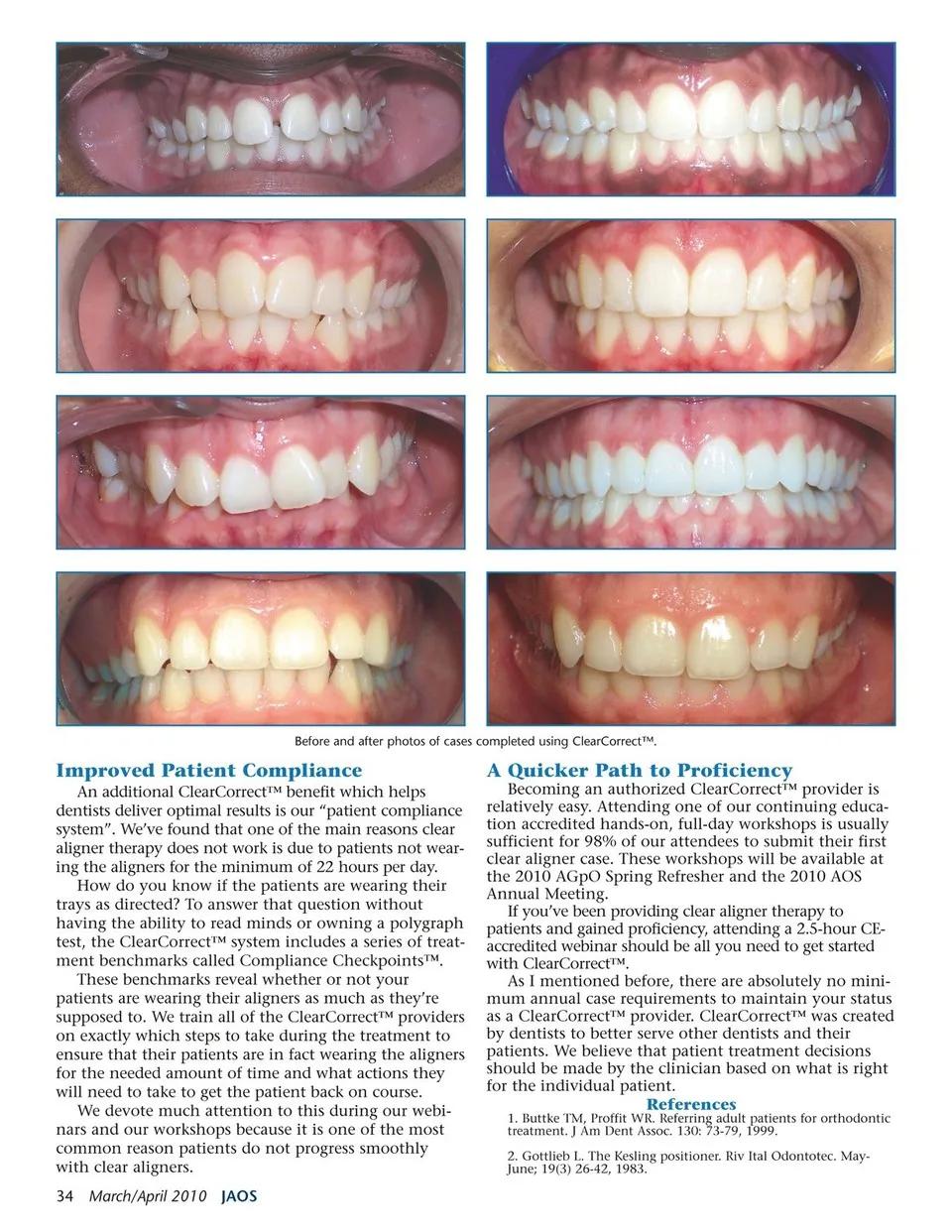
Before and after photos of cases completed using ClearCorrect™. Improved Patient Compliance An additional ClearCorrect™benefit which helps dentists deliver optimal results is our “patient compliance system”. We’ve found that one of the main reasons clear aligner therapy does not work is due to patients not wear- ing the aligners for the minimum of 22 hours per day. How do you know if the patients are wearing their trays as directed? To answer that question without having the ability to read minds or owning a polygraph test, the ClearCorrect™ system includes a series of treat- ment benchmarks called Compliance Checkpoints™. These benchmarks reveal whether or not your patients are wearing their aligners as much as they’re supposed to. We train all of the ClearCorrect™providers on exactly which steps to take during the treatment to ensure that their patients are in fact wearing the aligners for the needed amount of time and what actions they will need to take to get the patient back on course. We devote much attention to this during our webi- nars and our workshops because it is one of the most common reason patients do not progress smoothly with clear aligners. 34 March/April 2010 JAOS A Quicker Path to Proficiency Becoming an authorized ClearCorrect™ provider is relatively easy. Attending one of our continuing educa- tion accredited hands-on, full-day workshops is usually sufficient for 98% of our attendees to submit their first clear aligner case. These workshops will be available at the 2010 AGpO Spring Refresher and the 2010 AOS Annual Meeting. If you’ve been providing clear aligner therapy to patients and gained proficiency, attending a 2.5-hour CE- accredited webinar should be all you need to get started with ClearCorrect™. As I mentioned before, there are absolutely no mini- mum annual case requirements to maintain your status as a ClearCorrect™ provider. ClearCorrect™ was created by dentists to better serve other dentists and their patients. We believe that patient treatment decisions should be made by the clinician based on what is right for the individual patient. 1. Buttke TM, Proffit WR. Referring adult patients for orthodontic treatment. J Am Dent Assoc. 130: 73-79, 1999. References 2. Gottlieb L. The Kesling positioner. Riv Ital Odontotec. May- June; 19(3) 26-42, 1983.
Journal of the American Orthodontic Society March - April 2010: Page 34