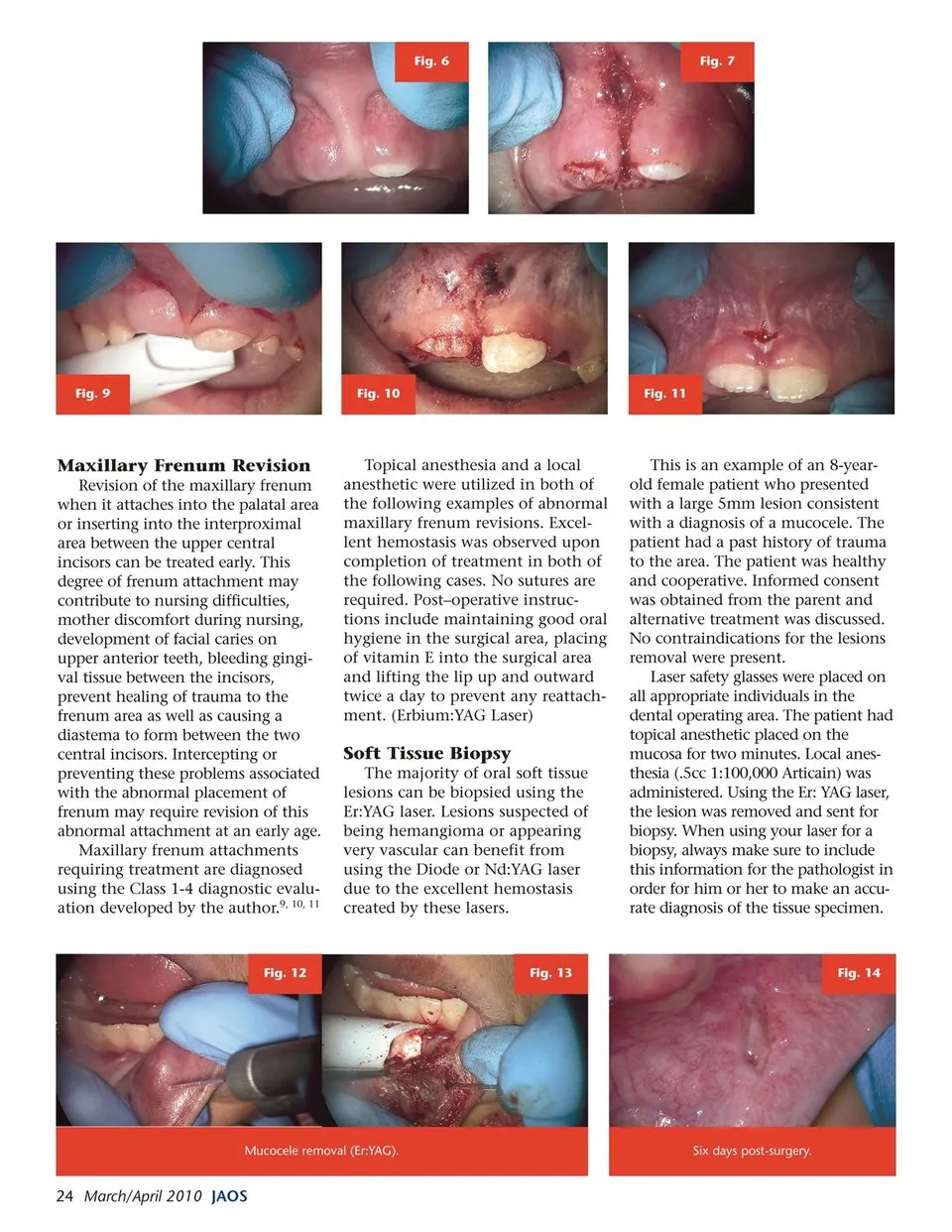
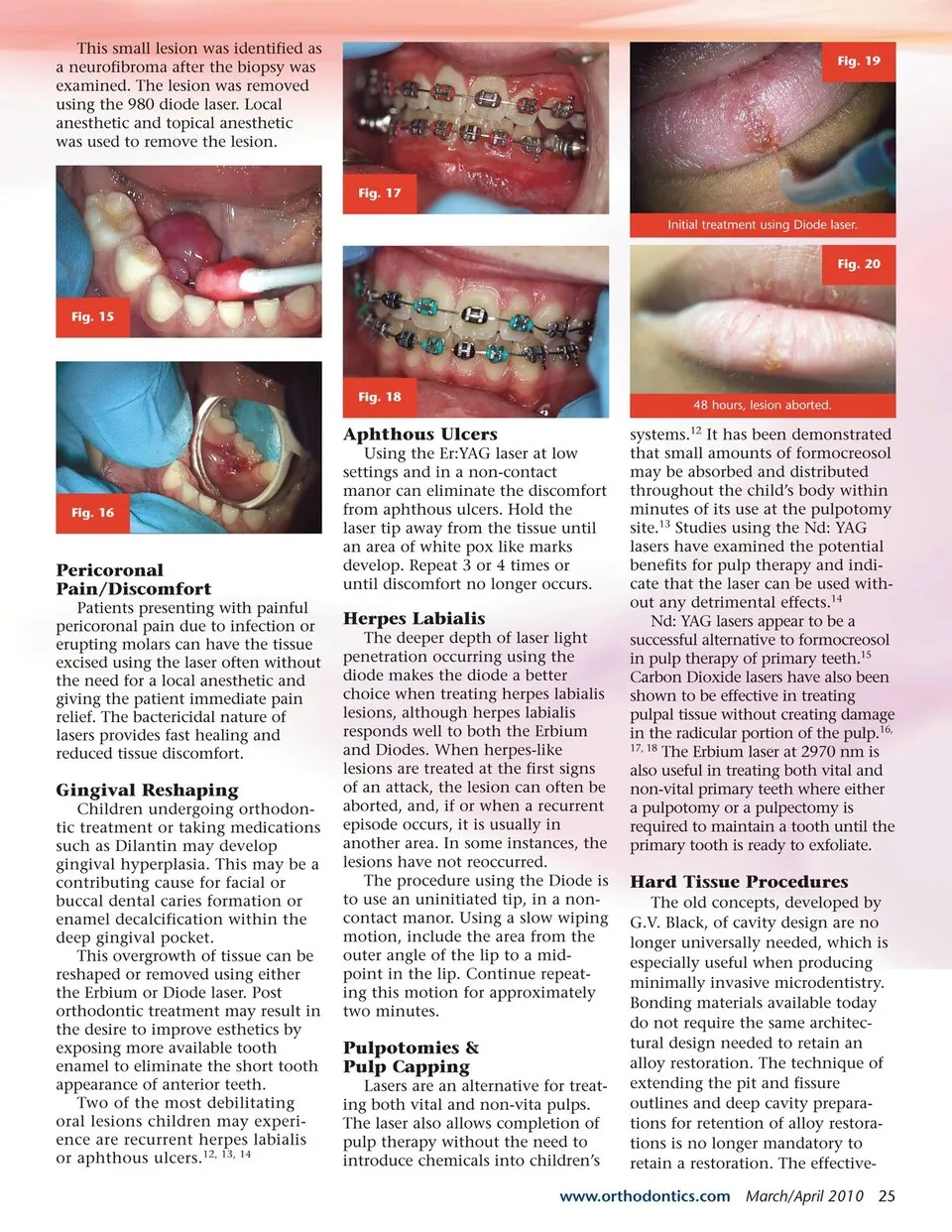
This small lesion was identified as a neurofibroma after the biopsy was examined. The lesion was removed using the 980 diode laser. Local anesthetic and topical anesthetic was used to remove the lesion. Fig. 17 Initial treatment using Diode laser. Fig. 20 Fig. 15 Fig. 19 Fig. 18 Fig. 16 Pericoronal Pain/Discomfort Patients presenting with painful pericoronal pain due to infection or erupting molars can have the tissue excised using the laser often without the need for a local anesthetic and giving the patient immediate pain relief. The bactericidal nature of lasers provides fast healing and reduced tissue discomfort. Gingival Reshaping Children undergoing orthodon- tic treatment or taking medications such as Dilantin may develop gingival hyperplasia. This may be a contributing cause for facial or buccal dental caries formation or enamel decalcification within the deep gingival pocket. This overgrowth of tissue can be reshaped or removed using either the Erbium or Diode laser. Post orthodontic treatment may result in the desire to improve esthetics by exposing more available tooth enamel to eliminate the short tooth appearance of anterior teeth. Two of the most debilitating oral lesions children may experi- ence are recurrent herpes labialis or aphthous ulcers.12, 13, 14 Aphthous Ulcers Using the Er:YAG laser at low settings and in a non-contact manor can eliminate the discomfort from aphthous ulcers. Hold the laser tip away from the tissue until an area of white pox like marks develop. Repeat 3 or 4 times or until discomfort no longer occurs. Herpes Labialis The deeper depth of laser light penetration occurring using the diode makes the diode a better choice when treating herpes labialis lesions, although herpes labialis responds well to both the Erbium and Diodes. When herpes-like lesions are treated at the first signs of an attack, the lesion can often be aborted, and, if or when a recurrent episode occurs, it is usually in another area. In some instances, the lesions have not reoccurred. The procedure using the Diode is to use an uninitiated tip, in a non- contact manor. Using a slow wiping motion, include the area from the outer angle of the lip to a mid- point in the lip. Continue repeat- ing this motion for approximately two minutes. Pulpotomies & Pulp Capping Lasers are an alternative for treat- ing both vital and non-vita pulps. The laser also allows completion of pulp therapy without the need to introduce chemicals into children’s 48 hours, lesion aborted. systems.12 It has been demonstrated that small amounts of formocreosol may be absorbed and distributed throughout the child’s body within minutes of its use at the pulpotomy site.13 Studies using the Nd: YAG lasers have examined the potential benefits for pulp therapy and indi- cate that the laser can be used with- out any detrimental effects.14 Nd: YAG lasers appear to be a successful alternative to formocreosol in pulp therapy of primary teeth.15 Carbon Dioxide lasers have also been shown to be effective in treating pulpal tissue without creating damage in the radicular portion of the pulp.16, 17, 18 The Erbium laser at 2970 nm is also useful in treating both vital and non-vital primary teeth where either a pulpotomy or a pulpectomy is required to maintain a tooth until the primary tooth is ready to exfoliate. Hard Tissue Procedures The old concepts, developed by G.V. Black, of cavity design are no longer universally needed, which is especially useful when producing minimally invasive microdentistry. Bonding materials available today do not require the same architec- tural design needed to retain an alloy restoration. The technique of extending the pit and fissure outlines and deep cavity prepara- tions for retention of alloy restora- tions is no longer mandatory to retain a restoration. The effective- www.orthodontics.com March/April 2010 25
Journal of the American Orthodontic Society March - April 2010: Page 25