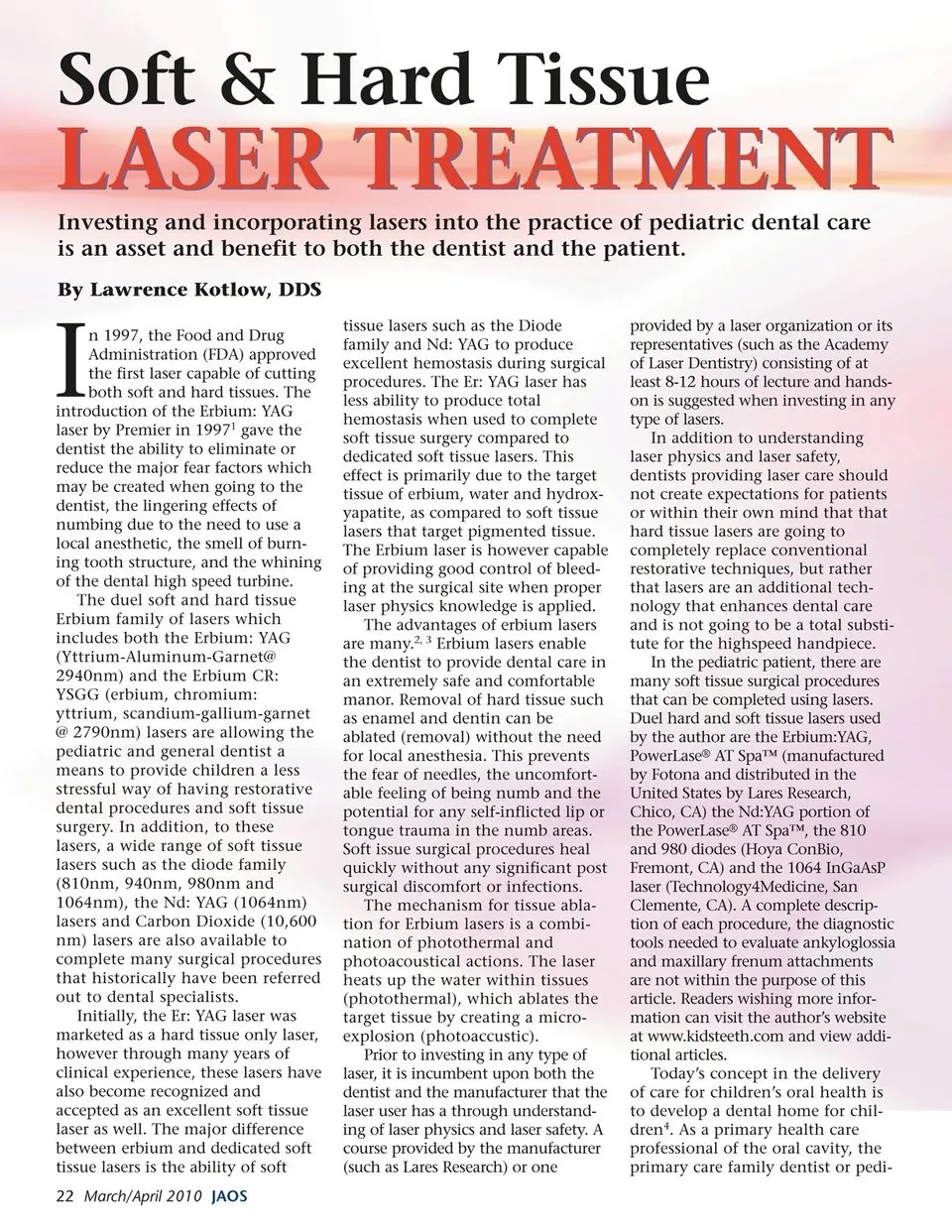
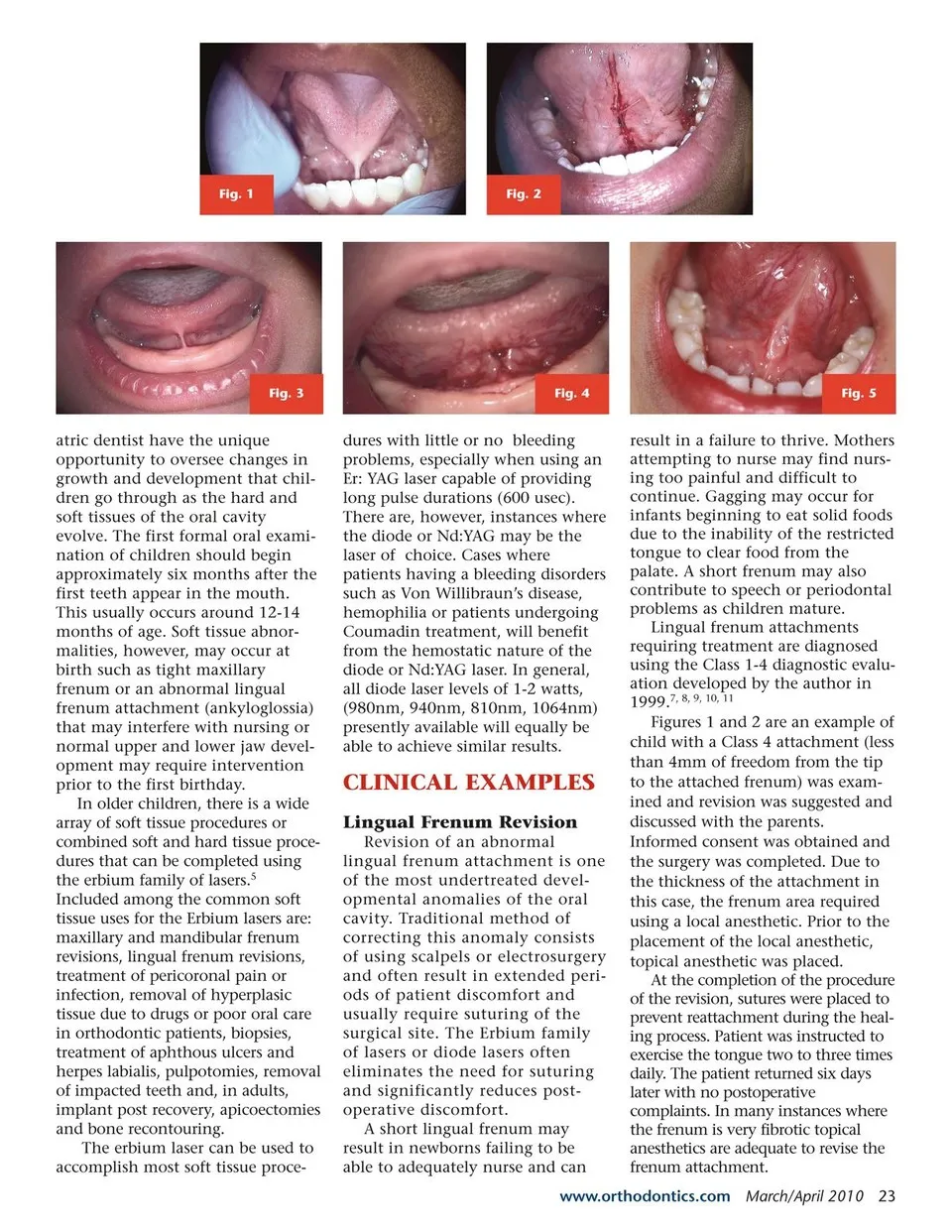
Soft & Hard Tissue LASER TREATMENT Investing and incorporating lasers into the practice of pediatric dental care is an asset and benefit to both the dentist and the patient. By Lawrence Kotlow, DDS I n 1997, the Food and Drug Administration (FDA) approved the first laser capable of cutting both soft and hard tissues. The introduction of the Erbium: YAG laser by Premier in 19971 gave the dentist the ability to eliminate or reduce the major fear factors which may be created when going to the dentist, the lingering effects of numbing due to the need to use a local anesthetic, the smell of burn- ing tooth structure, and the whining of the dental high speed turbine. The duel soft and hard tissue Erbium family of lasers which includes both the Erbium: YAG (Yttrium-Aluminum-Garnet@ 2940nm) and the Erbium CR: YSGG (erbium, chromium: yttrium, scandium-gallium-garnet @ 2790nm) lasers are allowing the pediatric and general dentist a means to provide children a less stressful way of having restorative dental procedures and soft tissue surgery. In addition, to these lasers, a wide range of soft tissue lasers such as the diode family (810nm, 940nm, 980nm and 1064nm), the Nd: YAG (1064nm) lasers and Carbon Dioxide (10,600 nm) lasers are also available to complete many surgical procedures that historically have been referred out to dental specialists. Initially, the Er: YAG laser was marketed as a hard tissue only laser, however through many years of clinical experience, these lasers have also become recognized and accepted as an excellent soft tissue laser as well. The major difference between erbium and dedicated soft tissue lasers is the ability of soft 22 March/April 2010 JAOS tissue lasers such as the Diode family and Nd: YAG to produce excellent hemostasis during surgical procedures. The Er: YAG laser has less ability to produce total hemostasis when used to complete soft tissue surgery compared to dedicated soft tissue lasers. This effect is primarily due to the target tissue of erbium, water and hydrox- yapatite, as compared to soft tissue lasers that target pigmented tissue. The Erbium laser is however capable of providing good control of bleed- ing at the surgical site when proper laser physics knowledge is applied. The advantages of erbium lasers are many.2, 3 Erbium lasers enable the dentist to provide dental care in an extremely safe and comfortable manor. Removal of hard tissue such as enamel and dentin can be ablated (removal) without the need for local anesthesia. This prevents the fear of needles, the uncomfort- able feeling of being numb and the potential for any self-inflicted lip or tongue trauma in the numb areas. Soft issue surgical procedures heal quickly without any significant post surgical discomfort or infections. The mechanism for tissue abla- tion for Erbium lasers is a combi- nation of photothermal and photoacoustical actions. The laser heats up the water within tissues (photothermal), which ablates the target tissue by creating a micro- explosion (photoaccustic). Prior to investing in any type of laser, it is incumbent upon both the dentist and the manufacturer that the laser user has a through understand- ing of laser physics and laser safety. A course provided by the manufacturer (such as Lares Research) or one provided by a laser organization or its representatives (such as the Academy of Laser Dentistry) consisting of at least 8-12 hours of lecture and hands- on is suggested when investing in any type of lasers. In addition to understanding laser physics and laser safety, dentists providing laser care should not create expectations for patients or within their own mind that that hard tissue lasers are going to completely replace conventional restorative techniques, but rather that lasers are an additional tech- nology that enhances dental care and is not going to be a total substi- tute for the highspeed handpiece. In the pediatric patient, there are many soft tissue surgical procedures that can be completed using lasers. Duel hard and soft tissue lasers used by the author are the Erbium:YAG, PowerLase® AT Spa™ (manufactured by Fotona and distributed in the United States by Lares Research, Chico, CA) the Nd:YAG portion of the PowerLase® AT Spa™, the 810 and 980 diodes (Hoya ConBio, Fremont, CA) and the 1064 InGaAsP laser (Technology4Medicine, San Clemente, CA). A complete descrip- tion of each procedure, the diagnostic tools needed to evaluate ankyloglossia and maxillary frenum attachments are not within the purpose of this article. Readers wishing more infor- mation can visit the author’s website at www.kidsteeth.com and view addi- tional articles. Today’s concept in the delivery of care for children’s oral health is to develop a dental home for chil- dren4. As a primary health care professional of the oral cavity, the primary care family dentist or pedi-
Journal of the American Orthodontic Society March - April 2010: Page 22