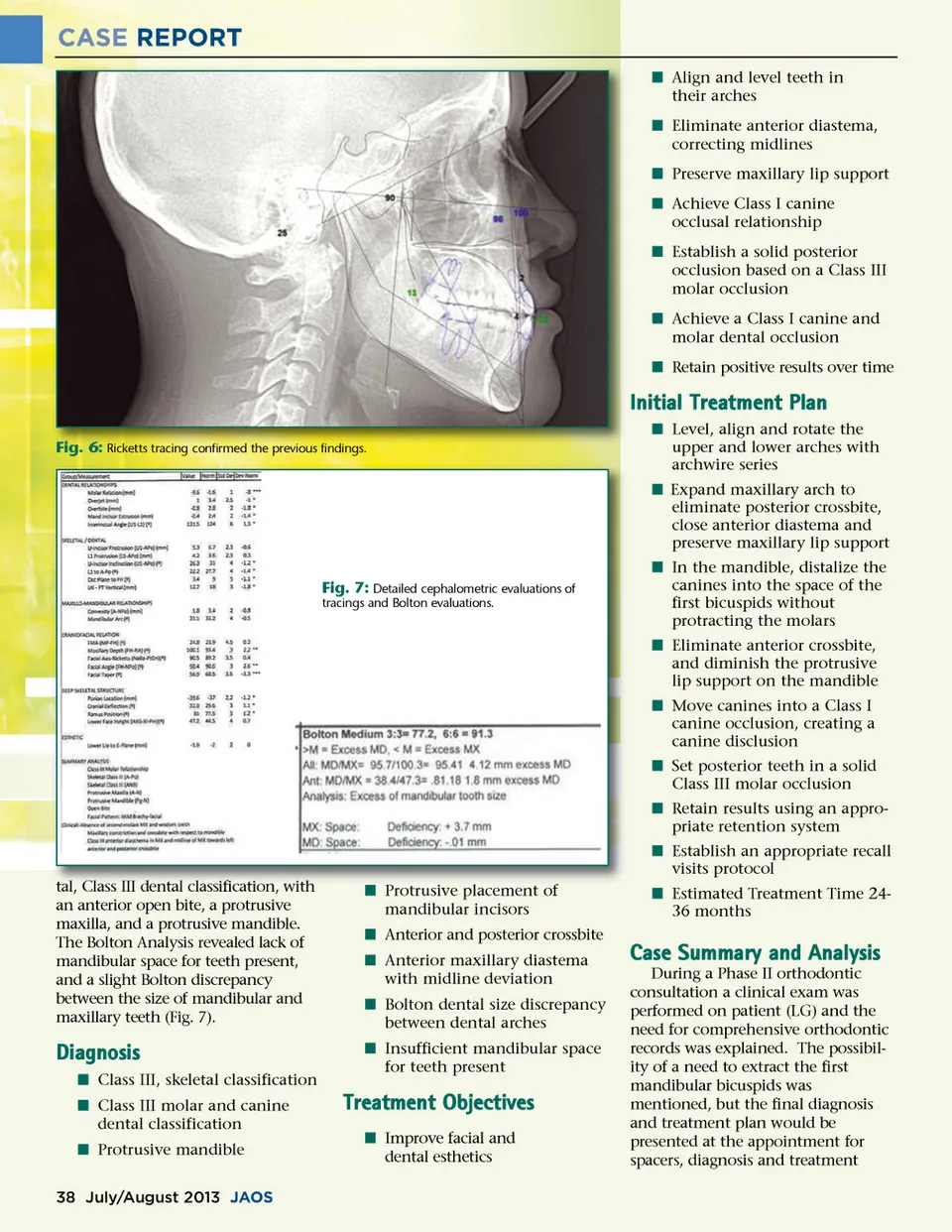
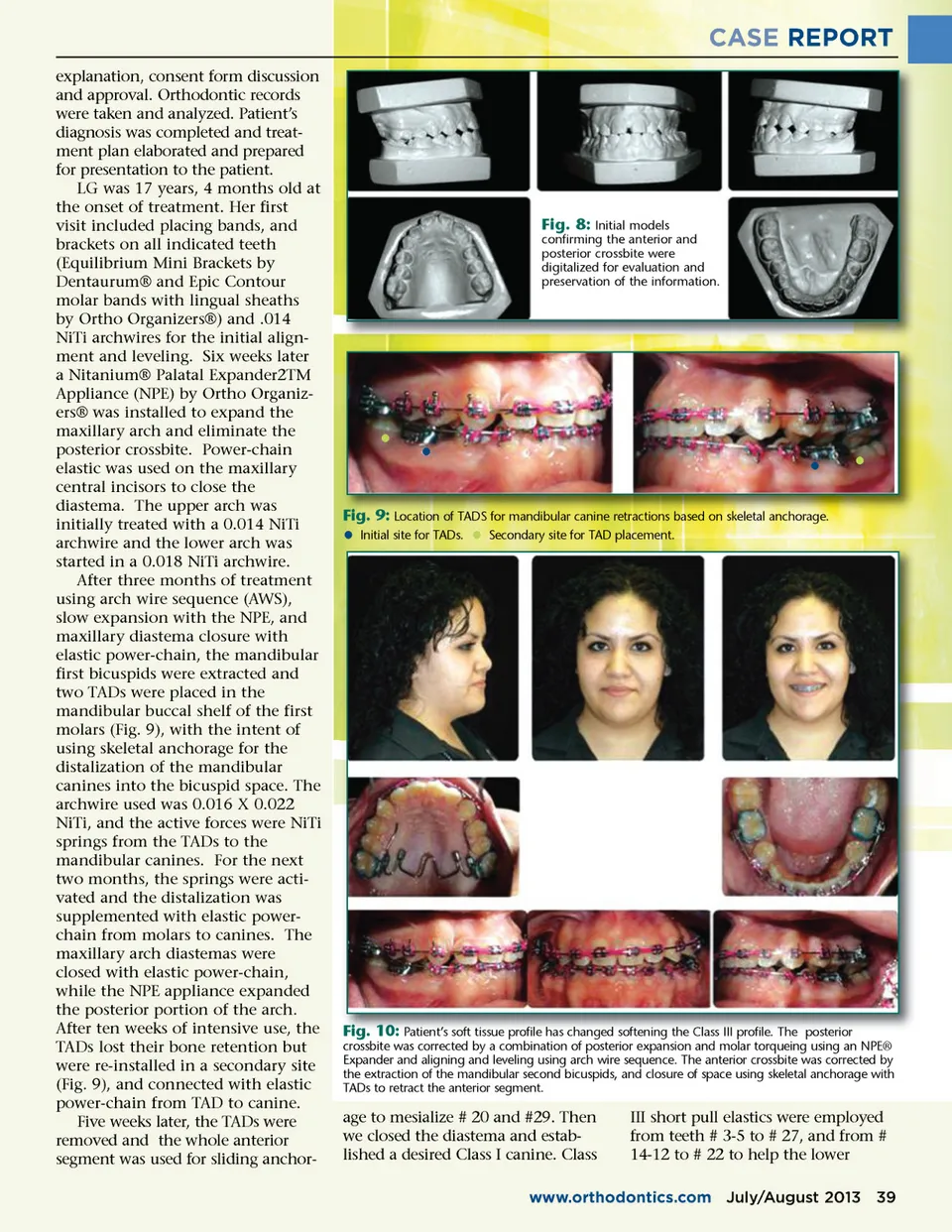
CASE REPORT í Align and level teeth in their arches í Eliminate anterior diastema, correcting midlines í Preserve maxillary lip support í Achieve Class I canine occlusal relationship í Establish a solid posterior occlusion based on a Class III molar occlusion í Achieve a Class I canine and molar dental occlusion í Retain positive results over time Initial Treatment Plan Fig. 6: Ricketts tracing confirmed the previous findings. í Level, align and rotate the upper and lower arches with archwire series í Expand maxillary arch to eliminate posterior crossbite, close anterior diastema and preserve maxillary lip support Fig. 7: Detailed cephalometric evaluations of tracings and Bolton evaluations. í In the mandible, distalize the canines into the space of the first bicuspids without protracting the molars í Eliminate anterior crossbite, and diminish the protrusive lip support on the mandible í Move canines into a Class I canine occlusion, creating a canine disclusion í Set posterior teeth in a solid Class III molar occlusion í Retain results using an appro-priate retention system í Establish an appropriate recall visits protocol tal Class III dental classifi tal, classification, f cation with an anterior open bite, a protrusive maxilla, and a protrusive mandible. The Bolton Analysis revealed lack of mandibular space for teeth present, and a slight Bolton discrepancy between the size of mandibular and maxillary teeth (Fig. 7). í P Protrusive t i placement l t of f mandibular incisors í Anterior and posterior crossbite í Anterior maxillary diastema with midline deviation í Bolton dental size discrepancy between dental arches í Insufficient mandibular space for teeth present í Estimated Treatment Time 24-36 months Case Summary and Analysis During a Phase II orthodontic consultation a clinical exam was performed on patient (LG) and the need for comprehensive orthodontic records was explained. The possibil-ity of a need to extract the first mandibular bicuspids was mentioned, but the final diagnosis and treatment plan would be presented at the appointment for spacers, diagnosis and treatment Diagnosis í Class III, skeletal classification í Class III molar and canine dental classification í Protrusive mandible 38 July/August 2013 JAOS Treatment Objectives í Improve facial and dental esthetics
Journal of the American Orthodontic Society July-August 2013 Buyer's Guide: Page 38