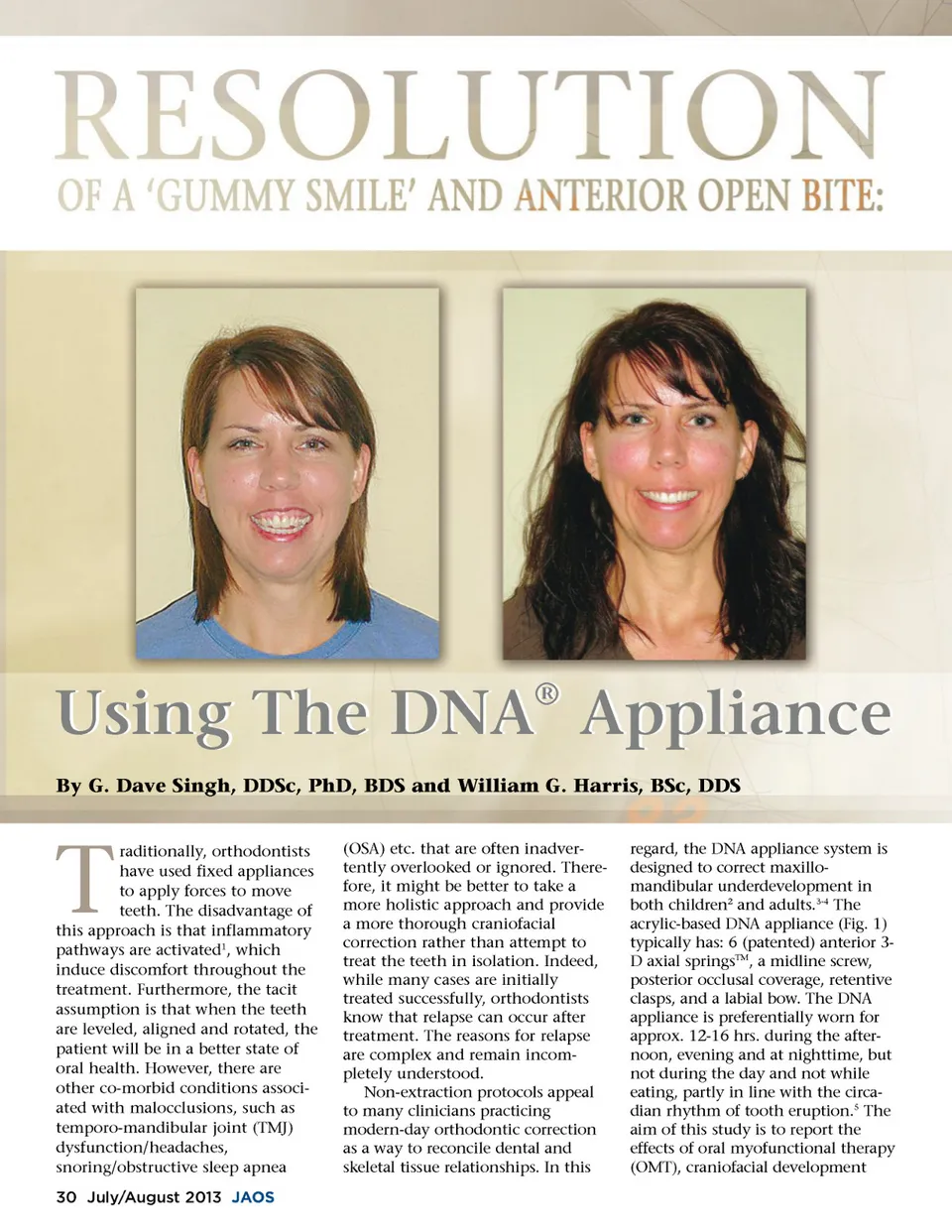
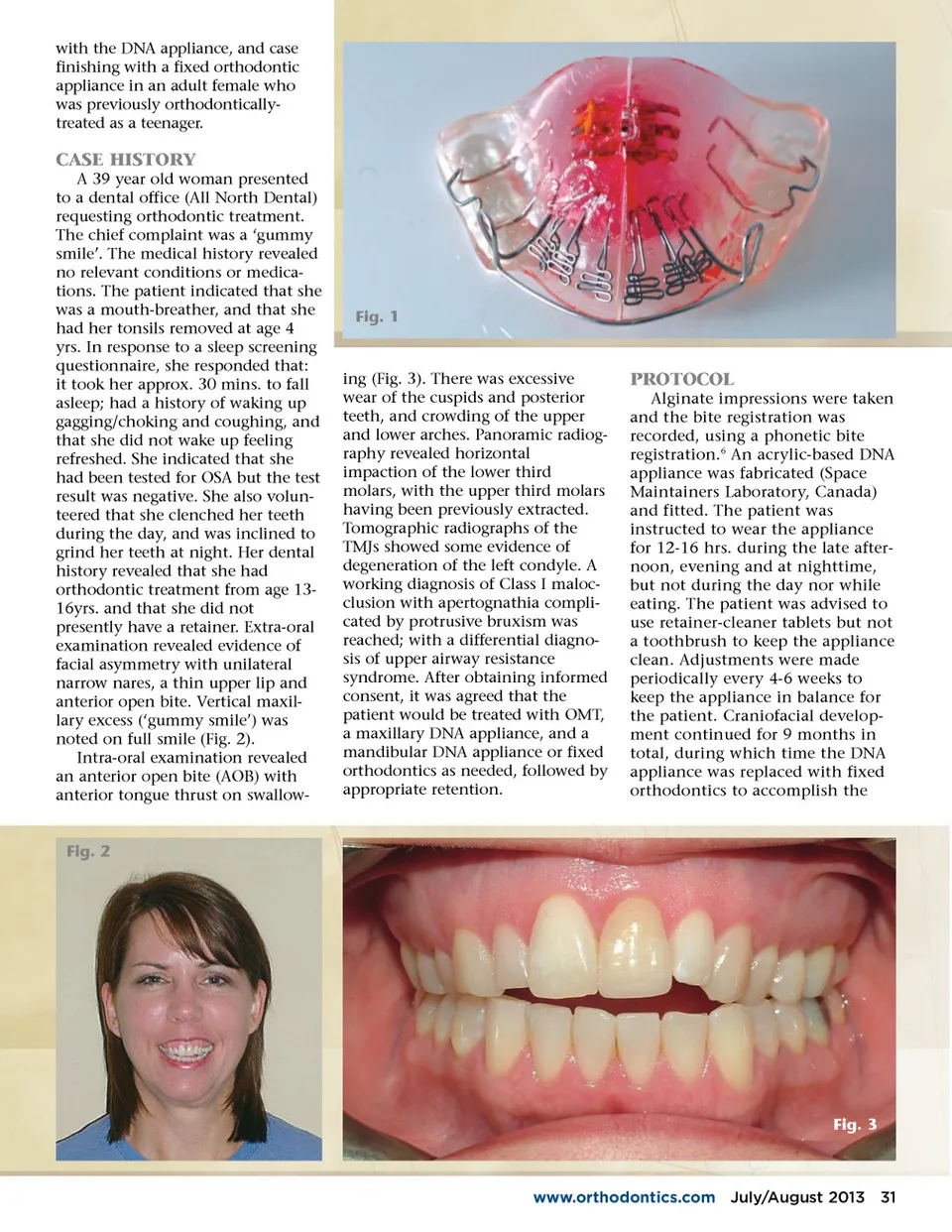
with the DNA appliance, and case finishing with a fixed orthodontic appliance in an adult female who was previously orthodontically-treated as a teenager. CASE HISTORY A 39 year old woman presented to a dental office (All North Dental) requesting orthodontic treatment. The chief complaint was a ‘gummy smile’. The medical history revealed no relevant conditions or medica-tions. The patient indicated that she was a mouth-breather, and that she had her tonsils removed at age 4 yrs. In response to a sleep screening questionnaire, she responded that: it took her approx. 30 mins. to fall asleep; had a history of waking up gagging/choking and coughing, and that she did not wake up feeling refreshed. She indicated that she had been tested for OSA but the test result was negative. She also volun-teered that she clenched her teeth during the day, and was inclined to grind her teeth at night. Her dental history revealed that she had orthodontic treatment from age 13-16yrs. and that she did not presently have a retainer. Extra-oral examination revealed evidence of facial asymmetry with unilateral narrow nares, a thin upper lip and anterior open bite. Vertical maxil-lary excess (‘gummy smile’) was noted on full smile (Fig. 2). Intra-oral examination revealed an anterior open bite (AOB) with anterior tongue thrust on swallow-Fig. 1 ing (Fig. 3). There was excessive wear of the cuspids and posterior teeth, and crowding of the upper and lower arches. Panoramic radiog-raphy revealed horizontal impaction of the lower third molars, with the upper third molars having been previously extracted. Tomographic radiographs of the TMJs showed some evidence of degeneration of the left condyle. A working diagnosis of Class I maloc-clusion with apertognathia compli-cated by protrusive bruxism was reached; with a differential diagno-sis of upper airway resistance syndrome. After obtaining informed consent, it was agreed that the patient would be treated with OMT, a maxillary DNA appliance, and a mandibular DNA appliance or fixed orthodontics as needed, followed by appropriate retention. PROTOCOL Alginate impressions were taken and the bite registration was recorded, using a phonetic bite registration. 6 An acrylic-based DNA appliance was fabricated (Space Maintainers Laboratory, Canada) and fitted. The patient was instructed to wear the appliance for 12-16 hrs. during the late after-noon, evening and at nighttime, but not during the day nor while eating. The patient was advised to use retainer-cleaner tablets but not a toothbrush to keep the appliance clean. Adjustments were made periodically every 4-6 weeks to keep the appliance in balance for the patient. Craniofacial develop-ment continued for 9 months in total, during which time the DNA appliance was replaced with fixed orthodontics to accomplish the Fig. 2 Fig. 3 www.orthodontics.com July/August 2013 31
Journal of the American Orthodontic Society July-August 2013 Buyer's Guide: Page 31