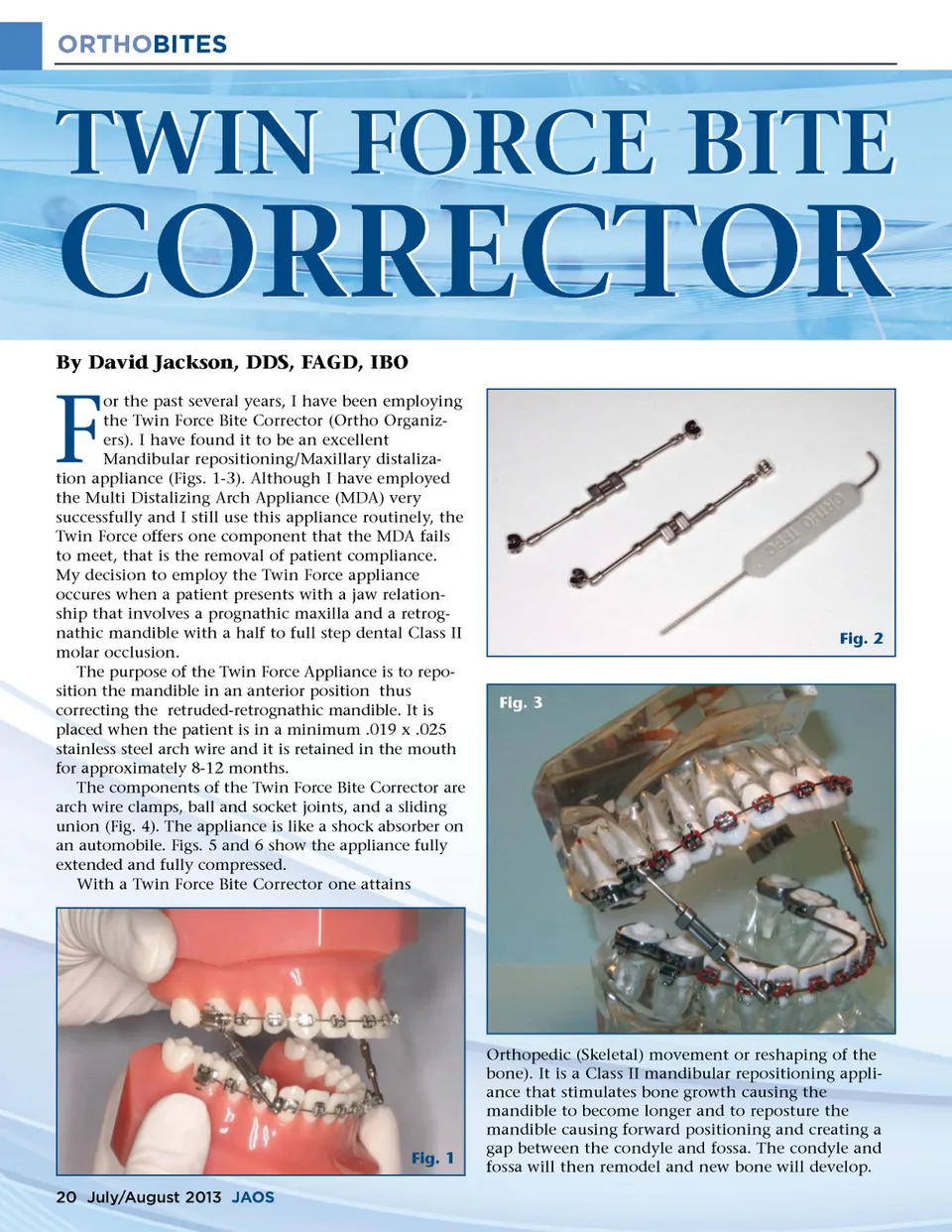
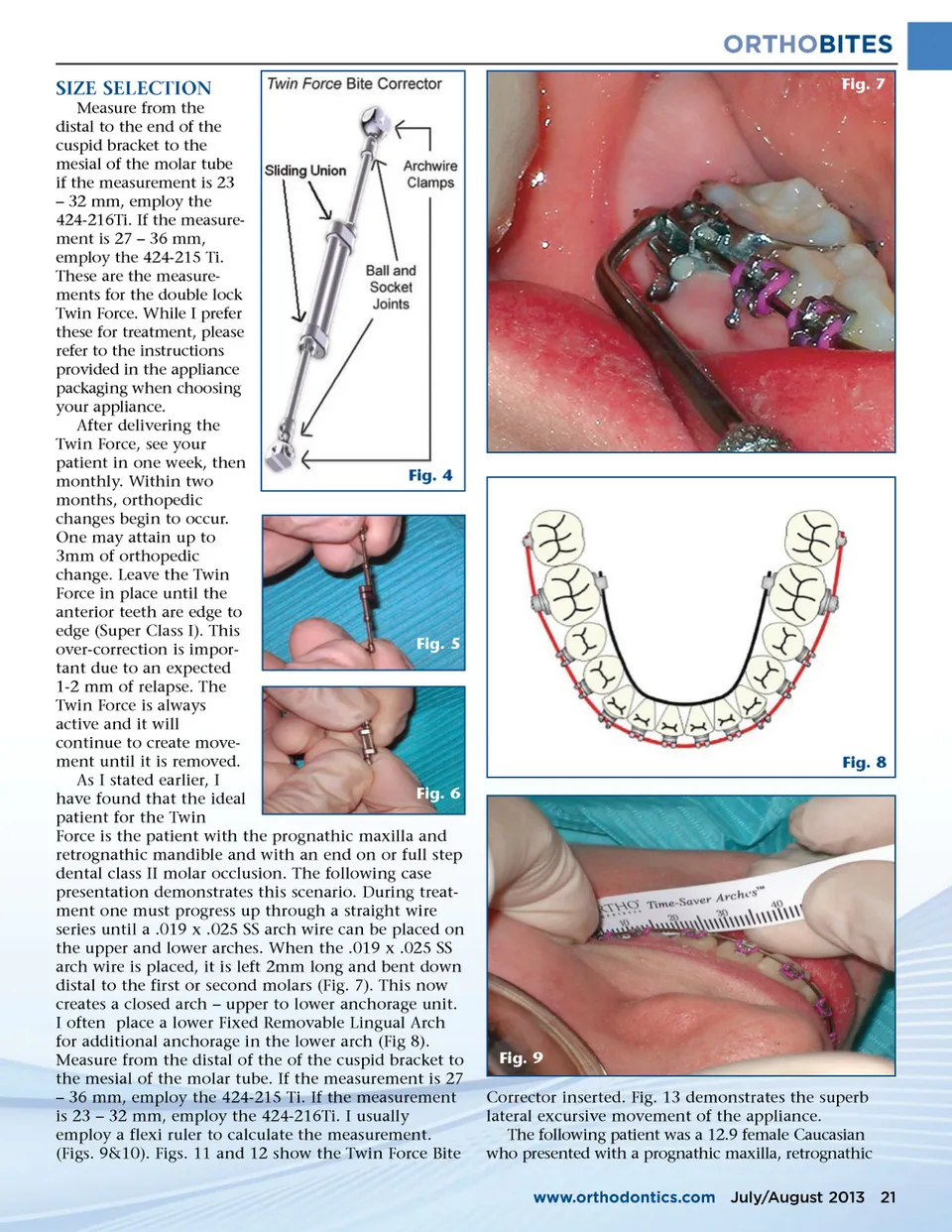
ORTHOBITES SIZE SELECTION Measure from the distal to the end of the cuspid bracket to the mesial of the molar tube if the measurement is 23 – 32 mm, employ the 424-216Ti. If the measure-ment is 27 – 36 mm, employ the 424-215 Ti. These are the measure-ments for the double lock Twin Force. While I prefer these for treatment, please refer to the instructions provided in the appliance packaging when choosing your appliance. After delivering the Twin Force, see your patient in one week, then Fig. 4 monthly. Within two months, orthopedic changes begin to occur. One may attain up to 3mm of orthopedic change. Leave the Twin Force in place until the anterior teeth are edge to edge (Super Class I). This Fig. 5 over-correction is impor-tant due to an expected 1-2 mm of relapse. The Twin Force is always active and it will continue to create move-ment until it is removed. As I stated earlier, I Fig. 6 have found that the ideal patient for the Twin Force is the patient with the prognathic maxilla and retrognathic mandible and with an end on or full step dental class II molar occlusion. The following case presentation demonstrates this scenario. During treat-ment one must progress up through a straight wire series until a .019 x .025 SS arch wire can be placed on the upper and lower arches. When the .019 x .025 SS arch wire is placed, it is left 2mm long and bent down distal to the first or second molars (Fig. 7). This now creates a closed arch – upper to lower anchorage unit. I often place a lower Fixed Removable Lingual Arch for additional anchorage in the lower arch (Fig 8). Measure from the distal of the of the cuspid bracket to the mesial of the molar tube. If the measurement is 27 – 36 mm, employ the 424-215 Ti. If the measurement is 23 – 32 mm, employ the 424-216Ti. I usually employ a flexi ruler to calculate the measurement. (Figs. 9&10). Figs. 11 and 12 show the Twin Force Bite Fig. 7 Fig. 8 Fig. 9 Corrector inserted. Fig. 13 demonstrates the superb lateral excursive movement of the appliance. The following patient was a 12.9 female Caucasian who presented with a prognathic maxilla, retrognathic www.orthodontics.com July/August 2013 21
Journal of the American Orthodontic Society July-August 2013 Buyer's Guide: Page 21