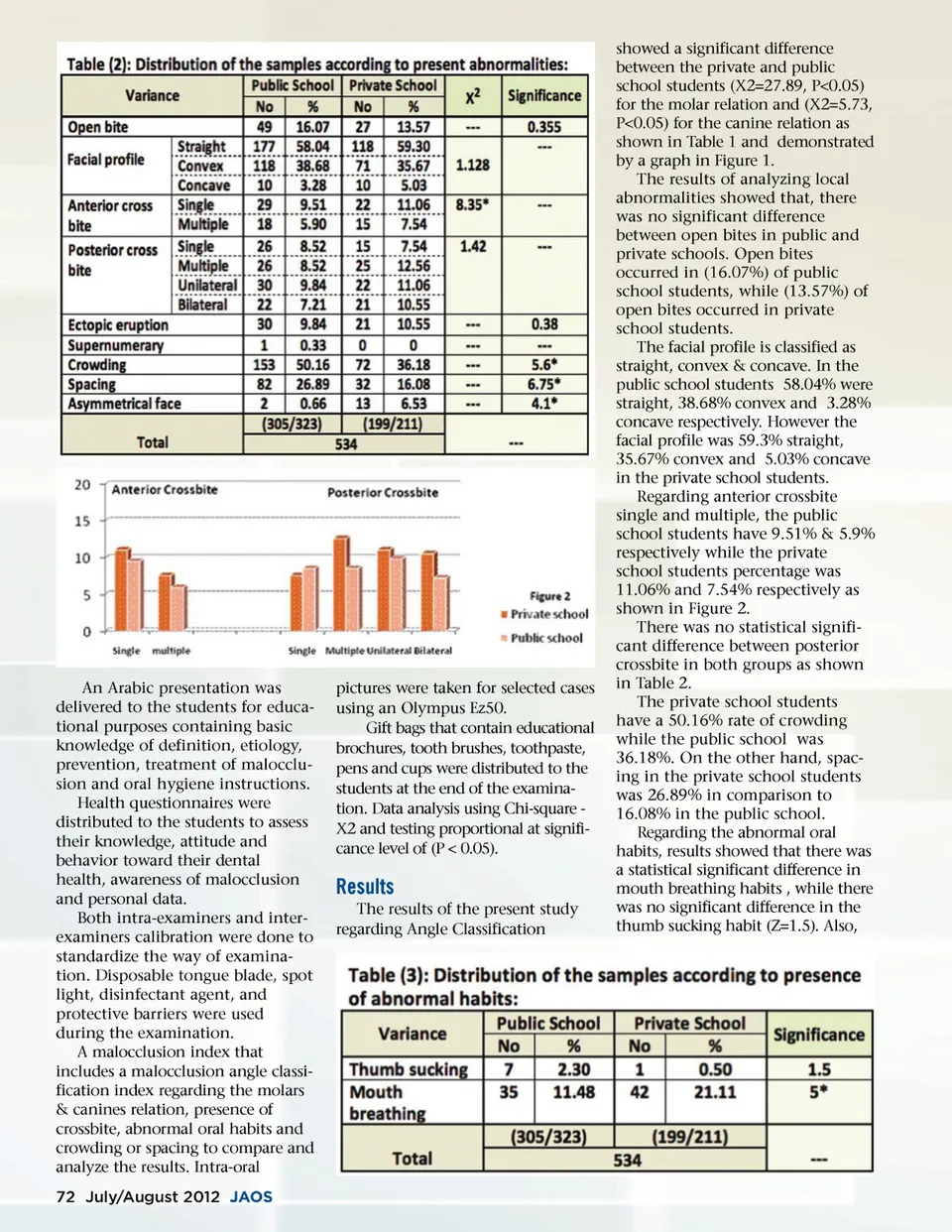
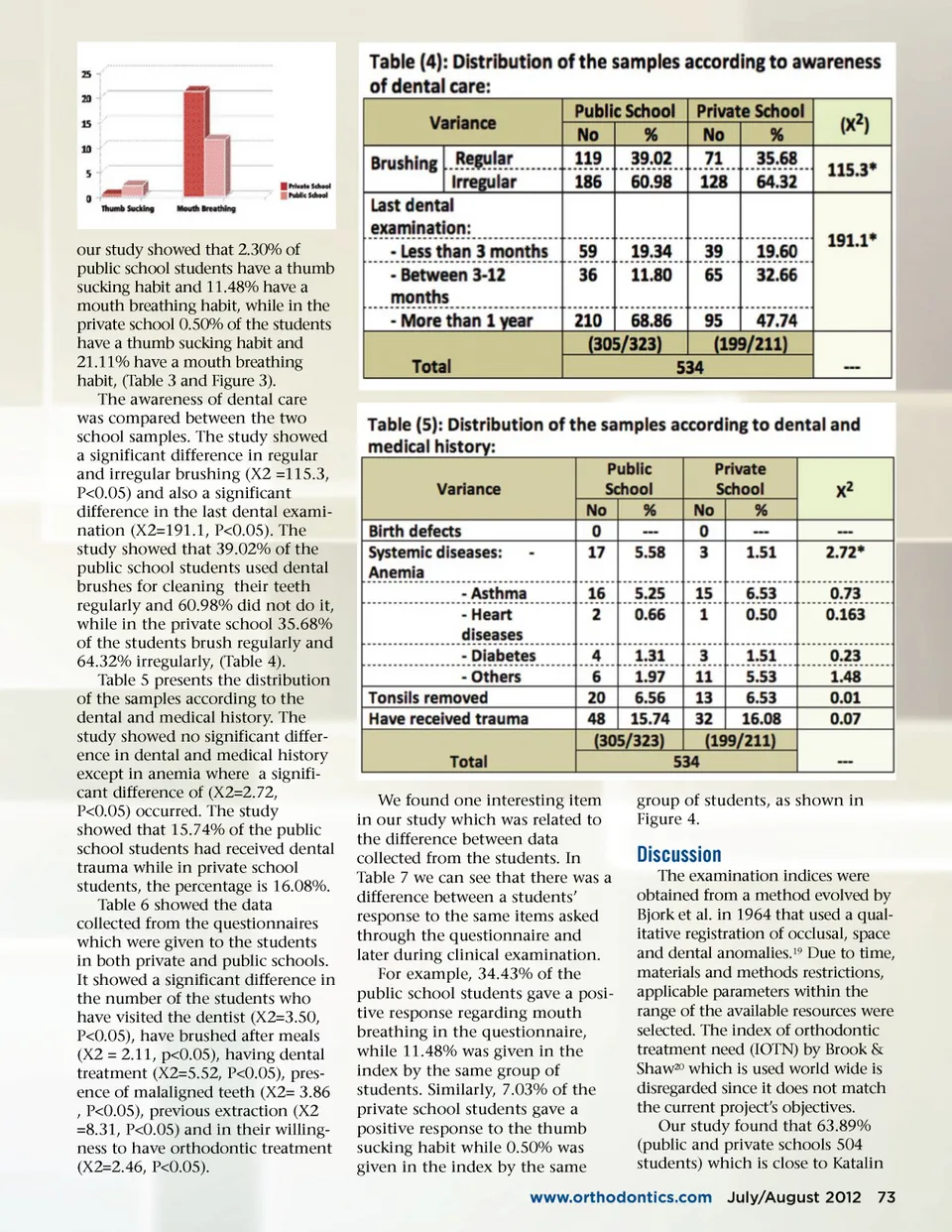
our study showed that 2.30% of public school students have a thumb sucking habit and 11.48% have a mouth breathing habit, while in the private school 0.50% of the students have a thumb sucking habit and 21.11% have a mouth breathing habit, (Table 3 and Figure 3). The awareness of dental care was compared between the two school samples. The study showed a significant difference in regular and irregular brushing (X2 =115.3, P<0.05) and also a significant difference in the last dental exami-nation (X2=191.1, P<0.05). The study showed that 39.02% of the public school students used dental brushes for cleaning their teeth regularly and 60.98% did not do it, while in the private school 35.68% of the students brush regularly and 64.32% irregularly, (Table 4). Table 5 presents the distribution of the samples according to the dental and medical history. The study showed no significant differ-ence in dental and medical history except in anemia where a signifi-cant difference of (X2=2.72, P<0.05) occurred. The study showed that 15.74% of the public school students had received dental trauma while in private school students, the percentage is 16.08%. Table 6 showed the data collected from the questionnaires which were given to the students in both private and public schools. It showed a significant difference in the number of the students who have visited the dentist (X2=3.50, P<0.05), have brushed after meals (X2 = 2.11, p<0.05), having dental treatment (X2=5.52, P<0.05), pres-ence of malaligned teeth (X2= 3.86 , P<0.05), previous extraction (X2 =8.31, P<0.05) and in their willing-ness to have orthodontic treatment (X2=2.46, P<0.05). We found one interesting item in our study which was related to the difference between data collected from the students. In Table 7 we can see that there was a difference between a students’ response to the same items asked through the questionnaire and later during clinical examination. For example, 34.43% of the public school students gave a posi-tive response regarding mouth breathing in the questionnaire, while 11.48% was given in the index by the same group of students. Similarly, 7.03% of the private school students gave a positive response to the thumb sucking habit while 0.50% was given in the index by the same group of students, as shown in Figure 4. Discussion The examination indices were obtained from a method evolved by Bjork et al. in 1964 that used a qual-itative registration of occlusal, space and dental anomalies. 19 Due to time, materials and methods restrictions, applicable parameters within the range of the available resources were selected. The index of orthodontic treatment need (IOTN) by Brook & Shaw 20 which is used world wide is disregarded since it does not match the current project’s objectives. Our study found that 63.89% (public and private schools 504 students) which is close to Katalin www.orthodontics.com July/August 2012 73
Journal of the American Orthodontic Society July-August 2012 Buyer's Guide: Page 73