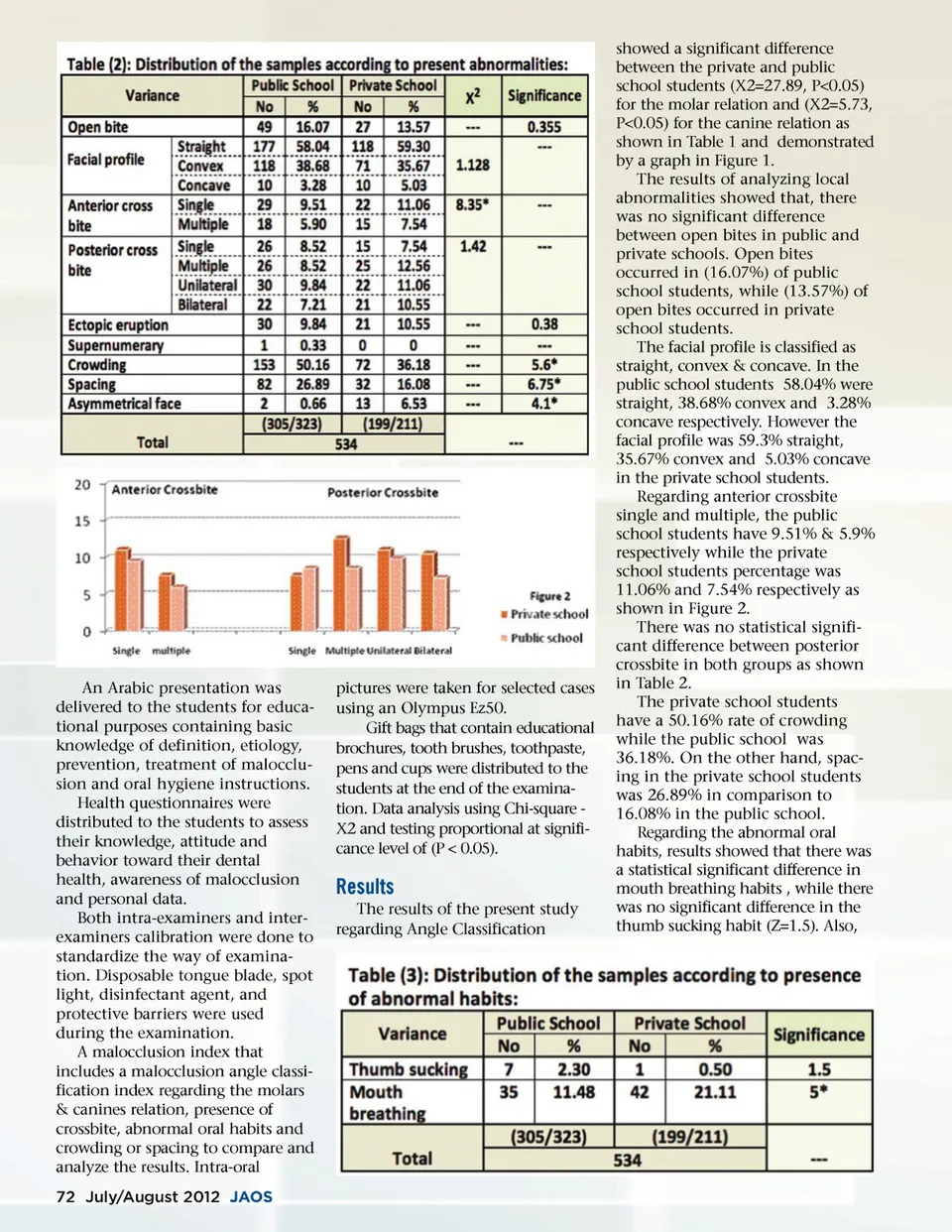
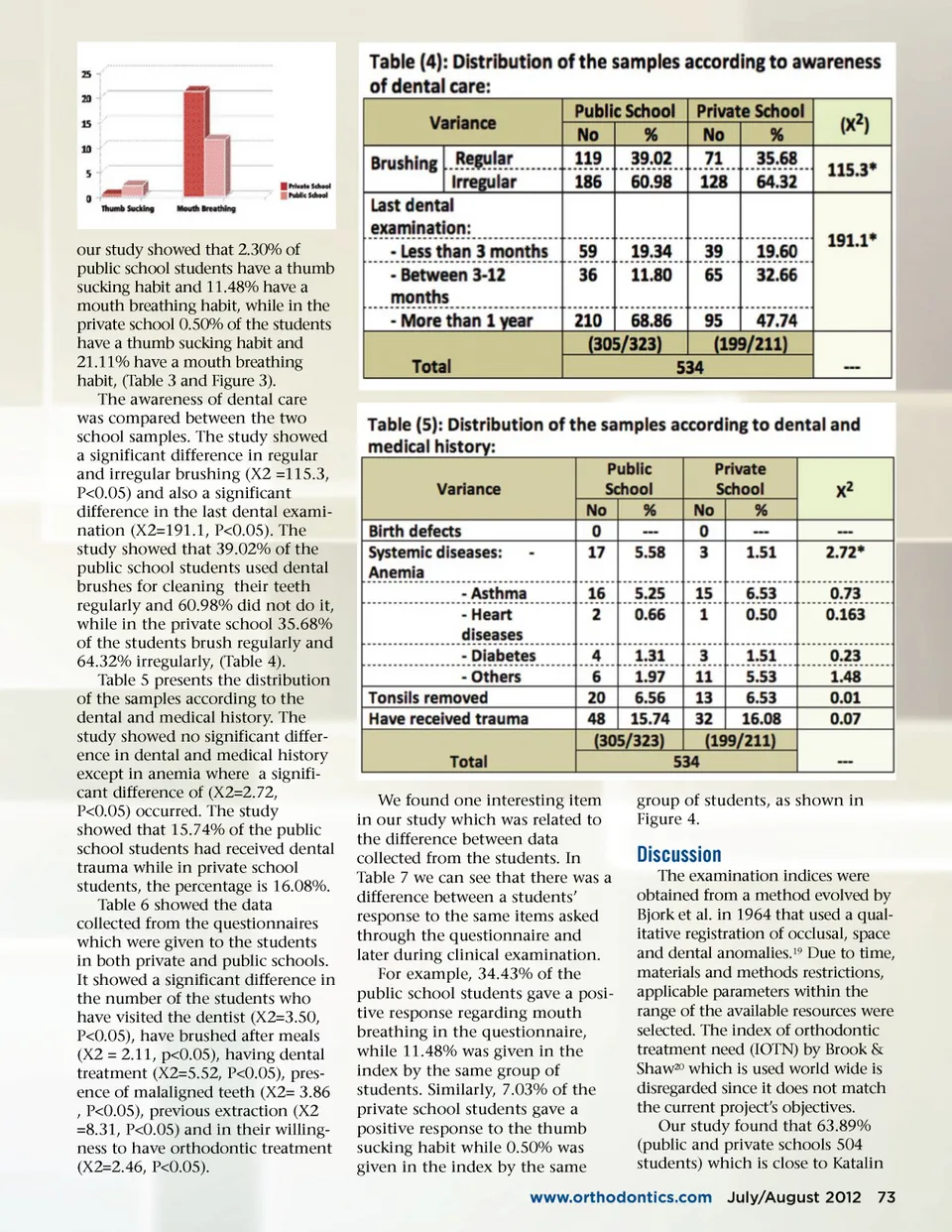
An Arabic presentation was delivered to the students for educa-tional purposes containing basic knowledge of definition, etiology, prevention, treatment of malocclu-sion and oral hygiene instructions. Health questionnaires were distributed to the students to assess their knowledge, attitude and behavior toward their dental health, awareness of malocclusion and personal data. Both intra-examiners and inter-examiners calibration were done to standardize the way of examina-tion. Disposable tongue blade, spot light, disinfectant agent, and protective barriers were used during the examination. A malocclusion index that includes a malocclusion angle classi-fication index regarding the molars & canines relation, presence of crossbite, abnormal oral habits and crowding or spacing to compare and analyze the results. Intra-oral 72 July/August 2012 JAOS pictures were taken for selected cases using an Olympus Ez50. Gift bags that contain educational brochures, tooth brushes, toothpaste, pens and cups were distributed to the students at the end of the examina-tion. Data analysis using Chi-square -X2 and testing proportional at signifi-cance level of (P < 0.05). Results The results of the present study regarding Angle Classification showed a significant difference between the private and public school students (X2=27.89, P<0.05) for the molar relation and (X2=5.73, P<0.05) for the canine relation as shown in Table 1 and demonstrated by a graph in Figure 1. The results of analyzing local abnormalities showed that, there was no significant difference between open bites in public and private schools. Open bites occurred in (16.07%) of public school students, while (13.57%) of open bites occurred in private school students. The facial profile is classified as straight, convex & concave. In the public school students 58.04% were straight, 38.68% convex and 3.28% concave respectively. However the facial profile was 59.3% straight, 35.67% convex and 5.03% concave in the private school students. Regarding anterior crossbite single and multiple, the public school students have 9.51% & 5.9% respectively while the private school students percentage was 11.06% and 7.54% respectively as shown in Figure 2. There was no statistical signifi-cant difference between posterior crossbite in both groups as shown in Table 2. The private school students have a 50.16% rate of crowding while the public school was 36.18%. On the other hand, spac-ing in the private school students was 26.89% in comparison to 16.08% in the public school. Regarding the abnormal oral habits, results showed that there was a statistical significant difference in mouth breathing habits , while there was no significant difference in the thumb sucking habit (Z=1.5). Also,
Journal of the American Orthodontic Society July-August 2012 Buyer's Guide: Page 72